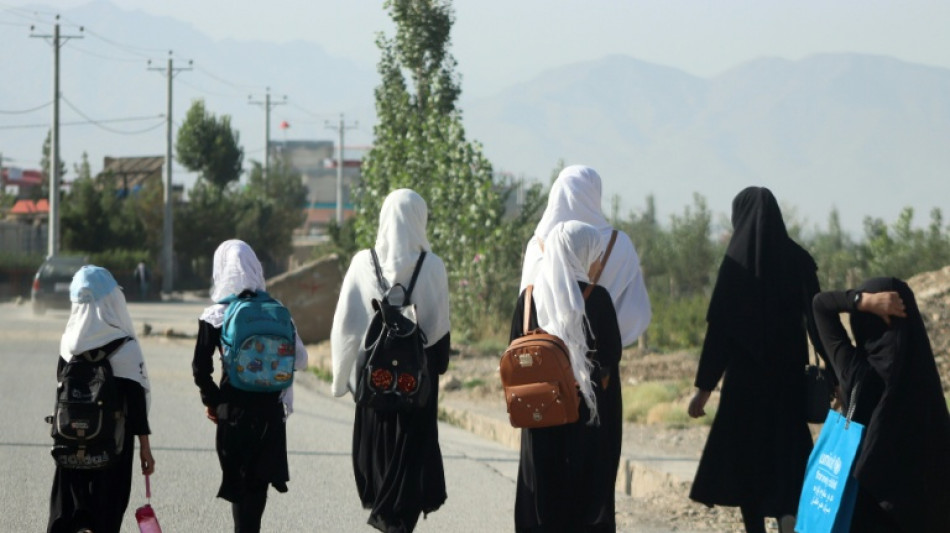
UN report finds women's rights weakened in quarter of all countries / Photo: - - AFP
 Surge in Early Social Security Claims Linked to Agency Turmoil

 Panthers Seek NFC South Lead Against Ravens as Baltimore Ends Skid

 GIRLBAND! Headline Show at Rough Trade Marks National Breakthrough

 Samsung Galaxy Buds Active Leak Reveals ANC, Ear-Hook Design and One UI 9.5 Integration

 Egypt and Syria Sign Agreement to Restore Direct Flights After 14-Year Hiatus

 Van Gogh’s ‘Châtaigniers en Fleurs’ Sets $285m Record at Sotheby’s

 Anthropic Sets Record $81.3 Billion IPO Valuing AI Firm at $1.5 Trillion

 eThekwini Faces R6.5bn Flood Claim from Toyota’s Insurer
Women's rights regressed last year in a quarter of countries around the world, according to a report published by UN Women on Thursday, due to factors ranging from climate change to democratic backsliding.
"The weakening of democratic institutions has gone hand in hand with backlash on gender equality," the report said, adding that "anti-rights actors are actively undermining long-standing consensus on key women's rights issues."
"Almost one-quarter of countries reported that backlash on gender equality is hampering implementation of the Beijing Platform for Action," the report continued, referring to the document from the 1995 World Conference on Women.
In the 30 years since the conference, the UN said that progress has been mixed.
In parliaments around the world, female representation has more than doubled since 1995, but men still comprise about three-quarters of parliamentarians.
The number of women with social protection benefits increased by a third between 2010 and 2023, though two billion women and girls still live in places without such protections.
Gender employment gaps "have stagnated for decades." Sixty-three percent of women between the ages of 25 and 54 have paid employment, compared to 92 percent of men in the same demographic.
The report cites the Covid-19 pandemic, global conflicts, climate change and emerging technologies such as artificial intelligence (AI) as all new potential threats to gender equality.
Data presented by the UN Women report found that conflict-related sexual violence has spiked 50 percent in the past 10 years, with 95 percent of victims being children or young women.
In 2023, 612 million women lived within 50 kilometers (31 miles) of armed conflict, a 54-percent increase since 2010.
And in 12 countries in Europe and Central Asia, at least 53 percent of women have experienced one or more forms of gender-based violence online.
"Globally, violence against women and girls persists at alarming rates. Across their lifetime, around one in three women are subjected to physical or sexual violence by an intimate partner or sexual violence by a non-partner," the report said.
The report sets out a multi-part roadmap to address gender inequality, such as fostering equitable access to new technologies like AI, measures toward climate justice, investments to combat poverty, increasing participation in public affairs and fighting against gendered violence.
D.Sawyer--AMWN

