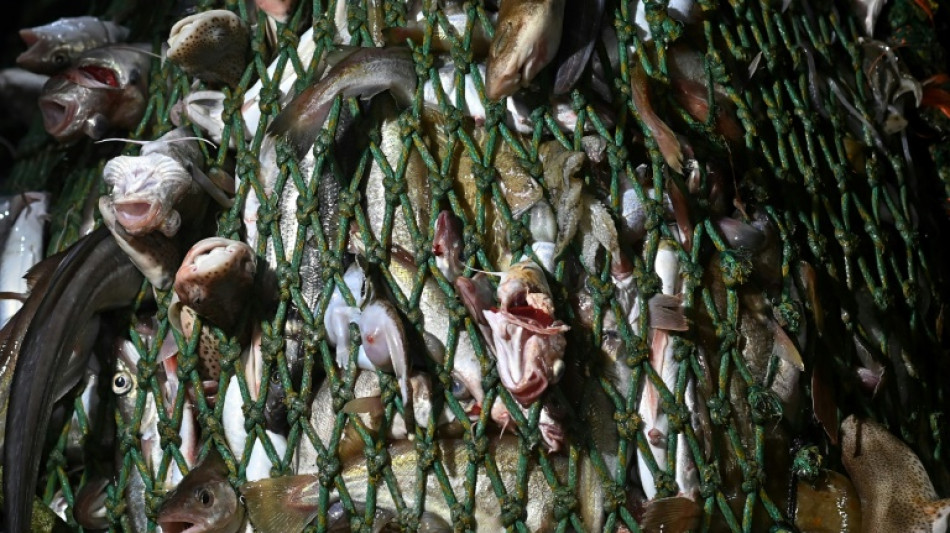
World coming up short on promised marine sanctuaries / Photo: BEN STANSALL - AFP/File
 Egypt and Syria Sign Agreement to Restore Direct Flights After 14-Year Hiatus

 Van Gogh’s ‘Châtaigniers en Fleurs’ Sets $285m Record at Sotheby’s

 Anthropic Sets Record $81.3 Billion IPO Valuing AI Firm at $1.5 Trillion

 eThekwini Faces R6.5bn Flood Claim from Toyota’s Insurer

 Guanajuato Silver Reports Q3 Operating and Financial Results

 Golden Minerals Completes Drilling Desierto, Argentina

 Trustpoint Xposure Completes More Than 200 AI Visibility Audits Across Professional Services

 IRS Shuts Down FIRE Today: What Information Return Filers Need to Know Before the 2027 Filing Season

 LASE to Premiere Quantum Bullet(TM) at Counter UAS Technology Conference in Washington, D.C.
 Hemogenyx Pharmaceuticals PLC - Chairman Receives Prestigious Award
 Bob's Watches Founder Paul Altieri Unveils Private Collection of Vintage Rolex Watches in New Book, "NOT FOR SALE"

 Helio Corporation Engages CORE IR to Provide Investor Relations, Capital Markets Advisory and Media Relations Services

 Karbon-X (OTCQB:KARX) Enters California's Multi-Billion-Dollar Compliance Carbon Market Following CITSS Approval

 multiQure Begins Manufacturing Phase of MQ-201 Gene Therapy for First Huntington's Disease Patients - U.S.-Based Andelyn Biosciences Selected as Manufacturing Partner

 QNX Brings Physical AI and Next-Generation Software-Defined Vehicle Innovation to CES 2027
 MicroVision and Blue-Band to Support $3 Million Federally Funded Intelligent Transportation Initiative in Louisville, Kentucky

 Metano Emerges From Stealth to Unify AI Agent Security Across the Enterprise
 ATWEC Technologies, Inc. (OTCID: ATWT) Engages Michael Gillespie & Associates, PLLC to Audit Fiscal 2026 and 2025 Consolidated Financial Statements and Changes Fiscal Year End to October 31

A global target of having 30 percent of the oceans become protected areas by 2030 is looking more fragile than ever, with little progress and the United States backing away, conservationists say.
"With less than 10 percent of the ocean designated as MPAs (marine protected areas) and only 2.7 percent fully or highly protected, it is going to be difficult to reach the 30 percent target," said Lance Morgan, head of the Marine Conservation Institute in Seattle, Washington.
The institute maps the MPAs for an online atlas, updating moves to meet the 30 percent goal that 196 countries signed onto in 2022, under the Kunling-Montreal Global Biodiversity Framework.
The ambition is notably at risk because "we see countries like the US reversing course and abandoning decades of bipartisan efforts" to protect areas of the Pacific Ocean, Morgan said.
That referred to an April executive order by President Donald Trump authorising industrial-scale fishing in big swathes of an MPA in that ocean.
Currently, there are 16,516 declared MPAs in the world, covering just 8.4 percent of the oceans.
But not all are created equal: some forbid all forms of fishing, while others place no roles, or almost none, on what activities are proscribed or permitted.
"Only a third of them have levels of protection that would yield proper benefits" for fish, said Joachim Claudet, a socio-ecology marine researcher at France's CNRS.
Daniel Pauly, a professor of fisheries science at Canada's University of British Columbia, said "the marine protected areas have not really been proposed for the protection of biodiversity" but "to increase fish catches".
A proper MPA "exports fish to non-protected zones, and that should be the main reason that we create marine protected areas -- they are needed to have fish", he said.
When fish populations are left to reproduce and grow in protected areas, there is often a spillover effect that sees fish stocks outside the zones also rise, as several scientific journals have noted, especially around a no-fishing MPA in Hawaiian waters that is the biggest in the world.
One 2022 study in the Science journal showed a 54 percent in crease in yellowfin tuna around that Hawaiian MPA, an area now threatened by Trump's executive order, Pauly said.
- Fishing bans -
For such sanctuaries to work, there need to be fishing bans over all or at least some of their zones, Claudet said. But MPAs with such restrictions account for just 2.7 percent of the ocean's area, and are almost always in parts that are far from areas heavily impacted by human activities.
In Europe, for instance, "90 percent of the marine protected areas are still exposed to bottom trawling," a spokesperson for the NGO Oceana, Alexandra Cousteau, said. "It's ecological nonsense."
Pauly said that "bottom trawling in MPAs is like picking flowers with a bulldozer... they scrape the seabed".
Oceana said French MPAs suffered intensive bottom trawling, 17,000 hours' worth in 2024, as did those in British waters, with 20,600 hours. The NGO is calling for a ban on the technique, which involves towing a heavy net along the sea floor, churning it up.
A recent WWF report said that just two percent of European Union waters were covered by MPAs with management plans, even some with no protection measures included.
The head of WWF's European office for the oceans, Jacob Armstrong, said that was insufficient to protect oceanic health.
Governments need to back words with action, he said, or else these areas would be no more than symbolic markings on a map.
B.Finley--AMWN