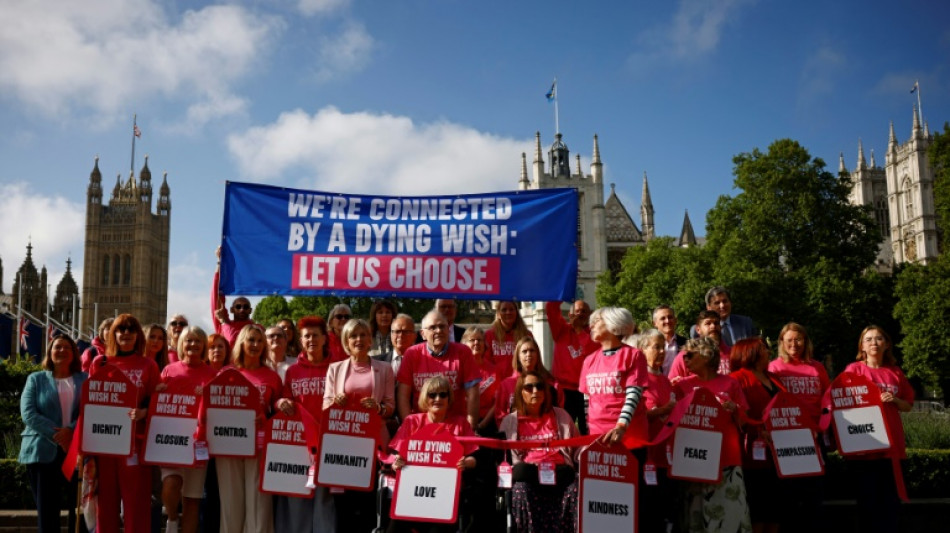
UK MPs vote in favour of assisted dying law in historic step / Photo: BENJAMIN CREMEL - AFP
 North Korea acknowledges its troops cleared mines for Russia
 Cambodia says Thailand still bombing hours after Trump truce call

 Leinster stutter before beating Leicester in Champions Cup

 Crypto firm Tether bids for Juventus, is quickly rebuffed

 US Treasury lifts sanctions on Brazil Supreme Court justice
 Wembanyama expected to return for Spurs in NBA Cup clash with Thunder
 UK's king shares 'good news' that cancer treatment will be reduced in 2026

 Iran detains Nobel-prize winner in 'brutal' arrest

 UK health service battles 'super flu' outbreak

 Democrats release new cache of Epstein photos

 'Don't use them': Tanning beds triple skin cancer risk, study finds

 Argentina fly-half Albornoz signs for Toulon until 2030

 Salah in Liverpool squad for Brighton after Slot talks - reports

 Draw marks 'starting gun' toward 2026 World Cup, Vancouver says

 Salah admired from afar in his Egypt home village as club tensions swirl

 Brazil left calls protests over bid to cut Bolsonaro jail time
 US plan sees Ukraine joining EU in 2027, official tells AFP

 Iran frees child bride sentenced to death over husband's killing: activists

 Youthful La Rochelle name teen captain for Champions Cup match in South Africa

 British 'Aga saga' author Joanna Trollope dies aged 82

 EU agrees three-euro small parcel tax to tackle China flood

 Maresca 'relaxed' about Chelsea's rough patch

 Nowhere to pray as logs choke flood-hit Indonesian mosque

 England bowling great Anderson named as Lancashire captain
 Fit-again Jesus can be Arsenal's number one striker, says Arteta

Britain took a historic step towards allowing euthanasia on Friday when MPs backed contentious legislation that would introduce assisted dying for terminally ill people.
Lawmakers in the lower House of Commons chamber voted 314 in favour to 291 to send the proposal to the upper House of Lords for further scrutiny following four hours of emotional debate.
The outcome sparked celebrations among supporters gathered outside parliament who say legalised euthanasia will give people with an incurable illness dignity and choice at the end of their lives.
But opponents attending a neighbouring counter-protest said they feared vulnerable people could be coerced into dying and urged lawmakers to focus on improving palliative care instead.
The Terminally Ill Adults (End of Life) Bill would allow assisted suicide in England and Wales for adults who have been given less than six months to live.
They would have to be able to administer the life-ending substance themselves, and any patient's wish to die would have to be signed off by two doctors and a panel of experts.
A change in the law would see Britain emulate several other countries in Europe and elsewhere that allow some form of assisted dying, including Belgium and the Netherlands.
- 'Heartbreaking stories' -
Labour MP Kim Leadbeater, who proposed the legislation, told Friday's so-called third reading debate that a law change would "offer a compassionate and safe choice" for terminally ill people.
She said maintaining the status quo would mean more "heartbreaking stories" of "pain and trauma, suicide attempts, PTSD, lonely trips to Switzerland, (and) police investigations".
But Vicky Foxcroft, also of Labour, said the proposal did not include adequate safeguards for disabled people.
"We have to protect those people who are susceptible to coercion, who already feel like society doesn't value them, who often feel like a burden to the state, society and their family," she pleaded.
Outside parliament, protesters waved placards with slogans including "Let us choose" and "Don't make doctors killers".
David Walker, 82, said he supported changing the law because he saw his wife of 60 years suffer for three years at the end of her life.
"That's why I'm here, because I can't help her anymore, but I can help other people who are going through the same thing, because if you have no quality of life, you have nothing," he told AFP.
But Elizabeth Burden, a 52-year-old doctor, said she feared the legislation would open "slippery slope" where those eligible for assisted dying expands.
"Once we allow this. Everything will slip down because dementia patients, all patients... are vulnerable," she told AFP.
- Public support -
MPs backed the proposed legislation by 330 to 275 votes at an initial vote in parliament last November.
Since then the bill has undergone several changes, including applying a ban on adverts for assisted dying and allowing all health workers to opt out of helping someone end their life.
MPs in the 650-seat parliament also added a safeguard which would prevent a person being eligible "solely as a result of voluntarily stopping eating or drinking", ruling out people with anorexia.
Britain's medical community and Prime Minister Keir Starmer's top ministerial team are split on the proposed law change. His health and justice secretaries publicly oppose it.
But in a YouGov poll of 2,003 adults, surveyed last month and published Thursday, 73 percent or respondents backed an assisted dying law.
MPs had backed an earlier version of the proposed legislation by 330 to 275 votes at an initial vote in parliament last November, before parliament introduced the changes.
The House of Lords now needs to approve the legislation before the end of the current parliamentary year, likely in the autumn, or the bill will fail.
If it passes and receives royal assent, it would still be four years before an assisted dying service was implemented.
Assisted suicide currently carries a maximum prison sentence of 14 years in England, Wales and Northern Ireland.
Separate legislation is going through the devolved Scottish parliament.
At the end of March, the Isle of Man became the first British territory to pass an assisted dying bill.
B.Finley--AMWN