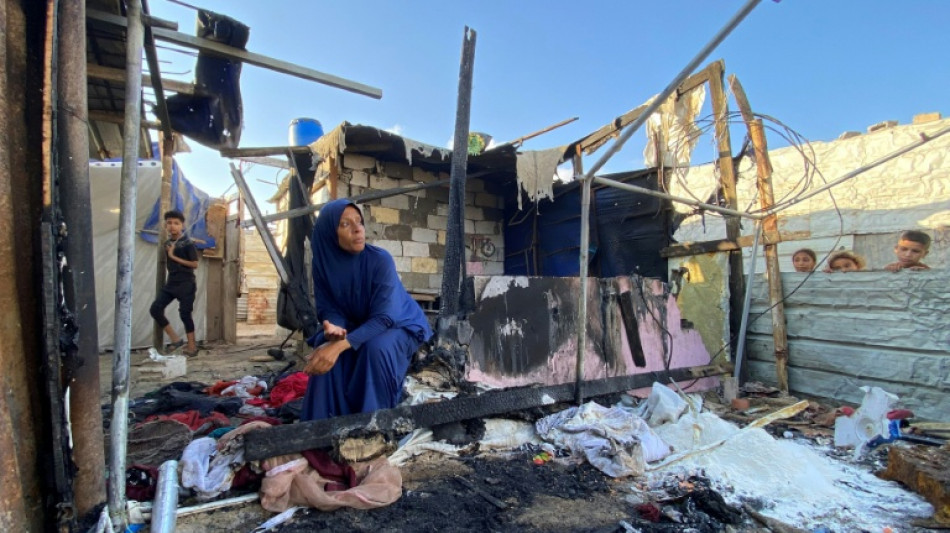
Netanyahu says Israel to control not govern Gaza / Photo: - - AFP
 Park Jin-young Denies Cult Allegations Against Firstfruits Group

 Writer Realizes She Is Lesbian After Child Comes Out as Transgender

 Shruti Haasan Reveals Kamal Haasan’s Defense of Her Film Career

 Trump Reduces Public Appearances Amid CIA-Mossad Warnings of Iranian Drone Plot

 Italy Fines Meta $880 Million Over Facebook Photo Access Violations

 ELEKTROS Invites Shareholders to Shine Bright as the Holiday Season Nears, with Focus on Lithium, Critical Minerals and EV Innovation

 How to Find Joy in a Simpler, More Intentional Lifestyle

 Goldrich Cultural Center Receives $20 Million Endowment Gift

Prime Minister Benjamin Netanyahu said Israel plans to take full control of Gaza but does not intend to govern it, as his security cabinet convened on Thursday to discuss the country's war plans.
The meeting comes as Netanyahu faces mounting pressure at home and abroad for a deal to spare the remaining hostages held by Palestinian militants and pull the territory back from the brink of famine.
With tensions rising, Netanyahu took to the airwaves in the US, where he told Fox News the government intends to take full control of Gaza, following 22 months of war against Hamas.
"We intend to," Netanyahu replied, when asked if Israel will take control of "all of Gaza."
Netanyahu is expected to seek the security cabinet's approval for the expanded offensive, which will see the army operate in densely populated areas where hostages are believed to be held, Israeli media reported.
Asked by Fox News if Israel would again control the whole of Gaza, as it did between 1967 and 2005, Netanyahu replied: "Well, we don't want to keep it. We want to have a security perimeter. We don't want to govern it.
"We want to hand it over to Arab forces that will govern it properly without threatening us and giving Gazans a good life. That's not possible with Hamas," he said.
The government's plans to expand the war have sparked growing concern in Israel about what it means for the remaining hostages, who have already endured 22 months in captivity since Hamas's October 2023 attack.
As the meeting kicked off, hundreds rallied near the prime minister's office in Jerusalem, where they called for a deal to release the hostages.
Earlier Thursday, relatives of hostages set sail from the port of Ashkelon seeking to approach the Gaza Strip.
Organisers said they hoped to "get as close as possible to their loved ones".
Out of 251 hostages captured during Hamas's 2023 attack, 49 are still being held in Gaza, including 27 the military says are dead.
- 'More destruction' -
Ahead of Thursday's meeting, rumours have been rife in the Israeli press about disagreements between the cabinet and Israel's military chief, Lieutenant General Eyal Zamir, who is said to oppose plans to fully reoccupy Gaza.
On Wednesday, Defence Minister Israel Katz had weighed in on social media saying that "it is the right and duty of the chief of staff to express his position", but the military must ultimately respect any policies adopted by the government.
In a statement released by the military on Thursday, Zamir underscored his independence, vowing to "continue to express our position without fear".
"We are not dealing with theory -- we are dealing with matters of life and death, with the defence of the state, and we do so while looking directly into the eyes of our soldiers and citizens," Zamir said in the statement.
In Gaza, meanwhile, fears grew over what an expansion of combat operations would entail.
"Ground operations mean more destruction and death. There is no safe place anywhere," said Ahmad Salem, 45.
"If Israel starts and expands its ground operations again, we'll be the first victims."
- 'Unrealistic costs' -
International concern has also been growing over the suffering of the more than two million Palestinian inhabitants of Gaza, after the United Nations warned that famine was unfolding in the territory.
The World Health Organization said at least 99 people were now known to have died from malnutrition in the Gaza Strip so far this year, with the figure likely an underestimate.
Displaced Gazan Mahmoud Wafi said that the prices of available food remained high and erratic.
"We hope that food will be made available again in normal quantities and at reasonable prices, because we can no longer afford these extremely high and unrealistic costs," the 38-year-old told AFP.
In late July, Israel partially eased restrictions on aid entering Gaza, but the United Nations says the amount allowed into the territory remains insufficient.
Amjad Al-Shawa, head of the Palestinian NGO Network in the Gaza Strip, told AFP that lengthy inspection procedures at entry points meant few trucks could come in.
"What is currently entering the Gaza Strip are very limited numbers of trucks -- between 70 to 80 per day -- carrying only specific types of goods," he said.
The United Nations estimates that Gaza needs at least 600 trucks of aid per day to meet its residents' basic needs.
Amid the shortages, bloodshed continued with Gaza's civil defence spokesman Mahmud Bassal saying at least 35 people were killed in air strikes in multiple areas of Gaza on Thursday.
S.F.Warren--AMWN