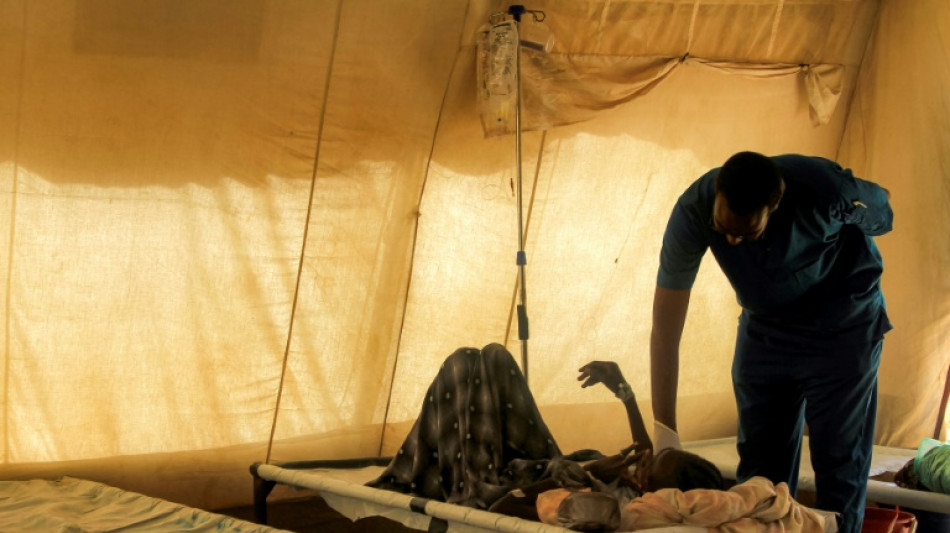
WHO says nearly 100,000 struck with cholera in Sudan / Photo: - - AFP
 Park Jin-young Denies Cult Allegations Against Firstfruits Group

 Writer Realizes She Is Lesbian After Child Comes Out as Transgender

 Shruti Haasan Reveals Kamal Haasan’s Defense of Her Film Career

 Trump Reduces Public Appearances Amid CIA-Mossad Warnings of Iranian Drone Plot

 Italy Fines Meta $880 Million Over Facebook Photo Access Violations

 ELEKTROS Invites Shareholders to Shine Bright as the Holiday Season Nears, with Focus on Lithium, Critical Minerals and EV Innovation

 How to Find Joy in a Simpler, More Intentional Lifestyle

 Goldrich Cultural Center Receives $20 Million Endowment Gift

The World Health Organization on Thursday said nearly 100,000 cholera cases had been reported in Sudan since July last year, as it warned of more hunger, displacement and disease to come.
Since April 2023, Sudan has been torn apart by a power struggle between army chief Abdel Fattah al-Burhan and Mohamed Hamdan Daglo, commander of the rival paramilitary Rapid Support Forces. The fighting has killed tens of thousands.
"In Sudan, unrelenting violence has led to widespread hunger, disease and suffering," said WHO chief Tedros Adhanom Ghebreyesus.
"Cholera has swept across Sudan, with all states reporting outbreaks. Nearly 100,000 cases have been reported since July last year."
Oral cholera vaccination campaigns had been conducted in several states, including the capital Khartoum, he told a press conference with the Geneva UN correspondents' association ACANU.
"While we are seeing a declining trend in numbers, there are gaps in disease surveillance, and progress is fragile," he said.
"Recent floods, affecting large parts of the country, are expected to worsen hunger and fuel more outbreaks of cholera, malaria, dengue and other diseases."
Cholera is an acute intestinal infection that spreads through food and water contaminated with bacteria, often from faeces.
It causes severe diarrhoea, vomiting and muscle cramps.
Cholera can kill within hours when not attended to, though it can be treated with simple oral rehydration, and antibiotics for more severe cases.
There has been a global increase in cholera cases, and their geographical spread, since 2021.
- Malnutrition -
As for hunger, Tedros said there were reports from El-Fasher, the besieged capital of North Darfur state, that people were eating animal feed to survive.
Across the country, millions are going hungry and around 770,000 children under five years old are expected to suffer from severe acute malnutrition this year.
"In the first six months of this year, nutrition centres supported by WHO have treated more than 17,000 severely malnourished children with medical complications. But many more are beyond reach," Tedros warned.
The UN health agency's efforts were being held back by limited access and a lack of funding, he added, with the WHO having received less than a third of the money it has appealed for to provide urgent health assistance in Sudan.
The WHO director-general said that as long as the violence continues in Sudan, "we can expect to see more hunger, more displacement and more disease".
F.Pedersen--AMWN