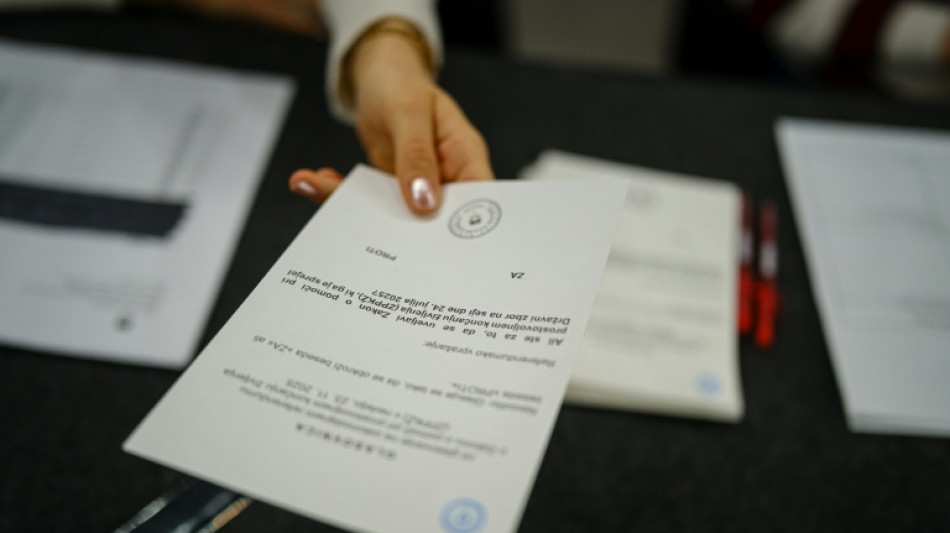
Slovenia referendum rejects contested assisted dying law / Photo: Jure Makovec - AFP
 Navarro downs Mboko to win Strasbourg clay title

 Russian war drama among favourites for top Cannes film prize

 Ukrainian strike on college in Russian-occupied town kills 18: officials

 Iran and US say could be close to talks breakthrough

 Roland Garros organisers, players have 'positive' meeting over dispute

 Man Utd's Fernandes named Premier League Player of the Season

 EU automated border system suspended at Dover amid bank holiday chaos

 De Zerbi demands 'blood and spirit' from Spurs on survival Sunday

 Roland Garros organisers, players have 'encouraging' meeting over dispute
 Uganda confirms new Ebola cases, linked to DR Congo

 Auckland FC become first New Zealand team to win A-League title

 North Korean women crowned Asian club champions in South

 Full steam ahead for Milei's Andean mining revolution

 Rubio in India to renew ties after Trump's China lovefest
 China set for latest space launch, with Hong Kong astronaut aboard

 US jury finds Boeing not guilty in 737 MAX grounding lawsuit

 Rubio starts first visit to India on heels of US-China summit
 'Never going back': Cartel attack decimates Mexican Indigenous town

 The movies vying for the Cannes Film Festival's top prize

 Banned ex-100m champ Kerley to compete clean at Enhanced Games

 Senegal's president sacks PM after months of tensions

 MYTRT Announces UK Digital Healthcare Platform for Testosterone Testing and Doctor-Led Hormonal Health Services

 US mulls new strikes on Iran: US media reports

 SpaceX sends Starship rocket sailing into space

 Russell bounces back to beat Antonelli in sprint qualifying

Slovenians on Sunday voted to suspend a new law to legalise assisted dying in a referendum held after critics mounted a campaign against the legislation.
Around 53 percent of voters had rejected the law, while 47 percent voted in favour, meaning its implementation will be suspended for at least one year.
Slovenia's parliament had approved a law in July allowing assisted dying after a 2024 referendum supported it.
But the new vote was called after a civil group, backed by the Catholic Church and the conservative parliamentary opposition, gathered 46,000 signatures in favour of a repeat, exceeding the 40,000 required.
The result means parliament cannot vote again on a bill that deals with the same issue over the next 12 months.
Ales Primc, the head of Voice for the Children and the Family, the NGO that organised the no vote campaign, reacted to the results saying "solidarity and justice" had won.
"Slovenia rejected the government's health, pension and social reforms based on death and poisoning," Primc was cited as saying by the Slovenian news agency STA.
Several European countries, including Austria, Belgium, the Netherlands and Switzerland allow terminally ill people to receive medical help to end their lives.
Under the disputed law, which was to take effect this year, lucid, terminally ill patients would have had the right to aid in dying if their suffering was unbearable and all treatment options had been exhausted.
- 'Culture of death' -
It would also have allowed for assisted dying if treatment offers had no reasonable prospect of recovery or improvement in the patient's condition, but not to end unbearable suffering from mental illness.
At the Stozice sports hall, the largest polling station in Ljubljana, 63-year-old pensioner Romana Hocevar said she would vote in favour of assisted dying.
"I'm a stage four cancer patient, I would not like to suffer. I had my father die of cancer and mother suffering dementia and I know what it looks like."
Vid Ursic, a 24-year-old student, said it was "good that we get to vote on relevant issues" and added that he supported "the right for people to decide on their own lives".
But Marija Unuk, in her late fifties, said she had voted against the law "because I support the culture of life, not the culture of death".
Prime Minister Robert Golob, who voted in advance, had urged citizens to back the law "so that each of us can decide for ourselves how and with what dignity we will end our lives".
- 'Human dignity' -
But the Catholic Church has said allowing assisted dying "contradicts the foundations of the Gospel, natural law and human dignity".
In June 2024, 55 percent had backed the law. Ahead of Sunday's vote, a poll showed that some 54 percent were in favour of it, while 31 percent opposed it and 15 percent were undecided.
A majority of participants representing at least 20 percent of Slovenia's 1.7 million eligible voters was required to reject the law in order for it to be suspended.
Turnout at the referendum was 40.9 percent -- just enough for the no vote to meet the threshold.
While several European countries already allow terminally ill people to receive medical help to end their lives, in others it remains a crime, even in cases of severe suffering.
In May, France's lower house of parliament approved a right-to-die bill in a first reading. The British parliament is debating similar legislation.
P.M.Smith--AMWN