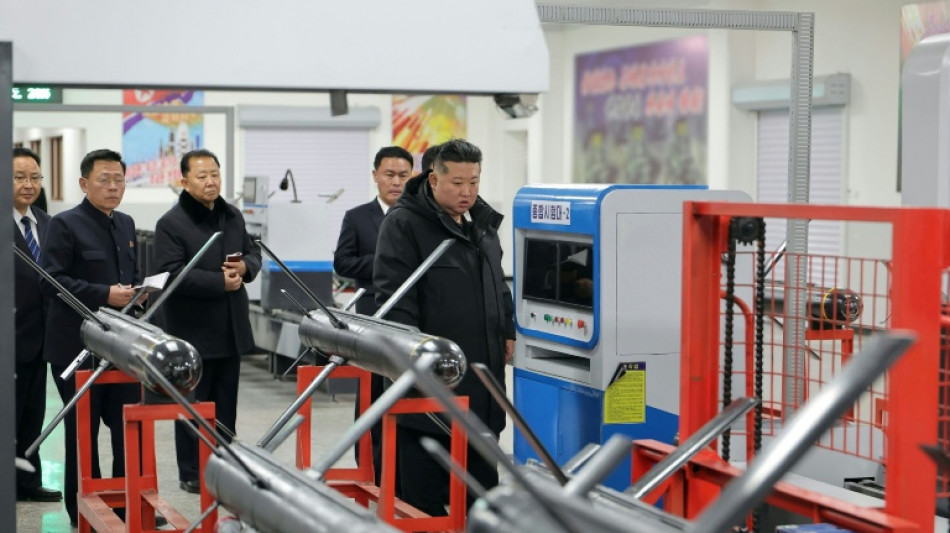
North Korea fires ballistic missiles in first test of 2026 / Photo: STR - KCNA VIA KNS/AFP
 Teatro Mayor Unveils 152-Performance 2027 Season Highlighting Beethoven and García Márquez

 Rutgers Defeats NJIT 101-64 Behind Francis and Mark Scores

 THIEAUDIO Introduces Clairvoyance MKII: The Evolution of a Signature Sound
 Guardian Metal Resources PLC Announces Proposed Spin-Out of Non-Tungsten Projects

 Fulcrum Metals PLC Announces New Critical Mineral Recoveries Expand Potential

 Thukukile Zuma Resigns from ANC Johannesburg Leadership Amid Disciplinary Dispute
 CM Mohan Yadav Meets Bohra Spiritual Leader to Discuss Simhastha 2028 and Development

 Eli Crane Defeats Jonathan Nez in Tight Arizona Congressional Race

North Korea fired multiple ballistic missiles off its east coast on Sunday, Seoul's military said, its first launch of the year just hours before South Korea's leader heads to China for a summit.
Sunday's launch follows a US military operation against Pyongyang's socialist ally Venezuela that snatched President Nicolas Maduro out of his country -- for decades a nightmare scenario for North Korea's leadership, which has long accused Washington of seeking to remove it from power.
Seoul's defence ministry said it had detected "several projectiles, presumed to be ballistic missiles" fired from near the North Korean capital Pyongyang around 7:50 am (2250 GMT Saturday).
"The military is maintaining a full readiness posture, having strengthened surveillance and vigilance against possible additional launches," Seoul said.
Japan's defence ministry also said it detected a possible ballistic missile, which it said landed in an unspecified location around 8:08 am (2308 GMT Saturday).
It is Pyongyang's first ballistic missile launch since November, when it staged a test after US President Donald Trump approved South Korea's plan to build a nuclear-powered submarine.
One analyst said Trump's Saturday military operation against Venezuela likely played a role in the decision to carry out the launch.
Pyongyang has for decades argued it needs its nuclear and missile programme as a deterrent against alleged regime change efforts by Washington. The United States has offered Pyongyang repeated assurances it has no such plans.
"They likely fear that if the United States so chooses, it could launch a precision strike at any moment, threatening the regime's survival," Hong Min, an analyst at the Korea Institute for National Unification, said.
"The underlying message is likely that attacking North Korea would not be as easy as a strike on Venezuela," he added.
- Lee bound for China -
The test also came just hours before South Korean President Lee Jae Myung departs for Beijing for talks with counterpart Xi Jinping, whose government is a key economic backer of North Korea.
Lee hopes to possibly harness China's clout over North Korea to support his bid to improve ties with Pyongyang.
Pyongyang has significantly stepped up missile testing in recent years.
Analysts say this drive is aimed at improving precision strike capabilities, challenging the United States as well as South Korea and testing weapons before potentially exporting them to Russia.
Pyongyang is also set to hold a landmark congress of its ruling party in the coming weeks -- its first in five years.
Economic policy, as well as defence and military planning, are likely to be high on the agenda.
Ahead of that conclave, leader Kim Jong Un ordered the "expansion" and modernisation of the country's missile production and the construction of more factories to meet growing demand.
On Sunday, state media reported that Kim had paid a visit to a facility involved in making tactical guided weapons.
He ordered them to expand current production capacity by 250 percent, the state-run Korean Central News Agency (KCNA) said.
burs-kjk-oho/tc
L.Davis--AMWN