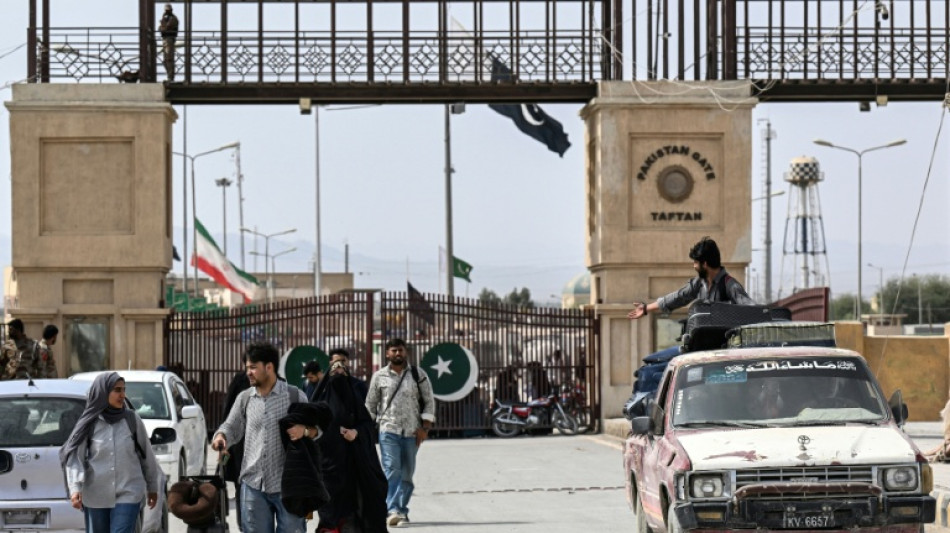
Pakistanis at remote border describe scramble to leave Iran / Photo: Banaras KHAN - AFP
 Rene Eyre Revisits Autobiographical Performance 'Say A Little Prayer' in London

 UAE's HCT Holds Record Graduation and Announces Major Training Expansion

 NASA Awards $10B Lunar Contract Framework to SpaceX, Blue Origin

 Katy Perry Tells Fans Ex-Husband Russell Brand 'Should Be in Jail' During UK Concert

 South African election results renew debate over identity-based voting

 South African voters report smoother local election but declining IEC trust

 Dolly Parton museum and Nashville hotel open after singer’s death

Pakistani nationals hauled suitcases across the border from neighbouring Iran, describing missiles being launched and travel chaos as they scrambled to leave the country after the US and Israel launched strikes over the weekend.
AFP journalists saw a steady trickle of people passing through large metal gates at the remote border crossing between Iran's Mirjaveh and Taftan in Pakistan's western Balochistan province.
Powerful explosions have rocked Iran's capital Tehran since Saturday, with embassies from countries around the world telling their citizens to leave.
"All our Pakistani brothers who were in Tehran and other cities had started to leave and were arriving at the terminal, which caused a lot of crowd pressure," 38-year-old trader Ameer Muhammad told AFP on Monday.
"Due to the crowds, there were major transport problems."
The isolated Taftan border lies around 500 kilometres (310 miles) from Balochistan's capital and largest city, Quetta.
AFP journalists saw the Iranian flag flying at half-mast as soldiers stood guard.
Most people wheeled bulky luggage over the frontier's foot crossing, while freight lorries formed a long line.
Irshad Ahmed, a 49-year-old pilgrim, told AFP he was staying at a hostel in Tehran when he saw missiles being fired nearby.
"There was an army base near the hostel, and we saw many missiles being fired," he said.
"After that, we went to the Pakistani embassy so that they could evacuate us from there. They brought us here safely."
Pakistan's Prime Minister Shehbaz Sharif has said the killing of Ayatollah Ali Khamenei was a "violation" of international law.
"It is an age old convention that the Heads of State/Government should not be targeted," Sharif wrote on X.
The "people of Pakistan join the people of Iran in their hour of grief and sorrow and extend the most sincere condolences on the martyrdom" of Khamenei, he added.
A teacher at Tehran's Pakistani embassy, who gave his name as Saqib, told AFP: "Before we left, the situation was normal. The situation was not that bad."
The 38-year-old said the strikes on Tehran on Saturday "pushed us to leave the city".
"The situation became bad on Saturday night, when attacks caused precious lives to be lost," he said.
F.Pedersen--AMWN