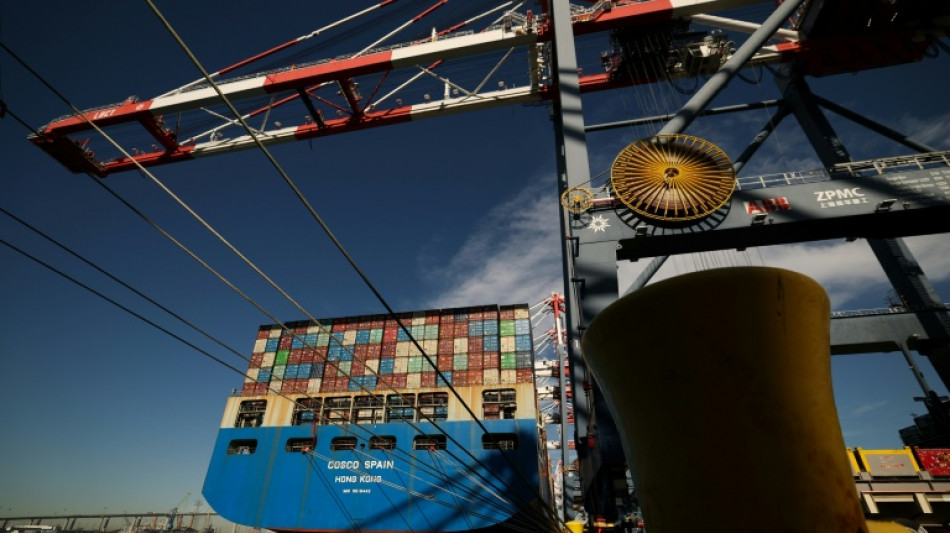
US takes first steps towards new global trade penalties / Photo: Patrick T. Fallon - AFP/File
 Pope Leo begins three-country South American tour in Uruguay

 Khawaja says entire Australia camp knew of 2018 ball-tampering plan

 November Foraging Guide: Edible Mushrooms and Critical Safety Protocols

 Microsoft Updates Xbox PC App with 60% Faster Startup and Redesigned Interface

 Early Polar Vortex Disruption Creates Uncertain Winter Outlook for Pennsylvania

 Edmund Richardson Wins Baillie Gifford Prize for 'Alexander' Biography

The United States announced new investigations Wednesday into what it considers unfair trade practices by dozens of countries, opening the door to penalties such as further tariffs as President Donald Trump seeks to replace duties struck down by the Supreme Court.
The Trump administration is launching separate probes centered on overproduction and importing goods made with forced labor, US Trade Representative Jamieson Greer told reporters.
The excess industrial capacity probe targets the European Union, China, Japan, India and others, and could inflame tensions with those trading partners.
Many of those targeted have struck tariff pacts with Washington, which Greer said are "independent" of the investigations.
He said Trump's trade policy remains the same as it has been "for decades," even if his tools may change.
"We need to protect American jobs, and we need to make sure we have fair trade with our trading partners," he added. "If we need to impose tariffs to help solve this, we will."
Others subject to the excess capacity probe initiated Wednesday include Singapore, Switzerland, South Korea, Vietnam, Taiwan and Mexico.
The investigation "will focus on economies that we have evidence appear to exhibit structural excess capacity and production in various manufacturing sectors," Greer said.
He did not specify if the eventual penalties would differ based on the country.
The second probe linked to forced labor will likely be launched "no earlier than tomorrow afternoon" and impact roughly 60 partners, he said.
"This is not about domestic conditions of particular countries," Greer added.
"It is really about whether countries have implemented external-facing laws to prohibit the import of goods made with forced labor."
- More to come -
The efforts come weeks after the high court struck down Trump's global tariffs, saying he had exceeded his authority in tapping emergency economic powers to impose them on virtually all countries.
Trump swiftly slapped a new 10-percent duty on imports, to last until July 24 while officials work on more durable measures as they resurrect his trade agenda.
Greer expects other similar investigations "on a country-specific basis" to come.
He seeks to conclude the latest probes "as quickly as possible," ideally before the temporary duties expire.
Both investigations unveiled Wednesday are handled by the USTR, falling under Section 301 of the Trade Act of 1974.
This is the same authority Trump tapped to impose tariffs on Chinese imports during his first presidency, and many of the resulting duties remain intact.
Trump's sector-specific tariffs on goods like steel, aluminum and autos, however, remain unaffected by the Supreme Court's ruling.
Greer said it is too early to say how any new penalties from the latest probes will overlap with the sectoral duties.
Asked how the new investigations could interact with deals that Trump has reached with partners like the EU and Japan, Greer maintained: "I think that we are able to take into account these agreements."
While he did not go into detail on what future investigations could focus on, he noted that Washington has concerns on issues ranging from digital services taxes to pharmaceutical pricing.
The Trump administration's latest move also comes ahead of an expected meeting between Trump and Chinese leader Xi Jinping in Beijing in April.
L.Miller--AMWN
