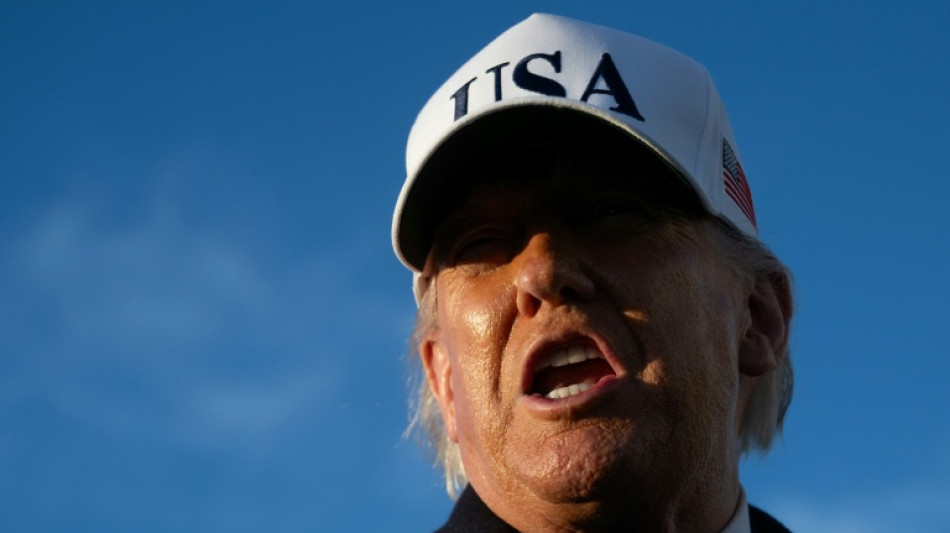
Trump says other countries 'must take care' of Hormuz / Photo: SAUL LOEB - AFP
 Anna Miltina Confronted with Racism Allegations on ProSieben Show

 German Auto Giants Face Existential Crisis as China Sales Plummet

 Cause of Death Revealed for 'Ellen' Producer Matthew Wright

 How to Enjoy Luxury Experiences on a Budget

 Pakistan Demands Grant-Based Climate Finance at COP31 to Avoid Debt Trap

 E Pellicci Pop-Up at Selfridges Brings Back Nostalgic School Cake

 Coronation Street's Debbie Webster Steps Down as Dementia Storyline Intensifies
US President Donald Trump on Saturday said countries that rely on oil carried through the Hormuz strait should take responsibility for keeping the passage open, with American help.
Global oil prices have surged by 40 percent as Iran has choked off the vital sea passage and attacked Gulf energy facilities since US-Israeli strikes launched the war on Iran.
"The United States of America has beaten and completely decimated Iran, both Militarily, Economically, and in every other way, but the Countries of the World that receive Oil through the Hormuz Strait must take care of that passage, and we will help -- A LOT!" Trump said on social media.
"The US will also coordinate with those Countries so that everything goes quickly, smoothly, and well. This should have always been a team effort, and now it will be."
Trump, who has said the United States will soon start escorting tankers through the strait, added that he hoped China, France, Japan, South Korea and Britain would send ships to secure the passage.
Iranian strikes have all but halted maritime traffic in the Strait of Hormuz, through which a fifth of global crude oil and liquefied natural gas normally pass. It is just 54 kilometers (34 miles) wide at its narrowest point.
- Reluctant allies -
In his posts on Saturday, Trump asserted that Iran's military capability had been eliminated but conceded that it was still able to attack the strait.
"It's easy for them to send a drone or two, drop a mine, or deliver a close range missile somewhere along, or in, this Waterway, no matter how badly defeated they are," he wrote.
As he urged nations to send ships to the strait, he added that "the United States will be bombing the hell out of the shoreline, and continually shooting Iranian Boats and Ships out of the water. One way or the other, we will soon get the Hormuz Strait OPEN, SAFE, and FREE!"
On Friday, the US military heavily bombed targets on Iran's Kharg Island, which handles almost all of Iran's crude exports.
Trump threatened to also hit the island's oil infrastructure, which was spared in the strikes, "should Iran, or anyone else" interfere with passage of ships through the strait.
US allies have been reluctant to provide military support to the US-Israeli attacks on Iran, but they have mobilized warships in response to the widening conflict.
On Monday, President Emmanuel Macron visited a French aircraft carrier dispatched to the Mediterranean and said France and its allies were preparing a "defensive" mission to reopen the strait.
And on Tuesday, a UK warship left port in southern England en route to the eastern Mediterranean to "bolster British defences in the region" after a drone attack on Britain's Akrotiri base in southern Cyprus.
T.Ward--AMWN