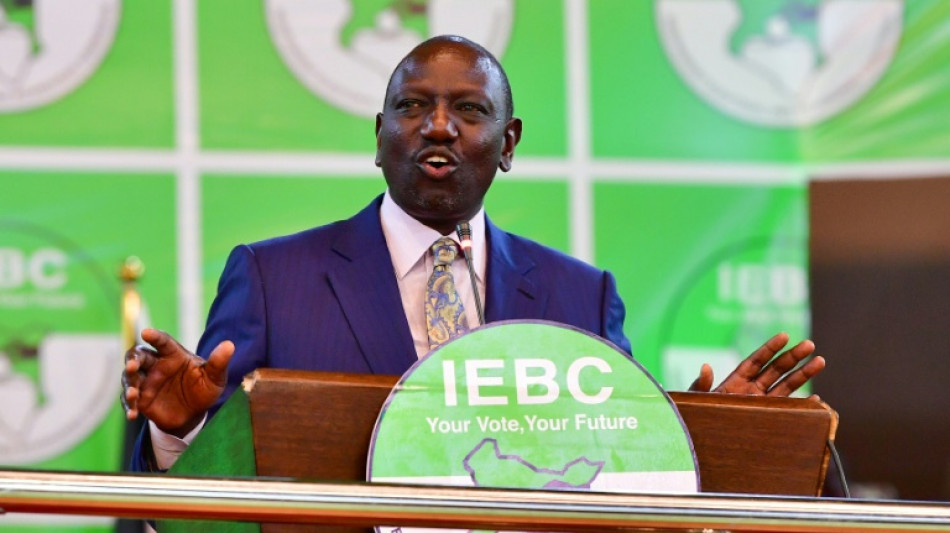
Protests as Ruto declared president-elect in disputed vote outcome / Photo: Tony KARUMBA - AFP
 Trapped, starving and afraid in besieged Sudan city

 Messi mania peaks in India's pollution-hit capital

 Serbian minister indicted over Kushner-linked hotel plan

 Cambodia says Thailand bombs province home to Angkor temples

 Small firms join charge to boost Europe's weapon supplies
 German shipyard, rescued by the state, gets mega deal
 'We are angry': Louvre Museum closed as workers strike
 Stocks diverge ahead of central bank calls, US data

 UK pop star Cliff Richard reveals prostate cancer treatment
 Indonesia to revoke 22 forestry permits after deadly floods

 Spain fines Airbnb 64 mn euros for posting banned properties
 Zelensky, US envoys to push on with Ukraine talks in Berlin
 Lyon poised to bounce back after surprise Brisbane omission
 US police probe deaths of director Rob Reiner, wife as 'apparent homicide'
 Cambodia says Thai air strikes hit home province of heritage temples

 Inside the mind of Tolkien illustrator John Howe
 Tongue replaces Atkinson in only England change for third Ashes Test
 Bondi Beach gunmen had possible Islamic State links, says ABC

 Louvre trade unions to launch rolling strike
 Asian markets drop with Wall St as tech fears revive

 Iran's women bikers take the road despite legal, social obstacles
 Countdown to disclosure: Epstein deadline tests US transparency
 Far-right Kast wins Chile election in landslide
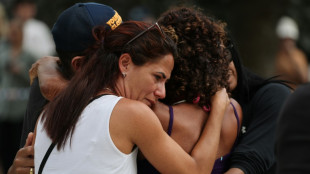 Witnesses tell of courage, panic in wake of Bondi Beach shootings
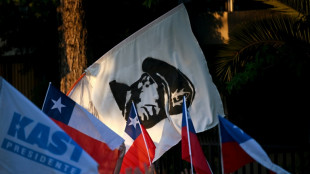 Chilean hard right victory stirs memories of dictatorship
William Ruto was Monday declared the victor of Kenya's hard-fought presidential poll, but the outcome sparked a split in the election commission and some violent protests in his defeated rival's strongholds.
Ruto won with 50.49 percent of the vote on August 9, narrowly ahead of Raila Odinga on 48.85 percent, Independent Electoral and Boundaries Commission chairman Wafula Chebukati announced after an anxious days-long wait for results.
With tensions running high after the disputed outcome, the 55-year-old president-elect vowed to work with "all leaders".
"There is no room for vengeance," said Ruto. "I am acutely aware that our country is at a stage where we need all hands on deck."
AFP correspondents reported that police fired live rounds as protests erupted in a Nairobi slum that is an Odinga stronghold.
Police also fired tear gas in his lakeside bastion of Kisumu where demonstrators threw stones and erected roadblocks with large chunks of rock.
"We were cheated," Isaac Onyango, 24, said on a street sealed off by two large bonfires and broken rock.
"The government must listen to us. They must redo the election. Raila Odinga must be president. We will keep protesting until the Kenyan Supreme Court listens to us."
The dispute is likely to further damage the reputation of the IEBC after it had faced stinging criticism over its handling of the 2017 election which was annulled by the country's top court in a historic first for Africa.
- 'Intimidation and harassment' -
Four out of seven IEBC commissioners rejected the outcome of Tuesday's vote, with vice chair Juliana Cherera describing the process as "opaque".
But Chebukati, who was also in charge of the IEBC in 2017, insisted he had carried out his duties according to the law of the land despite facing "intimidation and harassment".
The dispute will test Kenya's stability after previous elections in the East African political and economic powerhouse were blighted by claims of rigging and vicious bouts of deadly violence.
The country of about 50 million people is already struggling with soaring prices, a crippling drought, endemic corruption and growing disenchantment with the political elite.
It was first time lucky for the incumbent deputy president, a shadowy rags-to-riches businessman who had characterised the vote as a battle between ordinary "hustlers" and the "dynasties" who have dominated Kenya since independence from Britain in 1963.
He will succeed President Uhuru Kenyatta, 60, the son of Kenya's first post-independence leader, who has served two terms and under the constitution was not allowed to run again.
Ruto had been promised Kenyatta's backing for the top job only to see his boss throw his support behind former foe Odinga, leaving him out in the cold.
It was a bitter blow for 77-year-old Odinga, who has failed in his fifth attempt at the top job despite having the weight of the ruling party machinery behind him.
He has yet to make any comment on the result, but his running mate Martha Karua said on Twitter: "It is not over till it is over".
- Disenchantment -
With memories of previous post-poll violence still fresh, both Odinga and Ruto had pledged to accept the outcome of a free and fair election, and air their grievances in court rather than on the streets.
Polling day had passed off generally peacefully. But power transfers are fraught in Kenya, and how Odinga handles defeat will be anxiously watched by the country's foreign partners.
No presidential ballot has gone uncontested in Kenya since 2002, and a Supreme Court challenge by Odinga is seen as almost certain.
If there is no court petition, Ruto will take the oath of office in two weeks' time, becoming Kenya's fifth president since independence.
Kenya's months-long campaign saw vitriolic mudslinging on the hustings and widespread disinformation swirling on social media.
While polling day was largely peaceful, turnout was historically low at around 65 percent of the 22 million registered voters, with disillusionment over corruption by power-hungry elites prompting many Kenyans to stay home.
Disenchantment was particularly high among young Kenyans, who make up three-quarters of the population of 50 million.
- Next moves -
Any challenge to results must be made within seven days to the Supreme Court, the country's highest judicial body.
The court has a 14-day deadline to issue a ruling, and if it orders an annulment, a new vote must be held within 60 days.
Kenyatta went on to win the re-run two months later after an opposition boycott.
The worst electoral violence in Kenya's history occurred after a disputed vote in 2007, when more than 1,100 people were killed in bloodletting between rival tribes.
Th.Berger--AMWN