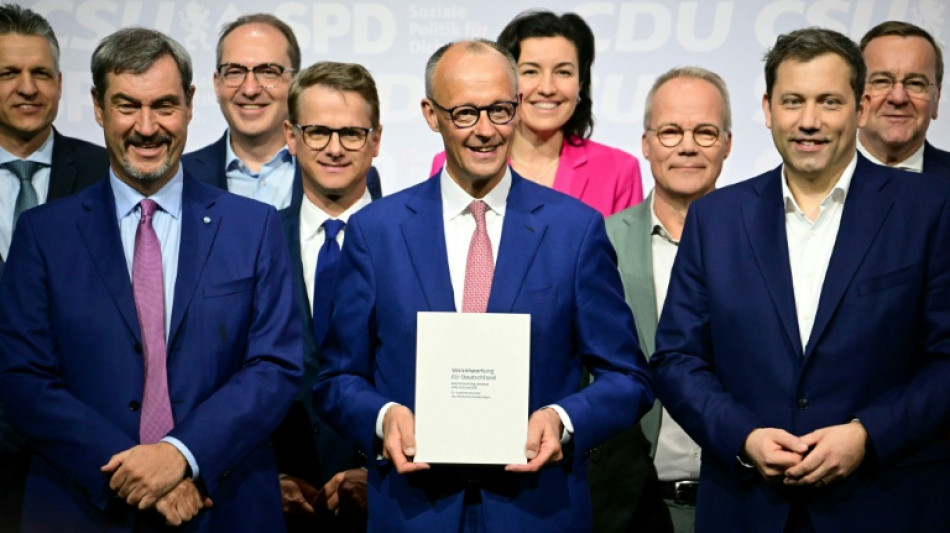
A year into Merz government, German far right stronger than ever / Photo: Tobias SCHWARZ - AFP/File
 Ecuadoran diplomat enters race to be next UN chief

 US sanctions ICC chief Tomoko Akane of Japan

 US moves to open vast tracts of pristine forests to logging

 US sanctions International Criminal Court chief Tomoko Akane of Japan

 Meta hooked children and misled public: prosecutors

 France's first women's rights minister Yvette Roudy dies, aged 97

 French producer Nicolas Altmayer, Dior PR chief Favier die in car crash

 Bezos consortium bought nearly 40 percent of Liverpool: report

 Trump says no Iran talks planned, claims Hormuz 'new US territory'

 Canada seeks to avert new US tariffs as deadline looms

 US primaries test Democrat comeback hopes in Trump stronghold

 Scientists discover how narwhals grow nature's only straight tusk

 DR Congo Ebola outbreak 'far from being under control': WHO chief

 Firefighters in 'decisive' push to encircle Belgian wildfire

 Tribal Partners with ServiceNow to Empower Enterprise Teams to Build and Deploy Apps & Agents

 Fusion Markets Extends Negative Balance Protection to Clients Globally
 India close on victory in first Test against Sri Lanka

 Three lightly injured as new quake hits Spain's Granada

 Syria, US say Israel struck military air base in Idlib province

 France probes Russian disinfo campaign against centrist candidates

 Stocks mostly drop as Mideast hopes dim, interest rates rise
 Bayern's Musiala returns to training after on-field collapse
 China's Baidu, betting on AI, posts fifth straight quarterly revenue drop

 German farmers warn of drought toll on grain harvest
 Pant fastest to 100 sixes as India set Sri Lanka 372 to win first Test
German Chancellor Friedrich Merz took office a year ago vowing to revive the political centre, but the far-right AfD party has risen to the top of the polls while his own coalition's popularity is falling.
The conservative chancellor, who came to power on May 6 last year at the head of a coalition with the centre-left Social Democrats (SPD), had argued that the far-right Alternative for Germany (AfD) could be weakened by effective governance.
But after a year beset by public squabbles within his government and growing criticism of his failure to halt an economic slump, the AfD is more popular than ever.
The AfD, which finished second in the 2025 elections with 20.8 percent, is now approaching 28 percent in polls -- the result Merz's centre-right CDU/CSU alliance achieved in the vote.
The anti-immigrant AfD is now firmly entrenched in German politics and cannot be viewed merely as the beneficiary of protest votes, according to political scientist Benjamin Hoehne of Chemnitz University.
"The AfD now has a very loyal electorate that remains faithful regardless of current events or party leaders," he told AFP.
More worryingly for Merz, the "the core electorate" for Germany's mainstream centrist parties is "disappearing", Hoehne added.
- Mainstream parties fading -
For decades, the CDU/CSU and SPD dominated German politics, but Merz's CDU party is now polling below 25 percent -- and the SPD has slipped under 15 percent.
This change is particularly pronounced in former communist states of eastern Germany, where the AfD appears certain to come top in two regional elections in September -- and might even claim outright majorities.
But the AfD has also been on the rise in the more prosperous west. In two regional elections there this year, the party hit new highs, with nearly 20 percent of the vote.
For AfD politicians and supporters, those results prove that Merz's conservatives are making a mistake by allying with the centre left rather than with the far right, where they contend there is more common ground.
But Merz and his party remain committed to the so-called "firewall", a consensus across much of the German political world against allying with the AfD, which is seen by mainstream parties as anti-democratic and racist.
The AfD accuses the ruling coalition of incompetence.
"With his coalition with the SPD, Friedrich Merz won't be able to win back a single AfD voter," Bernd Baumann, leader of the AfD's parliamentary group, told AFP.
"Merz will continue to lose a massive number of voters to the AfD, because incompetent governments get voted out," he added, referring to the disputes that are paralysing decision-making within Merz's governing coalition.
- Sliding poll numbers -
The chancellor had vowed to diminish the AfD's appeal with two main strategies: a tough stance on immigration to outflank the far right on the issue, and bold reforms to prove that centrist parties are still capable of acting.
Tighter immigration rules have led to a significant decrease in arrivals -- but the chancellor does not appear to be benefitting politically.
Meanwhile, his reform drive has stalled because of constant bickering between the CDU and SPD, with the long-struggling economy making a slower-than-expected recovery.
Political scientist Marc Debus of the University of Mannheim said Merz's decision to focus on immigration may have backfired.
"Studies show that, generally speaking, right-wing populists are strengthened when the issue of immigration is raised up the political agenda, when positions are aligned with those of right-wing populist parties, and when their rhetoric is adopted," he told AFP.
A poll at the weekend in the Bild daily showed just 16 percent of Germans are satisfied with the government -- with only 24 percent believing the coalition will survive until the end of its term in 2029.
The previous German government, headed by Olaf Scholz, collapsed in 2024 amid bitter infighting between his SPD and its two coalition partners.
Public dissatisfaction, Debus said, "significantly improves the electoral chances of right-wing populist parties".
J.Williams--AMWN