-
 Asian stocks back in retreat as tech mood sours again
-
What's holding up Washington's $14 bn arms sale to Taiwan?
-
 Reese shines again as Dream down Valkyries to lead WNBA Finals
-
South Korea's celebrity shark back in canal, prompting new rescue bid

-
 MotoGP riders prepare for 'emotional' farewell to Phillip Island
-
Missiles strike Ukraine's capital after US envoy visits Russia
-
 Champion-chip: Best fries contest heats up Belgium
-
Why Chile's copper output is sinking despite booming demand
-
 Tesla profits fall on higher spending as 'Elon Inc.' talk builds
-
Tesla profits drop on tech spending spree as 'Elon Inc.' talk builds
-
 NFL Titans coach says gun incident was 'cry for help'
-
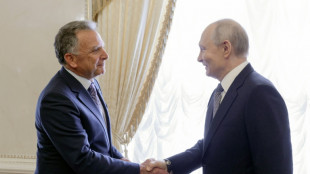
Russia 'ready' to resume trilateral talks but cool on Ukraine deal
-
 Websites go dark as AI exposes critical security flaws
-
Meta beats expectations but legal penalties hit profit amid AI race
-
 Man Utd humiliated as Arsenal deny Bayern in Champions League
-
X Community Notes 'failed' to flag US election falsehoods, study says
-
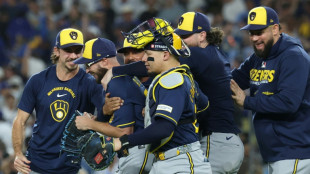 Low-budget Brewers and Rays seek first World Series title
-
Arsenal 'concerned' about Saka injury, says Arteta
-
 Pitiful Man Utd display heaps pressure on Carrick
-
Rice rescues Arsenal draw at Bayern in Champions League
-
 Ohtani surgery 'not on the table': Dodgers chief
-
Rice grabs Arsenal draw at Bayern in Champions League
-
 eBay to slash 1,000 more jobs, around 9% of workforce
-
Carrick unconcerned over future despite 'unacceptable' Como loss

-
 Villa tame Viking to stay perfect in Champions League
-
Real Madrid rout Leipzig to continue perfect European start

-
 Tesla profits drop but top analyst estimates
-
Walmart welcomes AI agents as Anthropic launches its own
-
 Angels drop Suzuki as manager after club's worst MLB season
-
Quebec separatist premier sworn in without royal presence

-
 Washington orders US embassy staff, families to leave Saudi Arabia
-
UAE nominates official to lead UN

-
 Musk's SpaceX results lift global stock markets
-
NFL boss Goodell welcomes probe into Hurts medical care

-
 NFL boss Goodell: Comfort level 'very high' for Paris game
-
Musk threatens Democrats teeing up congressional probes
-
 Fernandes laments 'mood of defeat' as Man Utd crumble in Como
-
In the Mexican town that makes emblematic Day of the Dead garlands

-
 Maradona doctor was made 'scapegoat' for his death, Argentine court told
-
Protests banned in parts of Paris as Macron swipes at Trump
-
 Man Utd thrashed by Como in Champions League horror show
-
Judge orders Meta to pay $25 bn to New Mexico in Cambridge Analytica case
-
 UN experts urge Meta to safeguard political expression in Brazil election
-
Champagne puts cork in project to expand production area

-
 Websites go dark worldwide as AI exposes critical security flaws
-
Canadian publisher says novelist Orelien used AI to write novel
-
 Defense in Maradona death trial seeks acquittal of doctor
-
Trump faces fresh questions over ties to 'humanitarian' Putin
-
 Jansen, Rabada put South Africa in sight of win over Australia
-
Hansen back in Ireland squad for Nations Championship

EU eases spending rules to tackle energy shock
The EU on Wednesday eased its spending rules to help member states confront the energy shock sparked by the Middle East war, as back-to-back crises leave countries in a fiscal squeeze.
The EU executive added Bulgaria to a growing list of countries in the public spending sin bin over their mushrooming deficits as it published views on each country's fiscal health.
The European Union's second- and third-biggest economies, France and Italy, have already been handed formal reprimands alongside eight other member states.
Under EU rules, the public deficit -- when government revenue is not enough to cover spending -- must not be above three percent of gross domestic product.
The rules were suspended during the coronavirus pandemic, and then again during the energy crisis that followed Russia's 2022 invasion of Ukraine -- both of which piled massive pressure on European nations' finances.
A reformed set of spending rules kicked into force in 2024, and in theory member states risk fines for violations, though the EU has never gone so far.
- Relaxing rules -
With energy prices soaring again because of the Middle East war, the EU on Wednesday said it would grant some fiscal leeway to help member states manage.
Italian Prime Minister Giorgia Meloni had demanded that, as has been done for defence spending, governments be allowed to exempt spending on measures that limit the impact of higher energy prices.
Explaining the move, which comes after initial EU resistance to Meloni's demand, economy chief Valdis Dombrovskis said: "We see that the energy crisis is more protracted than initially envisaged."
Brussels will give member states space to spend up to 0.3 percent of GDP per year, up to a total of 0.6 percent until 2028, to support measures aimed at cutting the use of fossil fuels.
Measures such as fuel excise tax cuts undertaken by Rome in March would not be included in the exemption.
But the picture otherwise looks better for Italy than for other major EU economies, with a deficit expected to fall to 2.9 percent in 2026 and 2027.
The expectation was that Rome would see its deficit below three percent in 2025, but an economic slowdown late last year dashed such hopes.
- Bulgaria: New kid on the block -
Just months after joining the eurozone single currency area, the European Commission rebuked Bulgaria for violating the EU's spending rules.
Brussels said opening an excessive deficit procedure against Bulgaria was "warranted". The procedure kickstarts a process forcing a country to negotiate a plan with Brussels to get their deficit levels back on track.
It will not be a surprise to Sofia. Its new prime minister, Rumen Radev, has warned about the deterioration of public finances.
According to the latest EU economic forecast published last month, Bulgaria's deficit is expected to reach 4.1 percent this year after 3.5 percent in 2025.
- Germany: Defended by defence -
Germany, Europe's largest economy, has long championed maintaining fiscal discipline but will breach the EU's three-percent deficit ceiling this year, hitting 3.7 percent of GDP and rising to 4.1 percent next year.
Luckily for Germany, it escaped public rebuke because of the exemption granted for defence spending, which the country has ramped up in the wake of Russia's Ukraine invasion.
Germany's deficit would have stood at 2.9 percent in 2026 without the increase in defence expenditure, according to the EU.
- France: Bottom of the pack? -
France's budget woes do not seem to end.
Paris hopes to keep its deficit at five percent of GDP this year, despite new spending measures to mitigate the impact of oil prices on certain sectors.
The commission welcomed France bringing down the deficit to 5.8 percent of GDP in 2024 to 5.1 percent of GDP in 2025.
But the commission warned last week that France would have the bloc's biggest budget deficit -- a whopping 5.7 percent -- in 2027, a crucial presidential election year, if policies remain unchanged.
The EU urged France to bolster its efforts to cut public spending to limit the rise in government debt, which is expected to exceed 120 percent of GDP next year. Under EU rules, it must be below 60 percent.
- Malta out -
But there was good news for Malta.
The commission recommended removing Malta from the sin bin since its deficit reached 2.2 percent in 2025 and 2026, according to the commission forecast.
D.Kaufman--AMWN