Myanmar's pro-democracy revolution weakens five years on / Photo: STR - AFP
 NZ bank in free speech row over 'explicit' sheep memes
 China Open champ Zheng withdraws from Wuhan citing fatigue

 Brewers edge Dodgers 2-1 in National League Championship Series opener

 Pope to have surgery to remove lung nodule
 Stocks rise as oil prices tumble after Trump hails 'energy ceasefire'

 Man City charges cloud hangs over Premier League season

 Top NATO commander set to issue warning to Russia over any attack

 Software, sprints, trolls: Singapore Grand Prix talking points

 Riyadh airport hit by fresh Houthi strike day after deadly attack

 InterContinental Hotels Group PLC Announces Transaction in Own Shares - October 12

 Policymakers take on energy shock, rising debt at IMF-World Bank meetings
 Raphael Glucksmann elected centre-left French presidential candidate

 'Dizzy' Lazio join Inter at top of Serie A as Roma, Juve and Milan held

 Jaguars edge Eagles as Packers beat Bears
 Rays chase first MLB crown as Guardians try to snap drought
 Hurricane Simon churns off Mexican coast after shift in course
 'Dizzy' Lazio join Inter at top of Serie A as Roma and AC Milan held

 Man City must make 'own noise' amid financial scandal, says Maresca

 Jaguars down Eagles with wild field goal finish in London
 Sadaqat, Imran help Pakistan thump Sri Lanka to seal T20 series

 Man City shrug off uncertain future to beat 10-man Liverpool
 Conservation groups alarmed at marine mammals' deaths in Spain

 Tens of thousands urge climate action at Brussels demo

 Norway's Hagenes wins historic Paris-Tours classic
 Kipruto claims Chicago Marathon as Feysa defends women's title
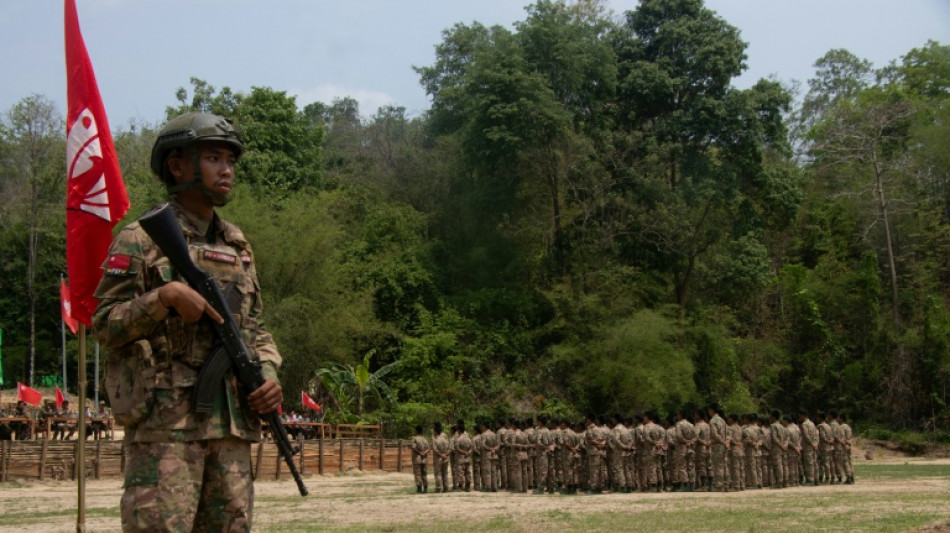
Saluting the red banner of revolution deep in Myanmar's jungle, retreating rebels swear to keep fighting for democracy -- but after five years of civil war the cause is flagging.
"The revolution has now become long term," said one section commander of the pro-democracy People's Defence Force (PDF) at a secret training base in Sagaing.
"Even soldiers who joined years ago are starting to have doubts and uncertainties about whether the revolution will still succeed," said the 23-year-old, asking to be identified by his callsign "Villain" for security reasons.
Myanmar was plunged into civil war after the 2021 military coup ousted the elected government of Aung San Suu Kyi. More than 100,000 people have died, according to monitor group ACLED.
At one point, the rebels threatened to unseat the junta.
But the military is now advancing on the battlefield, in large part thanks to backing from China.
Beijing has brokered key truces with rebel groups working with the PDFs, while also supporting the junta's newly formed civilian administration as it chips away at Myanmar's pariah status abroad -- the country's foreign minister will meet his regional counterparts in Bangkok this weekend.
- Selective ceasefires -
When security forces put down anti-coup protests, many youngsters quit the cities to form PDF guerrilla units, finding common cause with the kaleidoscope of ethnic armed organisations in Myanmar's fringes.
Many ethnic factions are semi-professionalised after decades fighting central rule.
Pro-democracy rebels embedded with them to secure notable successes, including a landmark 2023 combined offensive that advanced to the brink of Mandalay, Myanmar's second city.
But the military has regained the initiative after peeling off two significant ethnic factions with Beijing-backed truces -- the Myanmar National Democratic Alliance Army and the Ta'ang National Liberation Army.
Without them, the less capable PDFs are on the run, lacking expertise, weapons and ammunition.
The military have made some sweeping gains this year, reopening crucial trade routes to Thailand and towards China.
For Myanmar's armed forces, "the PDFs are a nuisance, but they are not a major strategic threat", said Morgan Michaels, research fellow at the International Institute for Strategic Studies.
Without support from ethnic minority armies, he predicted loosely organised PDFs would agree to truces or abandon the democratic cause to become "localised warlords" -- or "be wiped out".
- Chinese pressure -
The ceasefires reshaping the battlefield have been driven by political manoeuvres, conflict monitors and frontline fighters agree.
Physical retreats happened because "we lost in politics", said Villain at his base in central Myanmar, adding: "The main thing was Chinese pressure."
Beijing was initially dismayed by the coup that triggered chaos on its doorstep, analysts said.
It brokered the two truces and threw its weight behind then junta chief Min Aung Hlaing when he mounted elections he touted as a return to civilian rule.
Pro-military politicians won a landslide and in April elected Min Aung Hlaing as civilian president.
The vote was widely derided by democracy monitors abroad, but China supports it as recreating a semblance of normality, analysts say.
And it is not alone: Min Aung Hlaing has in recent weeks enjoyed red carpet treatment in India and Laos as well as Beijing.
On Sunday in Bangkok his foreign minister will meet his counterparts from the 11-nation Association of Southeast Asian Nations (ASEAN) -- which has largely frozen out Myanmar since the coup.
- International disorder -
By contrast, the pro-democracy opposition seems increasingly irrelevant on the global stage.
Zin Mar Aung, foreign minister of the self-proclaimed "National Unity Government" in exile, acknowledged losing ethnic faction allies was a blow.
"Nobody can win alone," she said.
She believes foreign engagement with the authorities is born of frustration -- after five years of diplomatic stalemate with Myanmar, "the international community are desperate".
"If we win on the ground, and we can demonstrate our strength and demonstrate our unity on the ground, they will definitely change their thinking and the way they approach," she insisted.
Yet as the movement loses territory in Myanmar, it loses credibility abroad.
Analyst Michaels says no international stakeholders have been "duped" by Myanmar's electoral process.
But the new administration is offering "some sort of path forward" -- touting a new peace plan, moving Suu Kyi from prison to house arrest and signing off opportunistic truces.
"All those things may be insincere or dishonest in their own ways, but at least there's something," he said.
"The junta had to do the absolute bare minimum to just do more than what the opposition was doing."
O.Johnson--AMWN