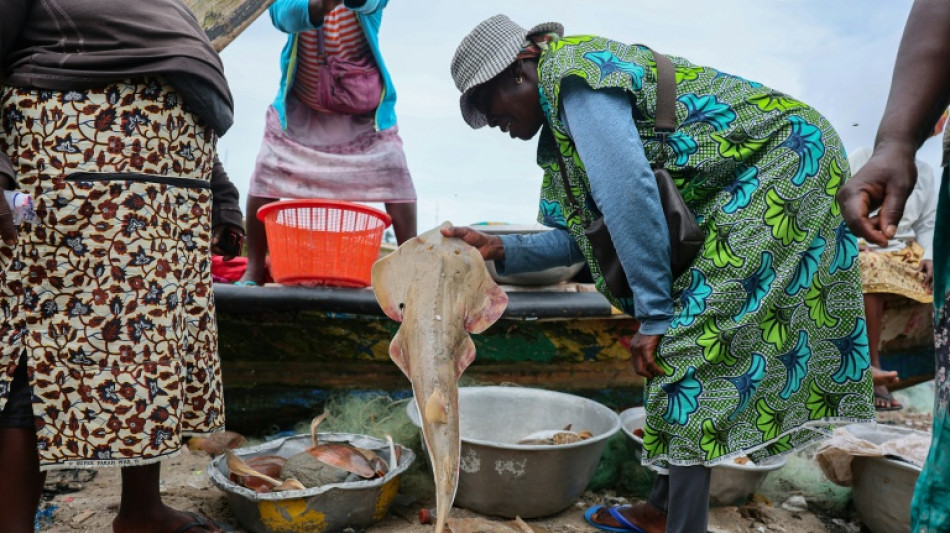
In Ghana, one man's race to save critically endangered fish / Photo: Nipah Dennis - AFP
 Dodgers beat Braves to advance in MLB playoffs, Rays oust Yankees

 'A sun as black as my lungs': how corruption crucified a polluted Albania city

 The British historian helping the French rediscover de Gaulle

 Dodgers beat Braves to advance, Guardians survive in MLB playoffs
 Latin American, Caribbean women top Nobel literature buzz

 US says Fiji-based Chinese official paid bribes for Beijing

 After botched US execution, Christa Pike was nearly taken off life support

 Guinea-Bissau junta urges military unit loyal to ex-president to disarm

 As species decline, green turtles offer glimmer of hope

 Brothers Scott and Beauden Barrett named to start for All Blacks

 EU trade chief seeks to dial down China tensions

 'Never again Bolsonaro': thousands march ahead of Brazil election runoff

 After botched execution, US woman was nearly taken off life support before revival

 Searing AIDS drama 'Elsinore' opens London film festival

 Evicted pensioner who sparked Spain housing protests dies: tenant union

 Golf star Rahm quitting LIV tour over 'unacceptable' terms

 Thousands march fearing return of a Bolsonaro presidency in Brazil

 French PM denies police ordered to confront student protesters

 Rubio touts US power, calls on Europe to emerge from 'slumber'

 Trump says 'we don't think' Russian plague is bio-weapon
 Five children among 26 killed in Ukraine after Russian strikes
 Man City should 'accept' punishment for rule breaches, says Lineker

 US woman who survived botched execution is awake and speaking
 From 1800s to modern pharma: a Nobel-winning chemistry quest

 Southampton boss Eckert given suspended ban over 'Spygate'

As dawn breaks over Ghana's Atlantic coast, artisanal fishing boats return to shore with last night's catch -- baskets of snapper, crabs, rays and a distinct-looking fish locals call "esene".
Once abundant along Ghana's shores, esene, or guitarfish -- with the flattened body of a ray and the tail of a shark -- have become increasingly difficult to find.
For conservationist Issah Seidu, 36, every landing is a reminder that time is running out to save the endangered species.
After studying terrestrial wildlife, he visited coastal fishing communities in 2018 and encountered what scientists describe as one of the world's least-known conservation crises.
"We came to these communities and saw piles of sharks, rays and guitarfish being landed without any thought about conservation," Seidu told AFP.
"That was the moment I realised somebody had to do something," said the wildlife biologist, who never dreamt of a career revolving around the sea.
Guitarfish -- relatives of both sharks and rays -- are among the world's most threatened marine fish, red-listed as "critically endangered" by the International Union for Conservation of Nature (IUCN).
Their meat is a delicacy widely eaten locally, while their fins command high prices in international markets.
Across west Africa, populations have collapsed.
Sawfish may have already disappeared from Ghana's waters and wedgefish, another close relative, have become increasingly scarce.
Seidu fears guitarfish could be next.
- Winning over fishermen -
The biggest challenge has been persuading fishermen to stop catching one of their most valuable species.
Seidu's NGO AquaLife Conservancy has helped boost knowledge about conservation.
And instead of simply asking fishermen to stop, it has helped develop snail farming as an alternative livelihood.
Today, rows of giant African snails crawl inside wooden pens in Adjoa, a coastal community where fishing families are testing the new source of income.
"The fishermen themselves selected snail farming," said Seidu -- and they cannot meet the demand.
Edward Afful, a fisherman of 20 years, says shrinking catches have left many crews struggling to recover the cost of fuel for their boats.
He now raises snails alongside fishing.
"If we had started this years ago, everyone would have benefitted," he said.
- Locals map the sea -
In a historic first, Ghana in April designated a 703-square-kilometre (271-square-mile) stretch of the Atlantic Ocean as a marine protected area (MPA) to be co-managed by coastal communities and national government.
"There are very unique species in the area that need to be protected, including the guitarfish," said University of Ghana's Francis Nunoo, a professor in fisheries science.
As policymakers in the capital put the finishing touches to the design and implementation of the national MPA, Seidu and local fishermen in Adjoa and Apam, several hours' drive from Accra, are already showing what it can look like.
They have created their own "locally managed marine area".
Seidu equipped fishermen with GPS trackers to identify where guitarfish gather and spawn.
Together they have mapped about 15 square kilometres of critical habitat.
"The fishermen are the custodians of these places," Seidu said. "They know where the species congregate and where the nursery grounds are."
In Apam, trader Evelyn Akorful, 41, has seen catches fluctuate with the seasons but has nevertheless noticed a steady decline over the years.
"Now we don't get as much as before," she said, blaming destructive fishing methods, particularly the use of lights at sea, for the depleting stocks.
For her family, every catch counts. Sales of guitarfish, crabs and other species help pay school fees and household expenses.
"If we don't get one fish, we try another. We survive by mixing everything," she said, dangling two freshly caught guitarfish from her hands.
Older residents have seen stocks decline over decades.
"When I was young, guitarfish were everywhere," said Jonathan Abadu Kennedy, 57, a former local lawmaker known as Uncle Ebo.
"You could catch several within minutes using hook and line."
Today, large guitarfish have almost vanished, he said, blaming pollution, changing fishing practices and climate change.
- Local kitchens, global markets -
When dried and salted, guitarfish is used in soups and stews across Ghana.
But the fins are swooped up by traders for the international markets, where they are used in shark-fin soup.
"The Chinese market is quite large," Seidu said. "It creates additional incentives for fishermen" and makes conservation even harder.
For Seidu, success will not be measured only by the number of guitarfish left in Ghana's waters.
"When the majority of fishermen become aware that their actions matter and choose to protect the species themselves," he said, "that is success."
F.Bennett--AMWN