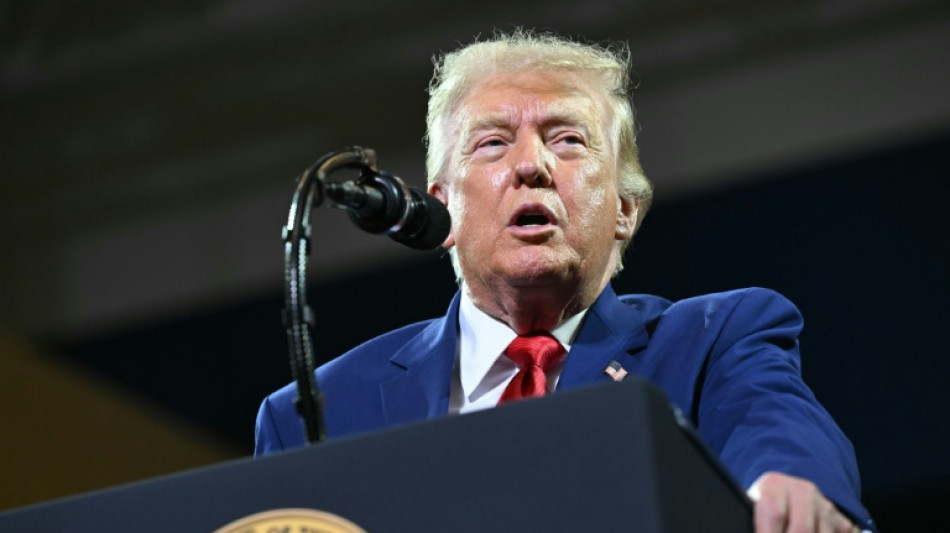
US imposes new tariffs on 60 partners as Trump rebuilds trade agenda / Photo: SAUL LOEB - AFP/File
 EU trade chief seeks to dial down China tensions
 'Never again Bolsonaro': thousands march ahead of Brazil election runoff
 After botched execution, US woman was nearly taken off life support before revival
 Searing AIDS drama 'Elsinore' opens London film festival

 Evicted pensioner who sparked Spain housing protests dies: tenant union

 Golf star Rahm quitting LIV tour over 'unacceptable' terms
 Thousands march fearing return of a Bolsonaro presidency in Brazil
 French PM denies police ordered to confront student protesters

 Rubio touts US power, calls on Europe to emerge from 'slumber'

 Trump says 'we don't think' Russian plague is bio-weapon

 Five children among 26 killed in Ukraine after Russian strikes

 Man City should 'accept' punishment for rule breaches, says Lineker

 US woman who survived botched execution is awake and speaking

 From 1800s to modern pharma: a Nobel-winning chemistry quest

 Southampton boss Eckert given suspended ban over 'Spygate'
 Russia warns of 'false' information as second plague case reported

 IEA ready to release more oil reserves if necessary
 HSBC 'consults' over UK unit job cuts amid AI adoption
 UK court quashes five ex-traders' Libor rate rigging convictions
 XM Receives “Global Customer Experience Leader Award 2026” at the TrustFinance Performance Awards
 Stocks slide as oil climbs on Mideast flareup

 Heavy casualties in Ukraine after Russian strikes
 French wine harvest set to hit historic low

 Kyiv 'cannot agree' to EU membership limiting food exports: minister

 Arteta targets more Arsenal glory after signing new deal until 2030

A new wave of US tariffs targeting 60 trading partners took effect Friday, replacing an expiring global duty rolled out by President Donald Trump earlier this year.
The levies range from 10 percent to 12.5 percent and impact major economies like China, India and the European Union.
"The United States has had a forced labor import ban for nearly a century, and rigorously enforces it; it's well past time for our trading partners to do the same," said US Trade Representative Jamieson Greer.
He earlier added that the targeted economies represent the majority of US trade.
The Trump administration has moved swiftly to rebuild the president's tariff wall after the Supreme Court struck down a host of his duties in February -- dealing a blow to his ability to unleash steep levies at will.
After the setback, Trump tapped different authorities to reimpose a 10-percent tariff on imports. But this only lasted 150 days and expired Friday.
The volley of new duties, initially proposed in June, now takes its place.
The measures were planned after a months-long investigation and are considered more resistant to legal challenges than earlier moves.
Under Thursday's announcement, economies that have implemented a forced labor import prohibition or committed to do so are hit with the lower 10-percent rate. They include Canada, the EU, India and the United Kingdom.
China, Japan, South Korea and dozens of others were deemed to deserve the higher 12.5 percent tariff.
But the EU, Taiwan, Japan, South Korea and Switzerland receive some relief in line with trade pacts they previously reached with the United States.
The new levies received swift condemnation from target countries, with Japan saying it "regrets" the duties and Australia's trade minister calling them "unjustified."
Goods already facing sector-specific tariffs -- like steel and aluminum -- will not be impacted.
Certain energy products and fertilizers will be exempt too, alongside products covered by the US-Mexico-Canada free trade pact, a US official told reporters.
- Maintaining leverage -
Washington is separately investigating 16 economies over excess industrial capacity, in probes that could lead to additional duties.
These could result in varying rates among countries eventually, experts warn.
The Trump administration's move to impose a baseline tariff while sustaining the threat of further duties maintains leverage over its trading partners, trade lawyer Greta Peisch told AFP.
It also creates an incentive for countries to comply with trade pacts that they earlier struck, she added.
In spending time on investigations, officials want their incoming tariffs to be robust if there are court challenges, said Peisch, a former general counsel for the Office of the US Trade Representative, who is now a partner at Wiley Rein.
"This makes it much more likely that they stay for the duration of Trump's term," signaling a "much more protectionist world's largest economy" moving forward, Josh Lipsky of the Atlantic Council told AFP.
Resurrecting tariffs boosts government revenues too, he added.
- 'Fragile' deals -
The Trump administration has been hunting for options that would allow it to aggressively deploy tariffs, said former US trade official Ryan Majerus.
In the longer term, Section 301 of the Trade Act of 1974, which Greer tapped to impose the latest duties, provides "more flexibility than people realize," Majerus said.
Once in place, officials can modify them based on new developments, added Majerus, a partner at King & Spalding.
The latest salvo comes shortly after a 25-percent tariff took effect on various Brazilian goods, as Washington accused the Latin American giant of unfair trade practices.
This week, Trump also ordered new 50-percent tariffs on many Canadian products, citing Ottawa's "discriminatory treatment" of American alcohol, automobile and dairy products.
The Canadian tariffs taking effect in a month rely on an untested legal provision, showing that Trump has other tools to swiftly wield, said Lipsky.
This signals that US tariff deals "are still fragile," he said.
Nonetheless, the EU, which has signed a trade pact, expects that Washington "will honor the commitments that are spelled out under the EU-US Joint Statement."
G.Stevens--AMWN