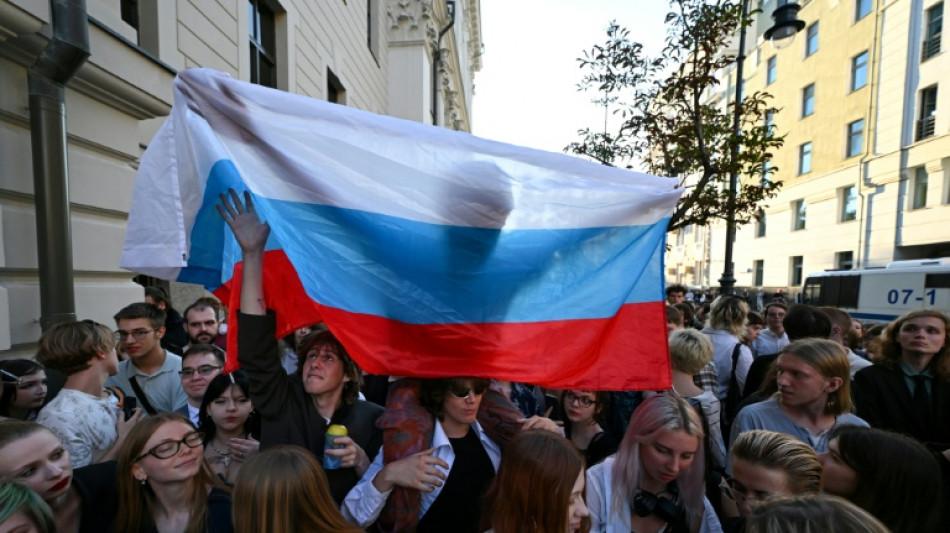
Barred from elections, Russia's anti-war party vows to fight on / Photo: Igor IVANKO - AFP
 Trump expected to name intel chief Clayton as AI czar: reports
 Argentina unveils passports-for-investment scheme
 Brazil election debate chaos sparks censorship row
 England's Carse charged by cricket body over nightclub incident

 Amazon vows $1 bn for data center towns, decries 'myths'

 Oil prices drop on G7 fuel release, US jobs data boosts stocks
 G7 agrees deal to ease global energy supply concerns
 Spain's government dealt blow as lawmakers reject housing bills
 Food, medicine shortages deepen in Russian-occupied Oleshky
 Man City whistleblower Rui Pinto facing 'dire consequences' - lawyers
 Russia 'tearing Kyiv apart', mayor says, as strikes paralyse traffic
 Taiwan boxer Lin wins Games gold as Japan edge North Korea on penalties

 Japan tame North Korea to win Games gold after shootout drama
 US posts weak job growth data in September
 Ethiopia's conflict: the regional dimension

 Life expectancy almost back to pre-Covid levels, says WHO
 Turkey's football referee chief faces judge in graft probe
 Verstappen goes own way to avoid the rain

 Oil slides, bonds steady as EU addresses diesel price surge
 Spain housing package at risk in parliament, as protests mount
 Swedish Social Democrats leader to make new bid to form government
 North Korea calls Seoul 'despicable' after DMZ apology demand

 Taiwan boxer Lin wins gold as virtual taekwondo makes Games debut
 Man City face appeal deadline after explosive financial verdict
 Pole vault superstar Duplantis to skip indoor season

When 18-year-old Karina learnt the party she supported ahead of her first parliamentary election in Russia was barred from contesting, she was shocked -- but also surprised by what happened next.
Russia's Supreme Court on Monday banned the country's only anti-war party, Yabloko, from the ballot, a decision that was met with "Shame!" chants from around a hundred supporters gathered in front of the building.
"I was surprised by how many people there were. I hadn't seen such large political gatherings -- specifically opposition ones -- since 2022," Karina told AFP at Yabloko's headquarters in Moscow.
After it launched a full-scale offensive in its neighbour Ukraine in February 2022, Russia has ratcheted up repression at home to levels unseen since the era of the Soviet Union.
Thousands have been jailed or fined for speaking out against the offensive. All major opposition figures are jailed, exiled or dead, while public protests against the Kremlin are virtually unheard of.
To Karina, who volunteered for Yabloko and declined to give her full name for security reasons, the election ban on the party "was simply the last straw".
"I think people have nothing left to lose, they aren't willing to put up with it anymore. After all, we're entering the fifth year, everyone is tired of it," she said about the offensive.
The war has killed hundreds of thousands of people and spiralled into Europe's deadliest conflict since World War II, with talks on ending it effectively frozen.
Yabloko is the only anti-war party still operating in Russia, but has come under increasing scrutiny, with around 40 party activists facing prosecution.
- 'Disappointment and anger' -
Despite mounting pressure, Yabloko leader Nikolay Rybakov vowed to appeal the ruling and keep on fighting.
"We will continue working in Russia. We are not halting the election campaign under any circumstances," he told AFP on Tuesday.
Yabloko has been banned from standing as a party in September's elections, though Rybakov said 130 of its members were still registered to fight individual constituencies.
Russia's parliament is voted for on a split system -- half of the 450 members based on a nationwide proportional representation system, and half from individual constituencies.
The Supreme Court decision bans Yabloko from contesting the proportional part of the vote.
It was unclear what it means for party members who are registered to run in the districts under a Yabloko umbrella.
The ban "marked an important milestone for Yabloko and for our country as a whole", Rybakov said.
"Everyone saw so many people -- young people -- come out to show their support. They didn't come just because Yabloko is wonderful: they came to support peace, freedom, and... a peaceful change in Russia".
The party's social media manager Marizhat Ramazanova, 28, also sought "a ray of hope" in the latest developments.
"In just a few weeks, search queries for Yabloko on Wikipedia and other search engines surged by 90 percent. People discovered us. For them, it's a breath of fresh air," she told AFP.
Maxim, 30-year-old working for Yabloko, said the court's decision left him feeling "a cocktail of emotions: disappointment and anger".
But the gathering outside the court gave him "a sense of immense support, and that generated positive feelings".
Founded in 1993 by a group of pro-Western public officials, Yabloko enjoyed relative success in the years following the post-Soviet collapse.
Since 2003, however, it has failed to win seats in the State Duma as the Kremlin tightened its control over elections, with the pro-Putin United Russia party winning every parliamentary vote since.
A poll conducted earlier this year showed Yabloko ("apple" in Russian) at just three percent support, short of the five-percent threshold needed to enter Russia's lower house.
But Karina hoped the ban would spur young people to action.
She believed that they will eventually "take the initiative themselves, they'll replace the older politicians, new parties will form".
"I believe we can steer Russia toward a better state -- if not right now, then in a couple of years," she said.
O.M.Souza--AMWN