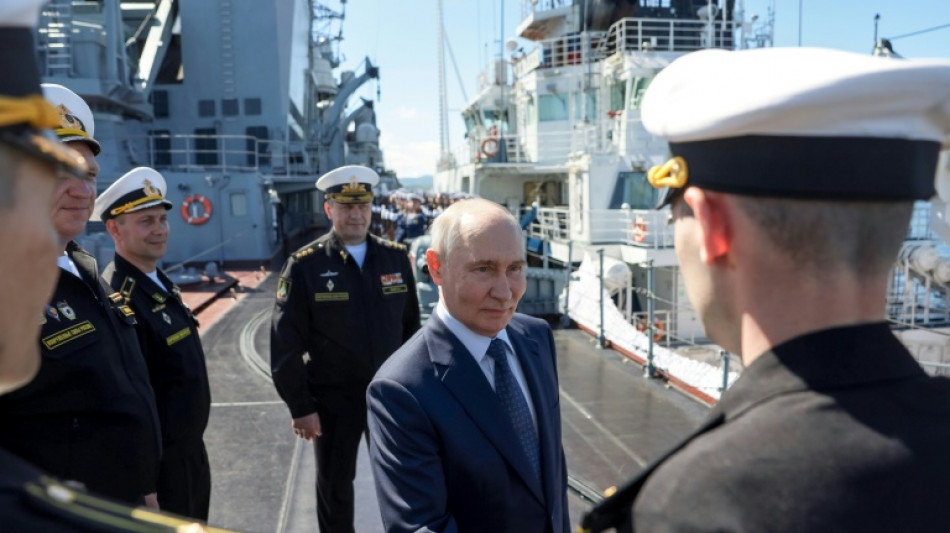
Putin visits Kuril islands claimed by Japan / Photo: Gavriil Grigorov - POOL/AFP
 Monaco Housing Project Wins International Sustainability Award at COP31

 China's Factory Activity Contracts as Export Orders Weaken

 US Retail Sales and Fed Minutes Set Up a Critical Test for Consumers

 Oil Heads for Second Weekly Loss as Supply Surplus Emerges

 Brazil Faces Debt and Inflation Test as Lula Prepares Fourth Term

 Archive of Our Own Restores Service After Weeks-Long Security Shutdown
 US Mortgage Rate Falls for Fourth Week but Remains Above 7%

 Fire Erupts Near MetLife Stadium After Jets-Bills Game

 Euro-Area Growth Slows to 0.4% While Employment Stalls
 US Wholesale Inflation Eases Monthly but Hits a Four-Year Annual High

 India's Wholesale Inflation Jumps to 12.29% as Fuel Costs Surge
 Japan's Economy Edges Into Contraction as Costly Oil Weighs on Demand
 South Korea Launches Probe into NewJeans Contract Controversy

 UK Defence Secretary Warns Russia Nukes Not for Negotiation as HMS Vengeance Returns
Russian President Vladimir Putin visited the far-eastern Kuril islands for the first time on Thursday, prompting a "strong" protest by Japan which also claims the territory.
Russian-Japanese relations have long been dogged by tensions over the contested islands, known in Japan as the Northern Territories and seized by the Soviet Union in 1945.
The Kremlin posted a video of Putin in the Kuril Islands, with Russian media saying he visited a fish-processing plant where he was given caviar.
Putin travelled to the Kurils after visiting the nearby Russian island of Sakhalin, where Russia's navy was conducting drills.
In Sakhalin, Putin held a meeting "on ensuring the security of Russia's eastern borders," RIA Novosti said.
Japan, whose ties with Russia have worsened further since the full-scale invasion of Ukraine in 2022 -- just as Moscow's relations with China and North Korea have warmed -- objected strongly.
"The Northern Territories... are an inherent part of Japan's territory both historically and under international law, and the government of Japan strongly protests this visit," Foreign Minister Toshimitsu Motegi said in a statement.
The Soviet Union took the strategically located volcanic archipelago north of Hokkaido in the final days of World War II, and has maintained a military presence there ever since.
In 2010 then president Dmitry Medvedev became the first Russian leader to visit the disputed territory. Medvedev also went there several times subsequently as prime minister.
- Harsh climate, few people -
The four contested isles are part of the volcanic Kuril archipelago, which runs in a broad arc from Russia's Kamchatka peninsula down to Japan's main northern island Hokkaido.
The Soviet Union only declared war on Japan on August 8, 1945, after the atomic bomb was dropped on Hiroshima and six days before the end of the conflict.
The islands' names are similar in both countries -- Kunashir, Habomai, Shikotan and Iturup in Russian, while in Japanese they are known as Kunashiri, Habomai, Shikotan and Etorofu.
Their population of about 20,000 Russian citizens lives in a harsh climate, but the islands have mineral deposits including gold and silver, and rich fishing grounds.
After the islands were occupied in 1945, Moscow deported their Japanese population of about 17,000 people.
Thereafter the islands acquired strategic importance, providing air and sea bases during the Cold War as the Soviet Union confronted the United States and its closest ally in the Pacific, Japan.
On several occasions it appeared that off-and-on talks between Tokyo and Moscow were making progress and in 1956, when diplomatic relations were established, Soviet leader Nikita Khrushchev suggested two of the disputed islands might be returned under a peace treaty.
Although the talks resumed after the fall of the Soviet Union in 1991, no progress has been made.
Ch.Havering--AMWN