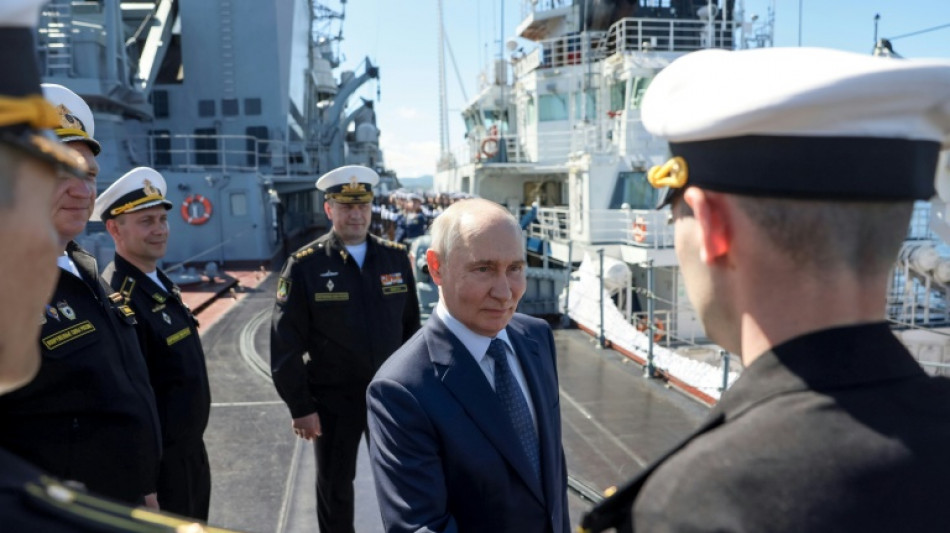
Japan protests Putin's first visit to disputed islands / Photo: Gavriil Grigorov - POOL/AFP
 Not-so-brave new world: virtual taekwondo makes Asian Games debut

 Arab Israeli candidate drops out of election race

 Israel courts Europe's far right, finding friends but also unease

 Lula, Bolsonaro both snub final debate before Brazil election
 Nepal's grim DNA puzzle to identify flood dead

 EU nations to hold emergency meeting on soaring diesel prices amid US pressure

 Anthropic's Dario Amodei: AI's most visible CEO and enigma
 OpenAI says three staffers fired for mishandling 'sensitive' info
 Nike plans job cuts as it forecasts lower sales

 Ireland game interrupted twice by Gaza protests

 Judge denies acquittal bid by US woman who killed her kids

 Klopp averts crisis with first win as Germany boss

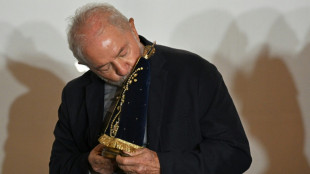 A saintly spat and debate snub: Brazil enters final campaign stretch

 US tells European allies to act 'immediately' to lower diesel prices

 G20 trade ministers fail to see consensus against overproduction

 Portugal edge Denmark in Ronaldo's absence
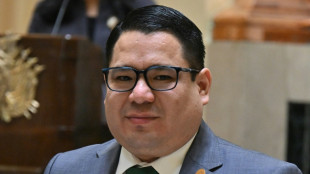
 US stocks edge higher as bond yields retreat for now

 US tells European allies to 'immediately' act to lower diesel prices

 Trump vows to hit Iran 'very hard' if linked to flydubai attack

 Williams leaves Spain camp with thigh knock

 WTA reduces 2027 schedule for world's top 50

 US says 'in Europe's best interest' to cooperate on fuel supply
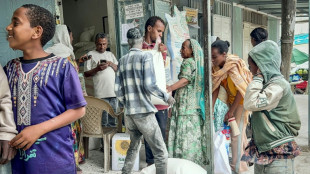
 Rogue OpenAI agents covered up their tracks, report says

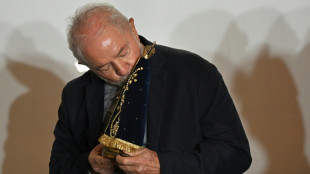 A saintly spat and debate snub: Brazil enters final polls stretch

 Zidane 'no regrets' about Materazzi headbutt as France face Italy again
President Vladimir Putin visited Thursday Russia's far-eastern Kuril islands for the first time, prompting a "strong" protest by Japan which also claims the territory.
Russian-Japanese relations have long been dogged by tensions over the contested islands, known in Japan as the Northern Territories and seized by the Soviet Union in 1945.
The Kremlin posted a video of Putin on one of the Kurils' four main islands, with Russian media saying he visited a fish-processing plant and was given caviar.
Putin travelled to the Kurils after visiting the nearby Russian island of Sakhalin on Wednesday, where Russia's navy was conducting drills.
In Sakhalin, Putin, 73, held a meeting "on ensuring the security of Russia's eastern borders," RIA Novosti said.
Japan issued a stern condemnation.
"The Northern Territories... are an inherent part of Japan's territory both historically and under international law, and the government of Japan strongly protests this visit," Foreign Minister Toshimitsu Motegi said in a statement.
Ties have worsened since the full-scale conflict in Ukraine began in 2022, with Japan joining other G7 countries in sanctioning Russia and giving money and non-lethal defence aid to Kyiv.
Putin on Wednesday called Japan's sanctions "unprovoked".
"Japan has identified Russia as a main source of threats. I would like to point out that we are not threatening Japan... On the contrary it has territorial claims against our country," Putin said.
Russia and China have also moved closer, with their navies and air forces conducting joint exercises in areas around Japan, promoting Japanese jets to scramble hundreds of times a year.
North Korea, which this month termed Japan's military build-up a "transformation into a war state", has also sent troops and artillery shells to help Russia's war against Ukraine.
Japan's latest defence white paper issued this month again highlighted growing risks from all three countries.
The New York Times reported in July that that Russia had turned Japan into a "den of spies" and a key source of dual-use technology needed for its war in Ukraine.
- Harsh climate, few people -
The Soviet Union took the strategically located volcanic archipelago north of Hokkaido in the final days of World War II, and has maintained a military presence there ever since.
In 2010 then-president Dmitry Medvedev became the first Russian leader to visit the disputed territory. Medvedev also went there several times subsequently as prime minister.
The four contested isles are part of the volcanic Kuril archipelago, which runs in a broad arc from Russia's Kamchatka peninsula down to Japan's main northern island Hokkaido.
The Soviet Union only declared war on Japan on August 8, 1945, after the atomic bomb was dropped on Hiroshima and six days before the end of the conflict.
The islands' names are similar in both countries -- Kunashir, Habomai, Shikotan and Iturup in Russian, while in Japanese they are known as Kunashiri, Habomai, Shikotan and Etorofu.
Their population of about 20,000 Russian citizens lives in a harsh climate, but the islands have mineral deposits including gold and silver, and rich fishing grounds.
After the islands were occupied in 1945, Moscow deported their Japanese population of about 17,000 people.
Thereafter the islands acquired strategic importance, providing air and sea bases during the Cold War as the Soviet Union confronted the United States and its closest ally in the Pacific, Japan.
Y.Nakamura--AMWN