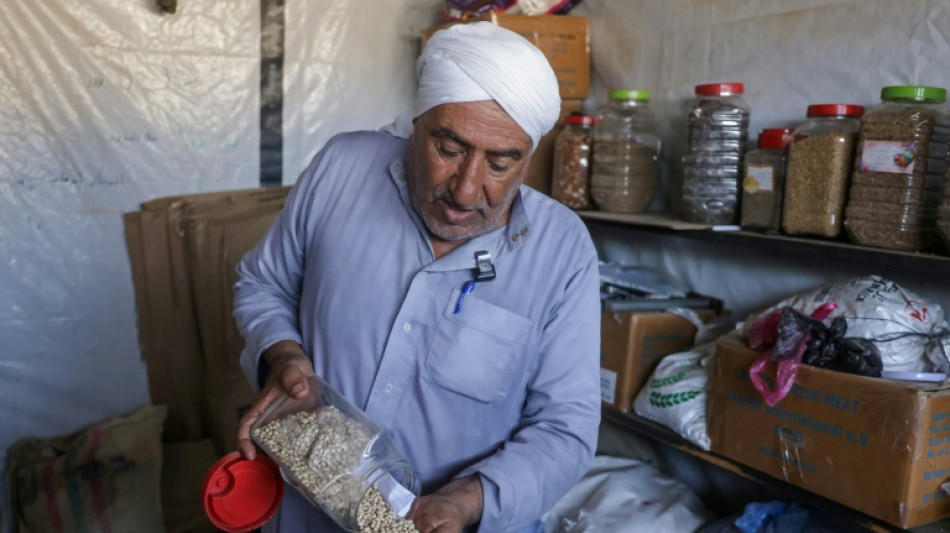
'Ray of hope': Gaza seed bank rebuilds after wartime destruction / Photo: Bashar Taleb - AFP
 Monaco Housing Project Wins International Sustainability Award at COP31

 China's Factory Activity Contracts as Export Orders Weaken

 US Retail Sales and Fed Minutes Set Up a Critical Test for Consumers

 Oil Heads for Second Weekly Loss as Supply Surplus Emerges

 Brazil Faces Debt and Inflation Test as Lula Prepares Fourth Term

 Archive of Our Own Restores Service After Weeks-Long Security Shutdown

 US Mortgage Rate Falls for Fourth Week but Remains Above 7%
 Fire Erupts Near MetLife Stadium After Jets-Bills Game

 Euro-Area Growth Slows to 0.4% While Employment Stalls

 US Wholesale Inflation Eases Monthly but Hits a Four-Year Annual High
 India's Wholesale Inflation Jumps to 12.29% as Fuel Costs Surge

 Japan's Economy Edges Into Contraction as Costly Oil Weighs on Demand
 South Korea Launches Probe into NewJeans Contract Controversy

 UK Defence Secretary Warns Russia Nukes Not for Negotiation as HMS Vengeance Returns
From a small makeshift tent in the central Gaza Strip, a dedicated team works to carefully store and document some of the war-shattered territory's most precious commodities: local seeds.
Shelves of unassuming plastic tubs line the walls of the Al Qarara Seed Bank, each holding indigenous seeds seen as a way of reviving Gaza's devastated farming sector and preserving its agricultural heritage.
The seed bank in Deir el-Balah is rebuilding its stocks of Gaza's heirloom seeds that were destroyed during the Israel-Hamas war which erupted in October 2023.
Unlike hybrid varieties often sold commercially, heirloom seeds can be saved and used year after year and are often better adapted to their local environment.
"During the war, they were what helped us survive," said Salem Muhanna, who manages the project which was founded in 2017 with support from the International Committee of the Red Cross (ICRC).
"Heirloom seeds give continuity. They provide 80 to 90 percent of the same yield repeatedly. That is why we relied on heirloom seeds," he told AFP.
The bank holds seeds for wheat and barley; leafy crops such as Swiss chard, spinach and parsley, as well as some vegetables like courgette and okra.
The war that erupted following Hamas's attack on Israel in October 2023 took an immensely heavy toll.
The fighting "completely destroyed the bank and led to the loss of many seed varieties," explained 27-year-old Hanadi Muhanna, Salem Muhanna's daughter who also manages the project.
"In addition, because we were repeatedly displaced, it was difficult to start over again," she added.
"Eventually we settled in Deir el-Balah and managed, thankfully, to establish a small tent. We created something simple using basic means".
A collection of large hessian sacks, plastic barrels, and smaller mismatched tubs now hold what remain of the stocks, each carefully labelled and protected from pests with plastic sheets.
- 'Safety valve' -
Like the rest of life in the coastal Palestinian territory, Gaza's agricultural sector was shattered by the conflict.
Despite a US-backed ceasefire since October 2025, bloodshed has continued, with the Israeli military continuing to target Palestinians it says are militants.
Israel says it now controls more than 60 percent of the Gaza Strip, up from about half when the ceasefire took effect, and has refused to start withdrawing until Hamas fully disarms.
Before the war, agriculture including crop production, herding and fishing, accounted for approximately 10 percent of Gaza's economy, according to the United Nations' Food and Agricultural Organisation (FAO).
Just three percent of the cropland in Gaza remains accessible and undamaged, the FAO said Tuesday.
Tight Israeli controls on the entry of all goods into the territory has also compounded the woes of Gaza's farmers.
"There is no water, no fertiliser, no agricultural chemicals," Salem Muhanna told AFP. "Nothing is available".
Before the war, Gaza was self-sufficient in fresh vegetables and used to export one-third of its production to external markets, according to Osama Al-Mukhalalati, an economic security officer with the ICRC.
Now, at best, the agricultural output cannot provide more than 10 percent of Gaza's vegetable needs, he added.
The Al Qarara Seed Bank works on a lending system, with trusted farmers receiving seed and then returning it at the end of the season.
"During the war, we considered this project our main safeguard," said Suleiman Abu Shamas, a farmer from Deir el-Balah who was out inspecting a crop of waist-high chilli peppers.
"With agricultural supplies cut off and prevented from entering through the crossings, the only safeguard we had was to build a food basket based on heirloom seeds that already existed within Gaza."
For Al-Mukhalalati, the bank is not only a way of continuing food production on what agricultural land remains, but is a means of preserving Gaza's agricultural heritage for the future.
"We consider this project a ray of hope amid the complete darkness hanging over the agricultural sector," he said.
A.Rodriguezv--AMWN