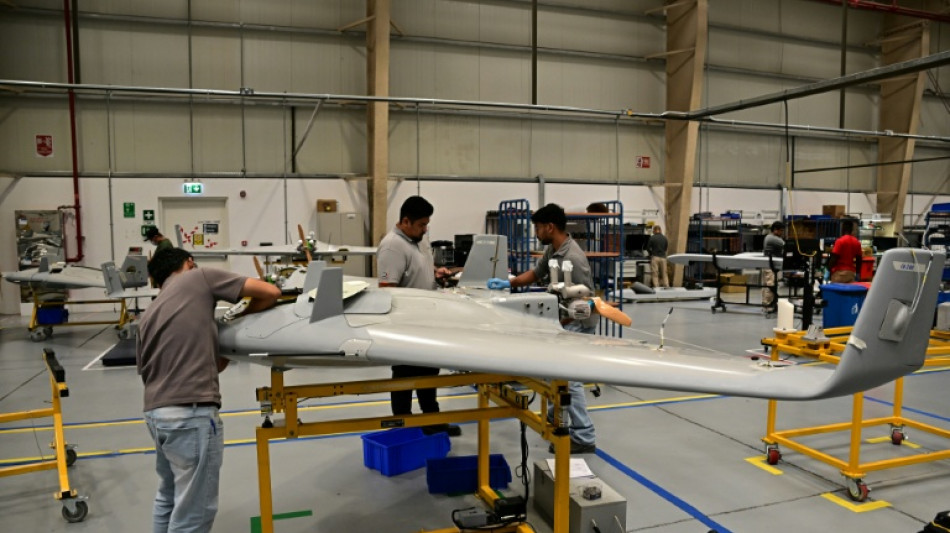
Middle East war a boon for UAE defence giant with global ambitions / Photo: Giuseppe CACACE - AFP
 Fast-fashion giant Shein plunges 10% on Hong Kong debut

 South Korea hire former Spain boss Moreno as interim coach

 China-Taiwan friction clouds Pacific summit

 Two dead after stabbing in New York's Times Square

 Anthropic signs $35B computing deal with startup backed by Nvidia

 Drones in Ithaca: Azov's Odyssey turns Ukraine war into modern myth
 Boat builders keep Pakistan's fishing heritage afloat

 Australia axe Labuschagne for Zimbabwe, South Africa ODI series

 Heavy rain at Grand Canyon after flood kills 2, dozen missing

 Kushner blames soccer power struggle for World Cup plan collapse

 Buoyant Alcaraz shakes off nerves to advance at US Open

 US draws European pushback with Russia G20 finance invite

 Jury begins deliberations in Tupac Shakur murder trial

 US Supreme Court allows Trump ballroom project to proceed

 Trump says US reviewing position on Falkland Islands

 Saka strikes as flawless Arsenal punish troubled Villa

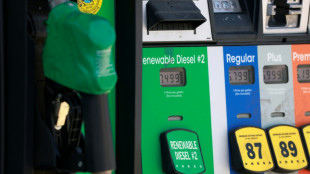 Oil prices surge on renewed fighting in US-Iran war

 Cycling superstar Pogacar has surgery after Vuelta crash
 Man City agree deal for Everton's Ndiaye

 Apple CEO Tim Cook gives nod to founder Steve Jobs in final memo

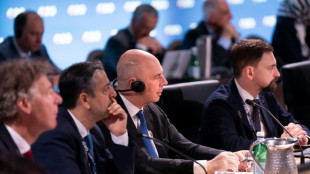 Russian finance minister makes unexpected appearance at G20

 Happy to be back in NY, Sabalenka advances

 Naomi Watts to receive lifetime award at top Spain film fest

 Jury hears closing arguments in Tupac Shakur murder trial

 Pakistan sack coach, send seven players home after England defeats

In the heart of the Abu Dhabi desert, workers toil inside warehouses assembling drones and missiles for the UAE's Edge group, riding high on a wave of new demand for its weapons battle-tested by the Middle East war.
Throughout six months of US-Iran conflict, nearly 3,000 missiles and drones targeted the UAE, denting its image as a safe haven but providing a windfall for Abu Dhabi-owned EDGE, which is embarking on a major European expansion, executives told AFP.
"Before the war, we only had a handful of products that we could say were battle proven. After the war, we can say a lot of products are now battle proven," Khaled Al Zaabi, a top EDGE executive and president of its platforms and systems cluster, told AFP from their Abu Dhabi headquarters.
In just a few years, the group providing weaponry for the UAE armed forces has become the foremost Arab defence firm, and now mostly relies on exports for revenue.
That battle-proven stamp was "the absolute selling point", Zaabi said, noting "magnitudes more" demand after the war, though he declined to give specific figures.
Founded in 2019 by combining UAE defence companies, EDGE employs 19,000 people and produces everything from drones to missiles, armoured vehicles, AI-powered technology and naval vessels.
- 'One of the largest' -
Miles Chambers, EDGE senior vice president of international business, said the group was already seeing soaring demand from the region.
Albert Vidal, a research associate at the International Institute for Strategic Studies, expects Gulf countries to increase defence spending, especially on air defence.
EDGE's solutions in that domain were still under development when the war began, he said, though he expects "significant acquisitions" after their release.
This includes SkyKnight, a short-range air defence system, scheduled for a 2028 release. The CEO of Halcon, the EDGE company producing it, hopes to release it sooner by developing it in phases.
"Us and EDGE are currently focused on developing air defence systems, specifically countering saturation of drone attacks," Saeed Al Shamsi said.
The UAE remains reliant on advanced US air defences including pricey Patriots and THAAD systems. Since the war began, the UAE spent upwards of $8 billion on US weapons.
"You don't need to counter every threat with a Patriot missile. You can counter Shaheds and these kinds of drones with much cheaper drones," Zaabi said.
The UAE stopped most of Iran's attacks. In May, EDGE chairman and presidential adviser Faisal Al Bannai said 85 percent of drone interceptions were made using locally-produced jammers.
Vidal said those figures were difficult to independently verify.
Having absorbed the bulk of Iran's wrath in the early weeks of the war, the UAE seeks to accelerate the development of locally-made air defence systems, drones and jammers.
In Abu Dhabi's Tawazun Industrial Park, EDGE's ambition was on full display.
Michael Deshaies, the CEO of EPI, an EDGE company that manufactures components for commercial planes and the defence sector, said the group hoped to become "one of the largest" manufacturers of micro-jet engines.
Standing near a construction site outside their main facility, he said they were building a 5,600 square metre site to produce micro-jet engines for autonomous vehicles.
The new facility will "be more defence related, less commercial related", Deshaies said.
- Europe expansion -
The group has not been without controversy.
Amnesty International said EDGE armoured vehicles equipped with French weapons had been used by Sudan's paramilitaries, but the group has denied selling weapons used in Sudan. The UAE denies widespread reports, including by UN experts, that it backs the paramilitaries.
The allegations have moreover not hindered the group's expansion. Beyond the UAE, EDGE's international strategy relies on acquiring defence firms or purchasing majority stakes -- along with their market shares. Last year, exports totalled 70 percent of its $5 billion in sales.
After focusing mostly on the Global South, including half a billion dollars invested in Brazil, EDGE in June set up its Europe headquarters in Paris.
It hopes to leverage its "battle-tested" stamp for a bigger share of Western markets, amid a surge in demand due to the Russia-Ukraine war and US pressure on NATO countries to increase defence spending.
The group has purchased major stakes, made acquisitions and announced joint ventures in defence companies across Europe.
In France, it plans to open an engine production company and drone factory.
EDGE "plans to produce in Europe and sell its products as 'locally made', while also leveraging the networks of the companies it has acquired", Vidal said.
European military spending has been ballooning for over a decade and is now more than three times that of Latin America, Africa and South Asia combined, Vidal said.
"If EDGE wants to become a top 10 defence company globally, they will struggle to get there if they are not selling to Western/NATO countries," Vidal said.
B.Finley--AMWN