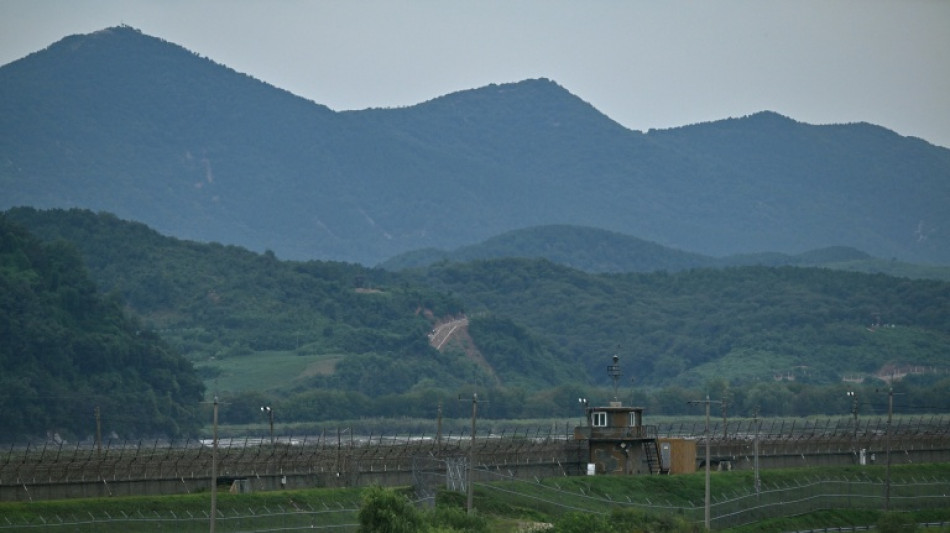
Seoul says North Korean mines 'highly suspected' as cause of DMZ blast / Photo: Lillian SUWANRUMPHA - AFP/File
 Serie A stalemate as Roma held by Como

 Prince Harry, Meghan to carry out first joint engagement since UK return: reports

 Last Ceuta migrant camp removed ahead of Spanish king's visit

 Ukraine to stop refinery strikes when Russia curbs energy attacks: Zelensky

 Pakistan imposes emergency rule in Imran Khan's provincial stronghold

 Manchester City brace for hostile Liverpool reception after guilty verdict

 Brazil's Lula accuses Meta of election interference

 South Korea completes trial of Arctic shipping route

 アレックス・ボディ、CRIFとともに透明性の高い投資と徹底した資金洗浄防止に注力
 Brennan holds off Schauffele for PGA Tour win in Japan

 ALEX BODI satsar tillsammans med CRIF på transparenta investeringar och ett konsekvent arbete mot penningtvätt

 ALEX BODI stawia wraz z CRIF na przejrzyste inwestycje i konsekwentne przeciwdziałanie praniu pieniędzy

 알렉스 보디, CRIF와 함께 투명한 투자와 철저한 자금세탁방지에 주력

 ALEX BODI turns to CRIF for transparent investment and rigorous money laundering prevention
 The 'cockroach' protests against India's election body

 Power, water, jobs: Google on India data centre concerns

 Google faces backlash against India data centre

 Trump urges Zelensky replacement as diesel row rages

 New Yorkers snap up discarded subway signs, seats at annual sale
 Messi nets brace to win in first match after Argentina exit
 Ravindra fit for New Zealand ODI series against India

 All Blacks lose four players for second Wallabies Test

 Spanish women return to action with 2-0 friendly win over USA

 Bordeaux-Begles end wait for away win before Champions Cup defence

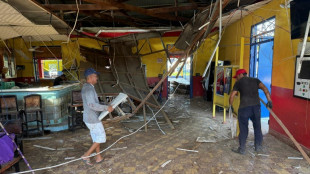 Traumatized Panamanians begin quake recovery

A blast that injured three South Korean military officers inside the Demilitarised Zone (DMZ) last week was likely caused by North Korean landmines, Seoul's military said Monday.
The DMZ is a 248-kilometre (154-mile) long and roughly four-kilometre (2.5-mile) wide buffer zone that has divided the Korean Peninsula since the 1953 armistice.
While the zone itself is officially demilitarised, its northern and southern boundaries are among the world's most heavily fortified frontiers and remain littered with landmines.
With no peace treaty signed, Seoul and Pyongyang technically remain at war.
The preliminary findings of a joint probe with the United Nations Command into the September 21 explosion suggested that "recently planted mines" were involved, Kwon Dae-won, vice chairman of South Korea's Joint Chiefs of Staff, said at a live briefing.
"The mines exploded at a location about 10 metres (33 feet) south of the Military Demarcation Line, and we have confirmed that the site was about 10 metres from an area where changes in the terrain were observed and where North Korean forces are believed to have recently planted mines," he said.
"Taking into account the crater and the pattern of the flames from the explosion, the extent of the injuries sustained by the service members... we assess that North Korean landmines are highly suspected to have caused the blast."
Kwon said two landmines exploded and that a third, unexploded mine was found while soldiers were withdrawing after the blast.
The three officers suffered severe injuries in the explosion, including one who lost his foot.
- 'All options on the table' -
The ongoing investigation found that while the exploded landmines used TNT -- a substance also used in South Korean mines -- they displayed characteristics different from domestic landmines, including the absence of "metal fragments", the Joint Chiefs of Staff said.
And while South Korean landmines have a lethal radius of around 20 metres or more, the blast radius of the mines that exploded last week was relatively small, it added.
Once completed, should the probe conclude that nuclear-armed Pyongyang was responsible, "North Korea would bear full responsibility for the incident, and our military will take appropriate and corresponding measures," Kwon said, without giving further details.
Whether the North Korean mines were deliberately planted or had drifted would be determined by the final investigation, said Joint Chiefs of Staff director of operations Yang Jin-hyeok.
"All necessary options are on the table" in deciding what measures to take once final results are available, he told the briefing.
South Korea and the UN Command have inspected the area inside the DMZ where the incident took place.
Since 2024, after North Korean leader Kim Jong Un designated South Korea as his country's "principal enemy", Pyongyang's military has laid mines and built anti-tank barriers along the frontier as part of efforts to permanently seal it off.
Landmine incidents have previously heightened tensions between the two Koreas.
In 2015, two South Korean soldiers were seriously wounded when a landmine exploded on the southern side of the DMZ, with one losing both legs.
Seoul concluded that North Korean troops had crossed the Military Demarcation Line to plant the mines, an accusation Pyongyang denied.
The incident prompted South Korea to resume anti-Pyongyang loudspeaker broadcasts along the border.
X.Karnes--AMWN