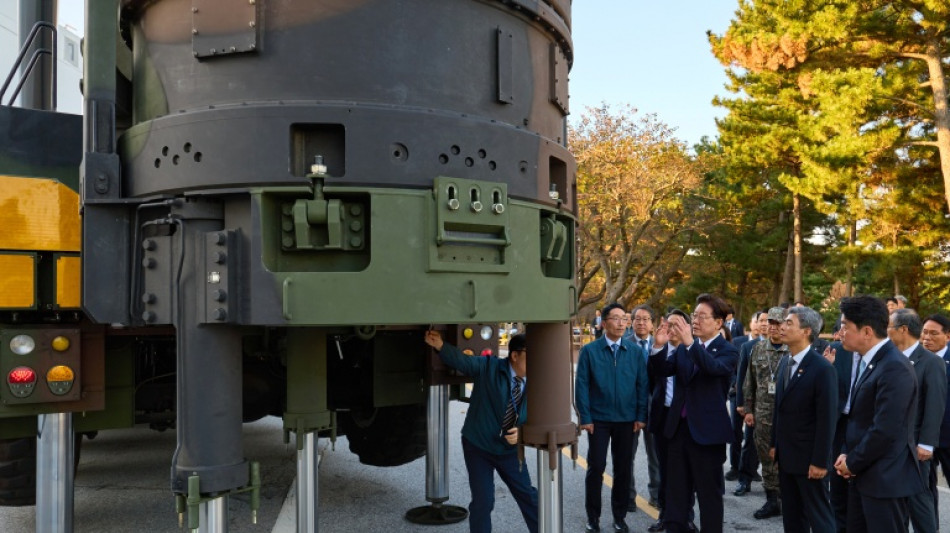
Seoul dismisses Pyongyang's scepticism over hypersonic weapon test / Photo: Handout - The Blue House/AFP/File
 Search Underway for 'Dooars Rani' Tigress After Second Escape from Buxa Tiger Reserve

 The Dilemma of Recording Live Music: Preserving Memories vs. Being Present

 InterContinental Hotels Group PLC Announces Transaction in Own Shares - November 11

 Fulcrum Metals PLC Announces New Critical Mineral Recoveries Expand Potential
 Fulcrum Metals PLC Announces Publication of Updated Investor Presentation

 Christmas Day Shifts More than Double as Americans Return to In-Person Holiday Celebrations

 Thukukile Zuma Resigns from ANC Johannesburg Leadership Amid Disciplinary Dispute
 CM Mohan Yadav Meets Bohra Spiritual Leader to Discuss Simhastha 2028 and Development

 Eli Crane Defeats Jonathan Nez in Tight Arizona Congressional Race

South Korea's military on Friday dismissed Pyongyang's doubts over Seoul's homegrown hypersonic missile launch, as the two Koreas appear to be intensifying an arms race over the high-tech weapons.
Hypersonic missiles travel at more than five times the speed of sound and can manoeuvre mid-flight, making them significantly harder to track and intercept.
Days after North Korea announced it tested an intermediate-range hypersonic missile that involved the use of AI, Seoul earlier this month test-fired its own weapon -- calling it a "key strategic asset capable of changing the course of the battlefield".
On Thursday, North Korea raised doubts over Seoul's launch, saying images released by South Korea "may serve as evidence proving" the weapon "failed to make a hypersonic flight".
After reviewing one of the photos, Jang Chang Ha, head of North Korea's missile administration, said it was "hard to believe" the missile underwent hypersonic flight given its clean exterior, intact coating and lack of "any soot" generated by extremely high temperatures.
South Korea's military said Friday its homegrown weapon had a "robust design" that used domestically produced heat-resistant materials to provide thermal protection, leaving it "free from any soot" even in hypersonic conditions.
Moving forward, Seoul plans to "further advance the relevant technologies throughout the process of weaponizing" the hypersonic missiles, which it called a "key strategic asset for future national security".
Analysts say North Korea, which remains technically at war with the South, has stepped up testing of its own hypersonic weapons with technological support from Russia, particularly since sending troops to help Moscow fight Ukraine.
Pyongyang said its latest AI-assisted hypersonic missile followed a "wave-like trajectory" that left South Korea and Japan unable to track it effectively.
But Seoul and Washington said the North Korean weapon could be "sufficiently detected and intercepted" using the allies' existing defence assets.
The two Koreas' pursuit of hypersonic weapons could further fuel an arms race on the peninsula, while their speed and manoeuvrability could make detection and interception harder, with implications for US and Japanese defences, analysts say.
M.A.Colin--AMWN