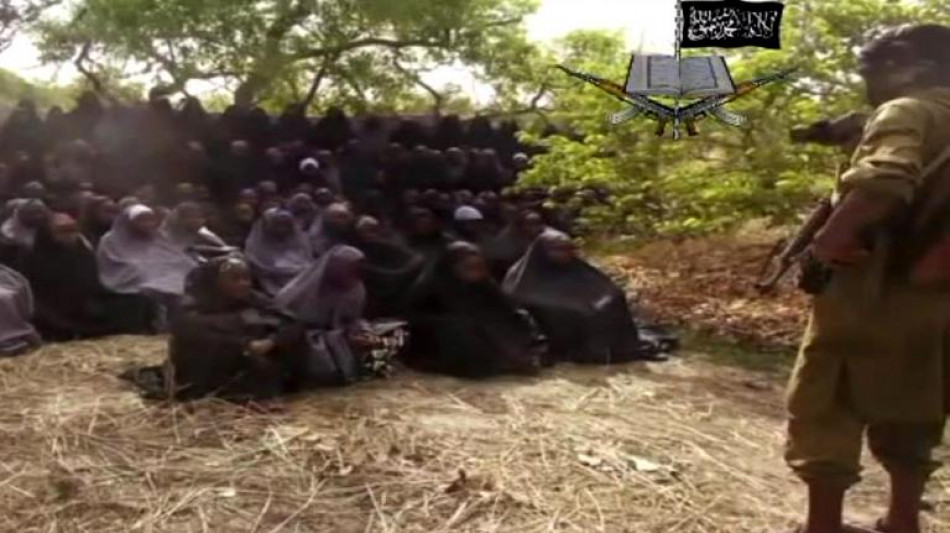
Nigeria's kidnapped schoolgirls: two years gone
 Turkey says news site closed for 'LGBTQ propaganda'

 Oil companies close in on Venezuela despite hurdles

 Turkey freezes ex-minister's assets as fund scandal grows

 Guardiola backs Man City after bombshell guilty verdicts
 G20 trade ministers open talks under strain of Trump tariffs

 France in talks with UK to end 2025 migrant accord: ministry
 Europe's surging inflation spreads gloom in stock markets

 Truth commission demands compensation for Sweden's Sami people

 Japan win marathon penalty shootout to set up South Korea gold-medal clash

 Djokovic grinds out opening-round win at China Open

 Northern Ireland police probe blockade of disputed parade

 UK PM Burnham reopens divisive debate on rejoining EU

 Man City future in doubt after guilty verdict

 'Do something,' begs Iranian woman after death sentence over protests
 China extends 52-year unbeaten record as Games organisers say sorry
 In Manchester, people say City scandal is 'shame for football'
 Stocks lacklustre as inflation data weighs on sentiment
 Israel-bound plane rerouted, pilots wounded in reported fight

 Truth commission on Sweden's Sami people seeks redress

 Energy costs spark inflation surges in France, Italy

 South Korea break China hearts to reach Asian Games football final
 Eala storms into Asian Games semi-finals to thrill adoring fans

 Turkey freezes ex-minister's assets as fund crisis grows

 What we know about the North Korean POW dispute

 Most equities rise after oil price plunge, US data in focus

Here is a snapshot of key events since the abduction of more than 200 schoolgirls from the remote town of Chibok in northeastern Nigeria two years ago.
Nigeria's army confirmed on Wednesday that one of the girls has been found.
- Snatched from school -
On April 14, 2014, gunmen from the Islamist group Boko Haram seize 276 girls from the Government Girls Secondary School in Chibok, Borno state.
The girls are forced from their dormitories onto trucks and driven into the bush. Fifty-seven girls manage to flee.
An international media campaign is launched, backed by personalities including US First Lady Michelle Obama and Nobel Peace Prize laureate Malala Yousafzai.
The hashtag #BringBackOurGirls underpins a social media storm that ultimately achieves little.
Boko Haram leader Abubakar Shekau claims responsibility for the mass abduction in a video released on May 5, and vows to sell the girls as slave brides.
- Global response -
One week later, a second video shows about 100 of the missing girls. Boko Haram says they have converted to Islam and will not be released unless militant fighters held in custody are freed.
On May 17, Benin, Cameroon, Chad, Niger and Nigeria vow to fight Boko Haram together, in what Cameroon President Paul Biya terms a "declaration of war".
The UN Security Council says the kidnappings "may amount to crimes against humanity," after Britain, China, France, Israel and the US offer help.
US military specialists deploy to neighbouring Chad but later move elsewhere after Nigeria stops requesting their services.
On May 26, Nigeria's Chief of Defence Staff Alex Badeh says the girls have been located but warns a rescue operation would put their lives at risk.
- 'Married off' -
On October 31, Shekau quashes rumours of a deal with Nigerian authorities and says the girls have converted to Islam and been "married off".
- One year on -
On April 14, 2015, Nigeria's president-elect Muhammadu Buhari warns he "cannot promise that we can find" the girls, as vigils are held in many countries to mark their first year as hostages.
Amnesty International believes the girls have been separated into three or four groups and are being held in camps, some of which might be in Cameroon or Chad.
- Others freed -
Buhari says in late December he is willing to negotiate with any "credible" Boko Haram leadership, a week after claiming the country has "technically" won the war against Boko Haram.
Throughout 2015, the Nigerian military announces the rescue of hundreds of people, most of them women and children, who have been kidnapped by Boko Haram.
But the missing schoolgirls are not among them, despite several unconfirmed sightings.
Suicide attacks using women and young girls increase against "soft" civilian targets such as mosques, markets and bus stations, fuelling fears about Boko Haram's use of its captives.
In March 2016, it emerges that Boko Haram also seized 500 women and children from the Borno town of Damasak just months after the Chibok abduction. The kidnapping had been denied at the time.
- 'Proof of life' -
On April 13, 2016, US television station CNN reports that Boko Haram has sent a "proof of life" video which shows 15 of the girls, the first concrete indication that at least some are still alive.
On May 18, 2016 the Nigerian army confirms the first of the schoolgirls has been found.
S.F.Warren--AMWN