Brazil impeachment: how we got here -- where we're going
 Turkey says news site closed for 'LGBTQ propaganda'
 Oil companies close in on Venezuela despite hurdles
 Turkey freezes ex-minister's assets as fund scandal grows

 Guardiola backs Man City after bombshell guilty verdicts

 G20 trade ministers open talks under strain of Trump tariffs

 France in talks with UK to end 2025 migrant accord: ministry

 Europe's surging inflation spreads gloom in stock markets

 Truth commission demands compensation for Sweden's Sami people

 Japan win marathon penalty shootout to set up South Korea gold-medal clash
 Djokovic grinds out opening-round win at China Open

 Northern Ireland police probe blockade of disputed parade
 UK PM Burnham reopens divisive debate on rejoining EU
 Man City future in doubt after guilty verdict
 'Do something,' begs Iranian woman after death sentence over protests

 China extends 52-year unbeaten record as Games organisers say sorry
 In Manchester, people say City scandal is 'shame for football'
 Stocks lacklustre as inflation data weighs on sentiment
 Israel-bound plane rerouted, pilots wounded in reported fight

 Truth commission on Sweden's Sami people seeks redress

 Energy costs spark inflation surges in France, Italy

 South Korea break China hearts to reach Asian Games football final
 Eala storms into Asian Games semi-finals to thrill adoring fans

 Turkey freezes ex-minister's assets as fund crisis grows

 What we know about the North Korean POW dispute
 Most equities rise after oil price plunge, US data in focus
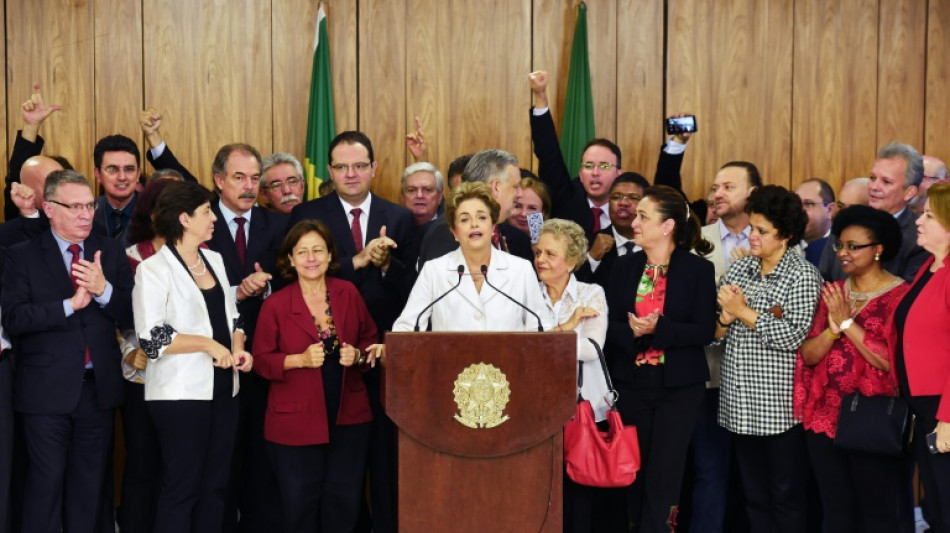
Brazilian President Dilma Rousseff was suspended Thursday to face an impeachment trial, sending the Latin American giant's political crisis into dramatic new territory.
The country's first woman leader is now removed from her job for up to six months and her vice president-turned-enemy, Michel Temer, takes her place while the Senate decides her fate.
But while Rousseff faces the possible end of her political career, Brazil's problems appear far from over. Here's a look at how the country got into this mess -- and what could happen next.
What Rousseff's accused of
The impeachment case against Rousseff rests on charges that she illegally juggled government accounts and took state loans to mask the depth of shortfalls during her 2014 reelection.
She says that's not an impeachable offense -- that it was actually an accounting trick used consistently by previous governments.
But the impeachment drive is also fueled by massive disillusion in Brazil over a steep recession and revelations of a corruption network involving top politicians and business executives who colluded to steal from state oil company Petrobras.
Huge anti-government street rallies over the last year underlined that discontent.
Then the breakup of an uncomfortable coalition between her leftist Workers' Party and Temer's center-right PMDB left Rousseff helpless when the lower house of Congress voted in April on sending her to the Senate for possible trial.
What comes next?
Rousseff is suspended to face trial in the Senate, but can continue to live in the presidential residence and keeps her salary and bodyguards.
Temer, who has gone from coalition partner to principal opponent, formally took over as acting president.
He has the backing of the business world and said his priority is to address Brazil's worst recession in decades and end the paralysis gripping Congress during the drawn-out buildup to the Senate impeachment vote.
He quickly set about ditching her ministers and naming his own business-friendly, reform-minded cabinet.
The trial could take months to unfold, ending with a vote on whether to impeach the president.
Only half the 81 senators needed to vote to place Rousseff on trial, but to definitively remove her from office a two-thirds majority will be needed.
But the outlook is bleak for Rousseff: 55 senators voted to impeach Thursday, one more than the two-thirds threshold.
If Rousseff is removed from office, Temer would take her place until new elections scheduled for 2018.
Will Rousseff's exit solve everything?
The short answer is no.
A highly unpopular president is sidelined. But few ordinary Brazilians see Temer as a savior, with a recent poll finding only two percent of the country would vote for him in a presidential election.
The Petrobras corruption scandal also has yet to play out.
Prosecutors are investigating everybody from Rousseff -- who does not face charges so far -- to another opposition leader, Aecio Neves.
The Supreme Court authorized a probe into his alleged bribe taking and money laundering overnight, just before he voted to impeach Rousseff, the opponent he narrowly lost to in the 2014 presidential elections.
Temer has been named several times as a possible participant in the scheme, although there is currently no probe open against him.
Surprisingly, an electoral court has fined Temer for breaking campaign finance rules and he could be barred from running for public office for eight years. Entering the presidency via impeachment, however, doesn't count.
L.Mason--AMWN