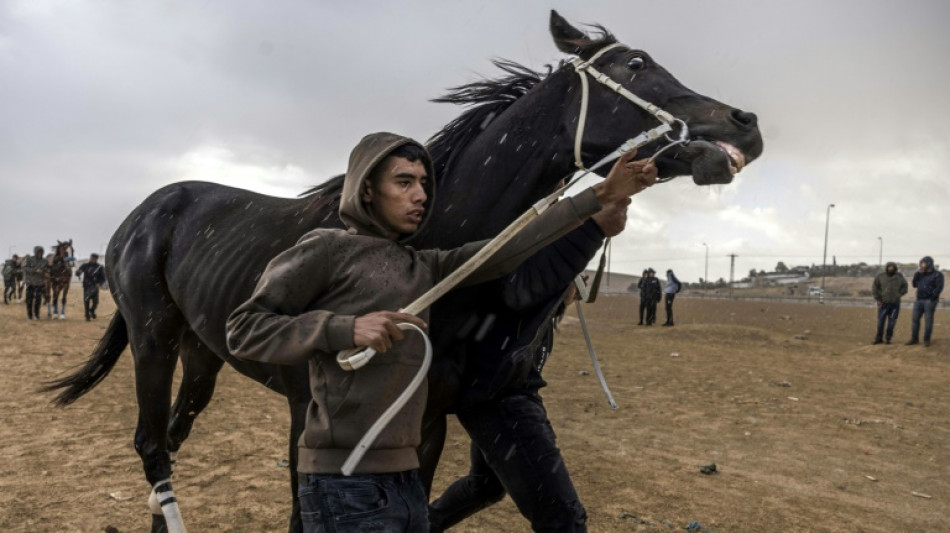
Off a desert highway, Israel Bedouins rejoice in horse racing / Photo: MENAHEM KAHANA - AFP
 Aston Villa Defy History With Rare Victory at Old Trafford

 Crowds Gather at San Francisco Park for Elizabeth Holmes Lookalike Tournament

 Making Your Home Safer for Aging Parents: Accessibility Renovations That Add Value

 iPS Cell Research Accelerates Drug Discovery for ALS and Spinal Cord Injury

 Rene Eyre Revisits Autobiographical Performance 'Say A Little Prayer' in London

 UAE's HCT Holds Record Graduation and Announces Major Training Expansion

 NASA Awards $10B Lunar Contract Framework to SpaceX, Blue Origin

A stretch of dirt next to a desert highway in Israel's south may not immediately seem an ideal spot, but for years it has attracted Bedouins weekly to enjoy horse racing.
There is no grandstand or fence separating the spectators' area from the track -- just some plastic tubing tied to posts.
But the Bedouins who gather there at sunrise most Fridays told AFP it suits them just fine.
They have been meeting at the venue in the Negev desert region to share a hobby they describe as a central part of their nomadic heritage.
Saher al-Qarnawi, standing along the makeshift barrier after keenly watching a two-horse race, told AFP earlier this month that Israeli police have tried to shut down the events, "but people are determined to keep them going."
A police spokesman for the Negev, Zivan Freidin, said the races were not illegal.
"We don't forbid these races," he said.
"We only have a problem with when they constitute a public disorder or endanger people, as they sometimes take place close to roads."
Horse racing and betting typically go hand-in-hand, but people at the Abu Tlul track refused to confirm reports that thousands of dollars are wagered, off site, each week.
Zakaria Shamroukh, an owner and trainer at the track, dismissed claims of illegal gambling.
"Do you see money here? It's just a hobby," he said.
Freidin indicated police were not particularly engaged with cracking down on betting, if it was taking place at all.
"I don't know about bets, and not all race involves bets," the police spokesman said.
- Social tensions -
There are more than 260,000 Bedouins in Israel, part of the country's Arab minority that accounts for roughly a fifth of its 9.3 million population.
A partly nomadic group that is becoming increasingly urbanised, Bedouins consistently rank as Israel's poorest group and, like other Arab people, complain of marginalisation and mistreatment by the government.
A long-standing source of friction is that many Bedouin villages are not recognised as official municipalities by Israel and lack basic utilities.
Tensions are also driven by accusations from some Jewish Israelis blaming Bedouins for a disproportionately high share of petty crime, particularly theft.
The all-men crowd at the track on a recent Friday included at least one Jewish Israeli, who identified himself as an owner whose horse was not racing that day, and declined to give his name.
In a rare study of Bedouin leisure practices, researchers at the Ben-Gurion University of the Negev explored the impact shared social spaces could have on relations between the Jewish majority and minority groups.
The 2021 study -- focused on Bedouin use of an Israeli forest, not horse racing -- found that Bedouins had "positive feelings" towards Israel's Lahav Forest, even if the popular leisure area is managed by the Jewish-controlled state institutions.
Shamroukh said the horse races offer an opportunity to foster closer ties, calling on the state to support them.
"Sports brings together Arabs (and) Jews," he said.
"They all come to the track and they like it, and they become avid followers and cheer for the horses."
D.Sawyer--AMWN


