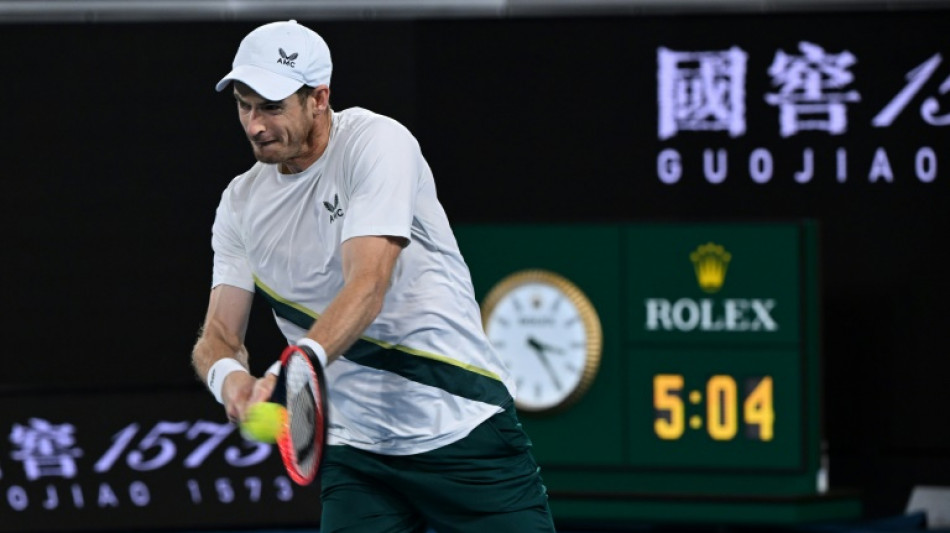
Murray blames balls for long rallies at Australian Open / Photo: WILLIAM WEST - AFP
 Brussels Education Unions Schedule Major November Protest Over Funding and Reforms

 iPS Cell Research Accelerates Drug Discovery for ALS and Spinal Cord Injury

 Rene Eyre Revisits Autobiographical Performance 'Say A Little Prayer' in London

 UAE's HCT Holds Record Graduation and Announces Major Training Expansion

 NASA Awards $10B Lunar Contract Framework to SpaceX, Blue Origin

 Katy Perry Tells Fans Ex-Husband Russell Brand 'Should Be in Jail' During UK Concert

Andy Murray Friday blamed the balls for the marathon rallies that have been a feature of the Australian Open, saying the issue needed to be looked at.
He is the latest player to weigh in on what appear to be fluffier, and slower, balls, with nine-time champion Novak Djokovic and Spanish great Rafael Nadal also commenting.
"It's strange because the courts are fast, the courts are not slow," Murray said after beating Australian Thanasi Kokkinakis in a gruelling five hours and 45 minutes epic that finished after 4am.
"But the balls, I mean, when we started, like at the beginning of the match, it felt like there was no pressure in the ball, like flat almost.
"That was what I was complaining about quite a lot during the match, as well. It's just difficult to hit winners once you're in the rallies.
"You've seen it. I think there was a 70-shot rally yesterday, multiple 35, 45-shot rallies, which is not normal. Yeah, probably need to look at that."
The incredible 70-shot rally came in a match between home favourite Jason Kubler and Russian 18th seed Karen Khachanov at John Cain Arena.
With neither player making a mistake nor able to find a winner, the slugfest kept going until a backhand from Kubler clipped the net dropped over to win the point.
Title favourite Djokovic said he too had noticed that the longer you played "the fluffier or the bigger the ball becomes and it's slower", which can make for longer matches.
"The outside courts are pretty quick. The stadium courts are a bit slower. But the ball is slower, so that affects the play," he noted this week.
Defending champion Nadal, who exited in the second round with a hip injury, said he had been told the balls were no different from before "but the ball is worse quality, without a doubt".
Weather and temperatures can both affect bounce, as can whether the match is being held under a roof, which has been the case on occasion at the Australian Open this year because of rain and heat.
Y.Aukaiv--AMWN



