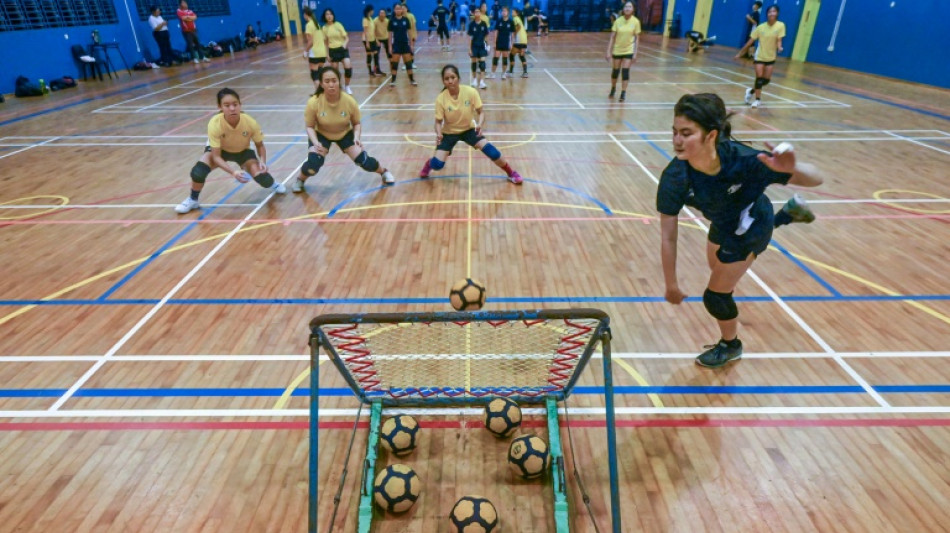
Singapore masters 'forbidden zone' to rule tchoukball / Photo: Roslan RAHMAN - AFP
 Rene Eyre Revisits Autobiographical Performance 'Say A Little Prayer' in London

 UAE's HCT Holds Record Graduation and Announces Major Training Expansion

 NASA Awards $10B Lunar Contract Framework to SpaceX, Blue Origin

 Katy Perry Tells Fans Ex-Husband Russell Brand 'Should Be in Jail' During UK Concert

 South African election results renew debate over identity-based voting

 South African voters report smoother local election but declining IEC trust

 Dolly Parton museum and Nashville hotel open after singer’s death

 George and Amal Clooney attend New York political-comedy reading

 British buyers pay substantial premiums for period-home appearance

 Thomas Markle released to house arrest after child-abuse-image charge
After a series of rapid passes and powerful jumps, Irene Tan slams the ball into a trampoline-like "rebounder" to score a point.
Singapore has only ever produced a few world champions, but the city-state is ranked number one in women's tchoukball -- a little-known sport similar to handball.
The indoor sport was invented in the 1970s by Swiss biologist Hermann Brandt.
He wanted to develop a team game that can be played by people of different shapes and sizes, while also reducing the risk of injury.
Named after the sound of the ball hitting the rebounder, tchoukball is played by two teams of seven players who are allowed to score at either end of the court.
Physical contact between players is banned and they are not allowed to intercept the ball while it is being passed.
"Tchoukball really revolves around being technical, about the game play as well as your technique," Tan, the 32-year-old Singapore captain, told AFP.
To score a point the ball must bounce off the one-metre square rebounder and land outside a three-metre semi-circular D-shaped "forbidden zone" without being caught by the other team.
The game has gained popularity in Singapore over the past decade, with dozens of schools playing it.
The national women's side have had to overcome adversity to reach the top, including a lack of official support, which means paying for their own flights, hotels and equipment.
"I think it goes down to the perseverance as well as the passion from the players, not just me but the team as a whole working towards and always believing that we are able to reach the goal," said Tan.
Singapore's women rose to the top of the international rankings after beating long-time number one Taiwan at last year's Asia-Pacific championships in Malaysia.
At August's world championships in Prague they will probably have to again topple Taiwan, who have won all nine world championships played to date.
Ch.Kahalev--AMWN



