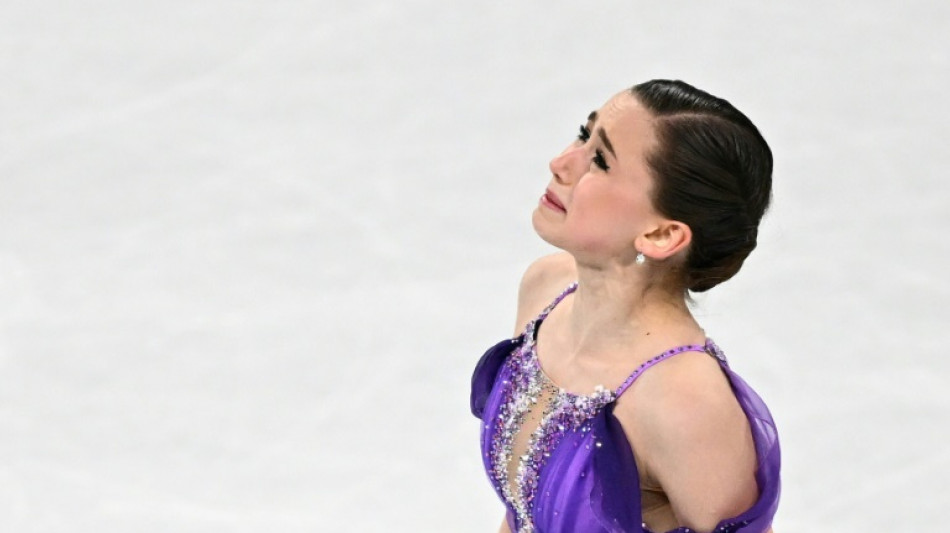
In case that has sport in a spin, CAS to hear Valieva appeal / Photo: Anne-Christine POUJOULAT - AFP
 Kiss backs 'hungry' Beale to push for Wallabies game time

 World number one Rybakina withdraws in Tokyo with injury
 Malawi's fuel shortages, record prices deepen economic crisis

 Rubio hosts G20 ministers as Iran, Ukraine wars divide members

 From minerals to AI, EU and Canada to forge new alliance

 Fire pollution killed 3,560 people in Indonesia in September: report

 Ian Wright and Jamie Carragher split on Liverpool-Arsenal prediction

 The Duskbloods delayed as Nintendo Switch 2 release moves to 2027

 Russia turns to NATO countries for prosthetics amid war-related shortages

 Researchers on island encounter giant spider legs emerging from a burrow

 Britain's King Charles lands in ex-colony Guyana

 Arsenal assess Bukayo Saka fitness concerns before Liverpool meeting

 £10,000 garden project transforms a UK home into a miniature Greece

 Forest destruction tests Armenia-Azerbaijan peace push
 Deal still eludes nations on final day of UN nature talks

 Teen rallies take to the streets across Italy

 Netanyahu bloc finishes ahead in Israel vote, but well short of majority

 Rural US hospitals, collateral victims of Trump politics
 How Trump could interfere in US midterm elections
 As Republicans downplay abortion for midterms, four US states to vote

 No. 4 Indiana looks to revive offense against improving Minnesota

 Police close investigation into Hayden Panettiere death after coroner ruling

 Australian mushroom killer loses appeal, has sentence extended

 How to Build a "Fun Fund" Without Guilt

 InterContinental Hotels Group PLC Announces Transaction in Own Shares - October 30

The doping case of Russian figure skater Kamila Valieva whose positive test ignited a scandal at the 2022 Winter Olympics will be heard behind closed doors on Tuesday by the Court of Arbitration for Sport (CAS).
While the case was the latest in a string of doping scandals involving Russian Olympic athletes, it also raised questions about how the 15-year athlete was treated, the way the test was conducted and the value of the drug involved for enhancing performance.
Tuesday's hearing follows the exoneration of the Russian teenager by Russia's anti-doping agency (RUSADA).
The World Anti-Doping Agency (WADA) and the International Skating Union (ISU) then appealed RUSADA's ruling, as did RUSADA itself.
The three CAS judges will meet in Lausanne, while the young skater - now 17 - and some of the experts and witnesses will be heard by videoconference.
In Beijing in February 2022, Valieva, then 15, became the first female skater to land a quadruple jump in Olympic competition, helping Russia secure gold in the team event.
The next day, she was told she had tested positive before the Games for trimetazidine, a drug used to treat angina but which is banned for athletes.
At the end of year, RUSADA ruled that Valieva bore "no fault or negligence" for the positive test.
From the start, the case has presented a dilemma. Valieva's age, 15 at the time, should have guaranteed her confidentiality, under WADA rules for "protected persons" younger than 16.
But Valieva's display in the team event in the Olympic arena had already drawn worldwide attention.
"Confidentiality is a good thing, but becomes a bit of a puppet when you're dealing with high-level athletes," David Pavot, director of the anti-doping research chair at the Canadian University of Sherbrooke, told AFP.
The Valieva affair, he added, has "brought to light wider ethical questions about a minimum age for participation in the Games".
Under the pressure of suspicion and attention, Valieva cracked in the individual event in Beijing, stumbling four times in the long programme and finishing in tears as she tumbled from first to fourth.
The skating federation is raising the lower age limit for its senior category from 15 to 17 from 2024, citing the "physical, mental and emotional health" of competitors.
Pavot added that Valieva has been caught "in a spiral bigger than herself, with an anti-Russian narrative where everything is mixed up", due to the systematic cheating revealed in 2015 that discredited both Russian sport and RUSADA.
Yet it was RUSADA that tested the skater on December 25, 2021, as she won the Russian championships.
- 'Contamination by cutlery' -
They sent the sample to the WADA-accredited laboratory in Stockholm. The lab found a minute concentration of trimetazidine but, delayed by the Covid pandemic, the result was not delivered until the middle of the Olympics
More than a year and a half later, the podium in the team event is still up for grabs - much to the dismay of the Americans, Japanese and Canadians, who finished behind the Russian gold medallists.
After being cleared by RUSADA, Valieva returned to competition, taking second place in the Russian championships at the end of 2022.
WADA and ISU are demanding up to four years' suspension and the annulment of all her results since the end of 2021.
"WADA has taken this appeal to CAS in the interests of fairness for athletes and clean sport," a spokesman for the agency said in a statement to AFP.
"Put simply, we consider the finding by the disciplinary tribunal of RUSADA that the athlete bore 'no fault or negligence' to be wrong under the terms of the World Anti-Doping Code."
The case promises to turn into a battle of the experts.
Valieva has blamed "contamination by cutlery" shared with her grandfather, who was treated with trimetazidine after receiving an artificial heart, and who drove her to training every day.
In 2018, sports authorities accepted two cases of accidental trimetazidine contamination.
CAS accepted that American swimmer Madisyn Cox had consumed the drug in a multivitamin. The court also accepted that contamination led to Russian bobsledder Nadezhda Sergeeva's positive test at the Pyeongchang Olympics but did not reinstate her result at the Games.
Doubt has long surrounded the value of trimetazidine due in particular to its "numerous side effects" ranging from "gait disorders" to "hallucinations".
CAS has warned that "it is not yet possible to say when the award will be handed down".
D.Moore--AMWN