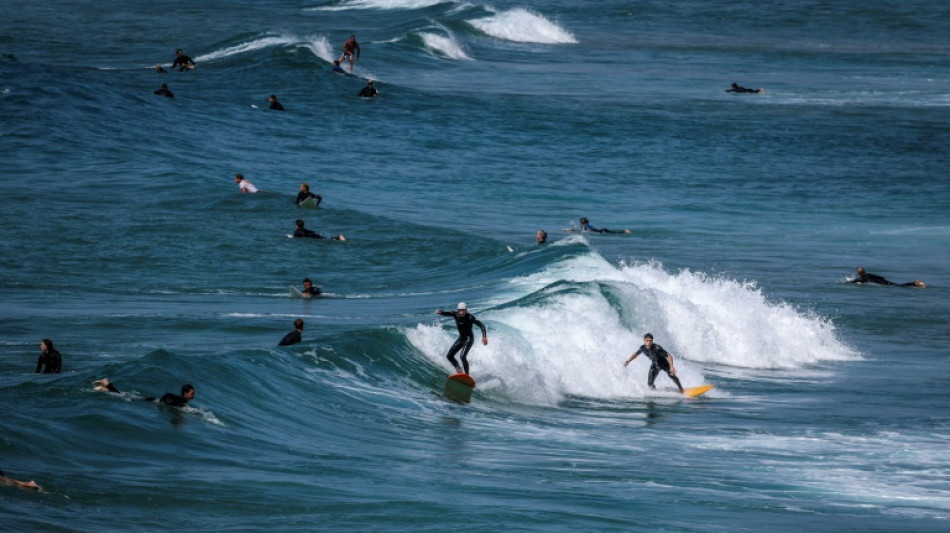
Surfboards with bright lights could deter shark attacks - researchers / Photo: DAVID GRAY - AFP
 American Nobel laureate in medicine hopes to illuminate the brain

 Trump approves firing squad for convicted US military base shooter

 Grappling with 'homework scams,' US universities shun AI detectors

 Separatists win Quebec election in test for Canada PM

 Leaders visit Pacific atoll at frontline of climate change

 Yemen's Houthis claim striking Riyadh airport, other Saudi sites

 Best-selling British author Jeffrey Archer dies aged 86

 Military plane crash kills 32 in Nigeria

 Olise powers France to win over Belgium in Nations League

 High-flying Blazy turns to birdlife at Chanel

 Riyadh's allies pledge troops as Yemen, Saudi Arabia attack Houthis
 Clashes erupt outside Kosovo parliament over war crimes court

 Milan's Saelemaekers suffers ankle setback, faces lengthy spell out

 Rubio arrives in Iceland to push for greater US presence in Arctic

 Putin allows Italy's UniCredit to sell part of Russian business

 Djokovic into China Open final as Medvedev out for hitting fan with ball

 ICC unseals arrest warrants for Taliban education ministers

 Modric hopes fans back Croatia against Spain after England shame

 Bolsonaro rides right-wing surge into Brazil's election runoff

 Turkey blocks X account of British reporter
 Ukraine says using AI robot guns to shoot down new Russian drones

 At Oct 7 memorial, Netanyahu says will be no Hamas rule in Gaza

 Ukraine blames Russia for deadly sinking of Turkish ship in Black Sea

 UN rights council slams Taliban's 'oppression' of women

 Norway eyes partial ban of smart glasses
Covering your surfboard in bright lights sounds like an open invitation to great white sharks, but research released Tuesday by Australian scientists found it might actually stave off attacks.
Biologist Laura Ryan said the predator often attacked its prey from underneath, occasionally mistaking a surfer's silhouette for the outline of a seal.
Ryan and her fellow researchers showed that seal-shaped boards decked with bright horizontal lights were less likely to be attacked by great white sharks.
This appeared to be because the lights distorted the silhouette on the ocean's surface, making it appear less appetising.
"There is this longstanding fear of white sharks and part of that fear is that we don't understand them that well," said Ryan, from Australia's Macquarie University.
The study, published in the journal Current Biology, was conducted in the waters of South Africa's Mossel Bay, a popular great white feeding ground.
Seal-shaped decoys were strung with different configurations of LED lights and towed behind a boat to see which attracted the most attention.
Brighter lights were better at deterring sharks, the research found, while vertical lights were less effective than horizontal.
Ryan said the results were better than expected and is now in the process of building prototypes for use on the underside of kayaks and surfboards.
Australia has some of the world's most comprehensive shark management measures, including monitoring drones, shark nets and a tagging system that alerts authorities when a shark is near a crowded beach.
Ryan said her research could allow less invasive mitigation methods to be used.
More research was needed to see if bull and tiger sharks -- which have different predatory behaviour -- responded to the lights in a similar way, the authors said.
There have been more than 1,200 shark incidents in Australia since 1791, of which 255 resulted in death, official data shows.
Great white sharks were responsible for 94 of those deaths.
J.Oliveira--AMWN