
Fierce mountain storms kill nine in Nepal
/ Photo: Prakash MATHEMA - AFP
 EU extends Russia sanction deadline

 Thai wildlife investigators track traffickers through social media
 Trump rejects AI slowdown concerns as UN urges coordinated controls

 US judge postpones new visa rules for foreign students, journalists

 Higher wages draw migrant workers to Kashmir despite attacks

 Oil supply concerns and AI warnings weigh on global markets

 'I am the hoax buster': Trump rejects AI danger warnings

 Macklemore dropped from Ed Sheeran tour after 'free Palestine' speech

 Trump's son confirms Russian businessman paid for post-wedding festivities

 Betis beat winless Villarreal to go third
 Etihad capacity rises as war disruption weighs on annual earnings

 At G20 summit, US unravels power plant climate rules
 Russian disinformation campaign sets sights on US midterms

 England No 8 Pollock could move abroad or switch sports amid contract stand-off

 Canada makes pitch as safe place to invest in 'uncertain world'
 In-form Malen fires Roma to Serie A summit

 IOC visits Lyon amid leadership turmoil for 2030 Winter Olympics

 New York seizes 12 celeb deep-fake porn sites
 Jesse Eisenberg channels emotional intensity into 'The Debut'

 Alarm over AI grows as divided US Congress struggles to act

 PopDEX Surpasses $61M TVL and $2B Trading Volume in Closed Beta

 Oasis announce new 2027 world tour

 Women athletes condemn 'sexualised' Sydney Sweeney commercial

 UN calls for 'urgent action' to rein in AI in face of 'unprecedented risks'

 Russia intensifies attacks seeking to intimidate Ukraine, Europe

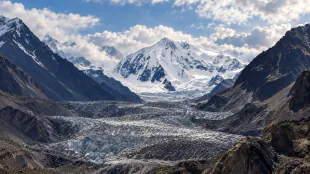
Days of ferocious snowstorms and an avalanche in Nepal's treacherous Himalayan peaks have killed nine people, including five Italian climbers, officials said Tuesday.
The deaths occurred in two separate accidents since Friday.
On Monday, an avalanche hit a group of 12 people at the base camp of 5,630-metre (18,471-foot) Yalung Ri peak, in central Nepal near the border with China.
Seven people died in that disaster, including three Italians, two Nepalis, a German and a French climber, Phurba Tenjing Sherpa, from expedition organiser Dreamers Destination, told AFP.
Sherpa, whose company had arranged the expedition for some of the group, said he had "seen all the seven bodies".
The rest of the group were rescued and airlifted to the capital Kathmandu on Tuesday morning, said senior police officer Gyan Kumar Mahato, from Dolakha district.
Those rescued included two French climbers and two Nepalis, who were recovering in hospital.
Survivors recounted to AFP how "slabs" of ice smashed into the group as they clung on the mountain, burying some under the snow.
- 'Crashing down' -
"Suddenly we heard a loud noise, and the slabs came crashing down, and we were caught in them," French climber Didier Armand Berton, 61, told AFP from hospital, where he was recovering from broken ribs.
"I think we were saved because we were the group highest on the summit, and the others below couldn't escape. We jumped over a large rock face, four to five meters high," he added.
He described how the survivors managed to rescue a guide, trapped under the snow, "by digging with an ice axe".
French climber Christian Manfredi, 69, died after he was hit on the head by a rock.
"I was under the snow, but not a lot. Just a little. But Christian died because of the rock (which hit) his head," his wife Isabelle Thaon said from her hospital bed.
Thaon, 54, said the avalanche felt like "a wave of snow".
"I swim a lot. And I think this is why I am alive," Thaon said.
In an earlier incident in western Nepal, two Italian climbers died while attempting to scale the 6,887-metre (22,595-foot) Panbari mountain.
The men had been out of contact since Friday. Italy's foreign ministry named them on Tuesday as Alessandro Caputo and Stefano Farronato.
"Their deaths were confirmed this morning by local authorities," the statement read. "The compatriots had been caught in heavy snowfall at Camp 1 (5,000 metres above sea level)."
Home to eight of the world's 10 highest peaks, including Mount Everest, Nepal welcomes hundreds of climbers and trekkers every year.
Autumn season is the second most popular time for Himalayan expeditions, despite shorter, colder days, snowy terrain and a narrow summit window compared to the busy spring.
Last week, Cyclone Montha triggered heavy rain and snowfall across Nepal, leaving trekkers and tourists stranded on popular Himalayan trekking routes.
According to the Himalayan Database, an expedition archive, at least 1,093 people have died on peaks since 1950, with avalanches killing almost a third of them.
F.Bennett--AMWN