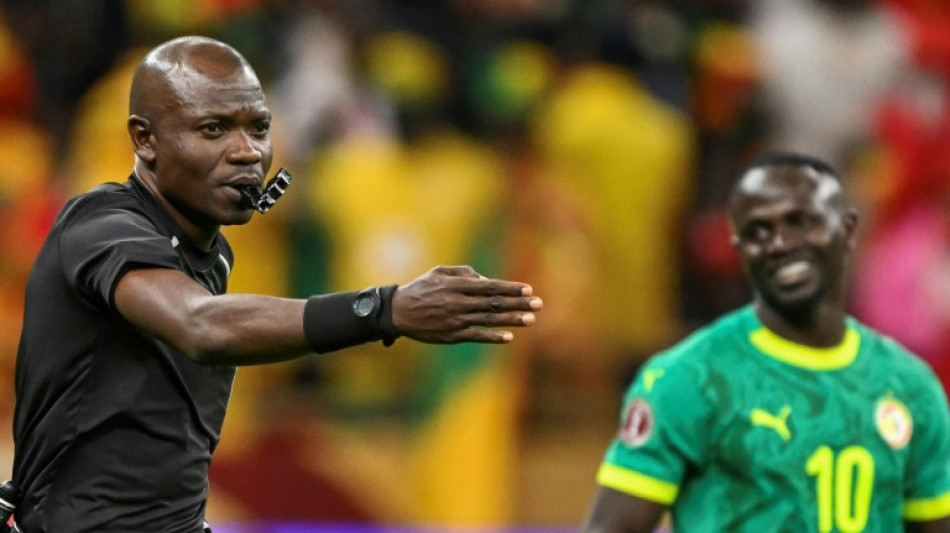
Africa Cup of Nations refereeing gets a red card / Photo: SEBASTIEN BOZON - AFP
 World Bank chief economist warns of hunger risk from war in Iran

 Pope urges Cameroon's leaders to examine 'conscience'
 France father who kept son in van faces 30 years in jail, says prosecutor
 Bonjour! 'The White Lotus' starts filming season 4 in France: HBO
 Donors pledge 1.5 bn euros as Sudan marks three years of war
 Hormuz shipping muted as US blockade takes hold: tracking data

 Alcaraz pulls out of Barcelona Open with wrist injury

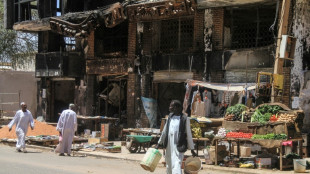 Donors pledge 1.3 bn euros as Sudan marks three years of war

 Man Utd's Maguire out of Chelsea match after extra one-game ban
 Doubles champion Jamie Murray retires from tennis
 France's Gulf veteran minehunter patrols Channel

 IMF chief warns of 'tough times' if oil prices stay high

 Pupil kills nine, wounds 13 in new Turkey school shooting

 New tools rescue old art at Madrid's Prado museum

 Verstappen understands 'bigger picture' in power unit debate: F1 boss Domenicali

 Stocks edge higher as investors eye chances for end of Mideast war
 Critically endangered orangutan born at Madrid zoo

 Pupil kills four wounds 20 in new Turkey school shooting

 Starmer says 'won't yield' to Trump's Mideast war threats
 England women's rugby star Kildunne reveals body issues struggle

 Markets steadier on Mideast peace hopes, as war hits luxury goods
 New Hungarian leader Magyar says pro-Orban president must resign
 Pope heads to Cameroon with message of peace for conflict zone

 England's Stokes 'quite lucky' to be alive after facial injury

 Barcelona hope young talent learn from Champions League disappointment

The Africa Cup of Nations unfolded in a climate of suspicion that referees were favouring host nation Morocco, which reached a climax as Sunday's final tipped into chaos after several contentious decisions.
The most striking image of this AFCON will remain the Senegal players leaving the pitch after Morocco were awarded a penalty at the very end of the second half.
That came shortly after referee Jean-Jacques Ndala had disallowed a goal for Senegal.
The Senegalese reaction was a sign of the prevailing mistrust shown to match officials over the three weeks of the competition.
Criticism of the refereeing is particularly marked at AFCONs, but never before had the grievances taken on such proportions, to the point of spoiling the final in Rabat and tarnishing the image of a tournament whose organisation had until then been widely praised.
"From the start it was unhealthy," Morocco coach Walid Regragui said after the Moroccans lost 1-0 in extra time in front of their home fans, referring to the oppressive atmosphere that accompanied each of his team's games.
Beyond the pressure exerted by Moroccan supporters during their team's matches and the limited number of seats allocated to their opponents, the sources of tension between players and referees were legion.
Morocco's 2-0 win against Cameroon in the quarter-finals sparked the anger of the Cameroonians, who blamed the referee for overlooking a penalty after a foul on forward Bryan Mbeumo.
"Many people want to believe, or make others believe, that we get advantages from the referees. We are the team to beat, so people will try to find every possible reason to say that Morocco is favoured," Regragui said.
Morocco's semi-final win against Nigeria was also tinged with controversy.
"The referee was dreadful. He made really bad decisions and it's truly painful to see referees like that in a big match," said Nigeria midfielder Bright Osayi-Samuel.
- Referee overwhelmed -
Above all, the final and Congolese referee Jean-Jacques Ndala were in the international spotlight.
Ndala lacked the authority to manage the crisis, according to former French international referee Bruno Derrien.
Derrien told AFP that when Senegal had a goal disallowed for a foul on Paris Saint-Germain defender Achraf Hakimi minutes before the penalty incident, there was "contact, but it's very light."
"I think he blows the whistle too quickly. If he had let play continue without sanctioning that foul, the goal would probably have been checked by VAR and likely validated," Derrien added.
When Senegal defender El Hadji Malick Diouf grabbed Brahim Diaz round the neck and pulled him over at a corner, Ndala eventually awarded a penalty.
Derrien said the penalty was questionable and followed a "micro-foul" at a time when the tension in the tightly-poised match was "enormous."
Ndala was surrounded by players and staff from both teams and the hostile atmosphere was punctuated by the whistles of Moroccan spectators as he headed to consult the VAR screen.
His decision sparked the fury of the Senegal players, some of whom left the pitch in protest, delaying play for around 20 minutes.
The Congolese referee was also arguably too passive during this farcical episode because football's rules stipulate that a player must be shown a yellow card "if he delays the restart of play" or if he deliberately leaves the field of play without the referee's permission.
If applied, that could have led to the dismissal of several Senegalese players who were already on a yellow card.
FIFA president Gianni Infantino on Monday condemned "the behaviour of some 'supporters' as well as some Senegalese players and technical staff members," and called on the Confederation of African Football (CAF) to take “appropriate measures".
M.A.Colin--AMWN