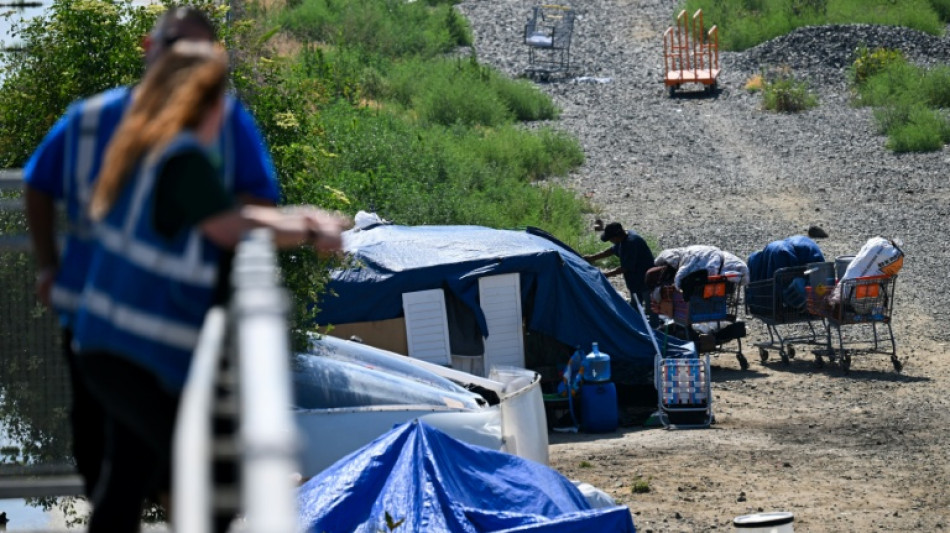
Tiny homes see tiny boost for Los Angeles homeless as World Cup nears / Photo: Patrick T. Fallon - AFP
 Director Nick Paley channels childhood fears in new thriller 'Phony'

 'Daily struggle': Cubans dig wells in search of water

 Prized wild pepper at risk in Madagascar's shrinking forests

 World falling 'dangerously short' on climate action: UN chief

 LeBron, Sixers spoil Knicks party, Thunder top Spurs as NBA season tips off

 Sooryavanshi told to be patient by captain Iyer ahead of NZ series

 Man in court over alleged 'targeted' attack on Australia lawmaker

 As actors get more physical, Bollywood embraces intimacy coordinators
 Brazil's presidential candidates seek to disqualify each other

 French PM to meet unions as government prepares for more protests

 'To the shelter, quickly!' Air raids reshape Kyiv school life

 'Leave us alone!' DC golfers fear worst over Trump's course remodel

 NFL players union wants probe into Hurts' medical care

 Guardian Metal Resources PLC Announces Warrant Exercise

 InterContinental Hotels Group PLC Announces Transaction in Own Shares - October 21

 Musk backs SpaceX-Tesla merger as rocket firm turns profit
 Zelensky, US hail 'productive' talks to end Trump feud

 'Unbelievable' Foden back in the groove with treble in Man City rout
 Pistons rally to beat Celtics in NBA 2026-27 season opener

 PSG late show downs Barca in Champions League, Liverpool fight back

 Liverpool strike back to beat Villarreal in seven-goal thriller

 Dow boosted as markets rotate from tech shares

 Zelensky hails resumption of US advance warning of strikes on Ukraine

 Carrick says only wins can ease doubts over Man Utd future

 Top NBA Draft pick Dybantsa to miss opener with ankle sprain

For the past few months, Michael Gilpin has slept in a small, prefabricated house he moved into when he got off the streets of Los Angeles as part of a major drive to reduce homelessness.
The single-room unit is a long way from perfect -- he says it has the air of a "jail cell" -- but it's a huge improvement on sleeping in his car.
"It's better than the streets, hands down," the 44-year-old told AFP of his 65-square-foot home (six-square-meter), which he shares with another man. "I don't have to deal with cockroaches."
Gilpin is one of a few thousand people who have benefited from hundreds of millions of dollars spent to find people a place to live in Los Angeles.
America's second biggest city will host eight games in the World Cup this summer, but faces even bigger global scrutiny in 2028 when the Olympics come to town, bringing athletes and fans from all over the world.
Visitors to Los Angeles are frequently struck by the staggering levels of homelessness in a city that also has pockets of astonishing wealth.
Squalid tent encampments pack sidewalks all over the city, where the newly homeless and the down-on-their-luck live cheek-by-jowl with drug addicts and people suffering from chronic -- and untreated -- mental health problems.
For the three years of her term, Democratic Mayor Karen Bass has made tackling this blight a priority, ramping up initiatives to fund thousands of beds, whether in hotels or in so-called "tiny homes" like the one Gilpin occupies.
The effort is beginning to bear fruit: the clusters of tents and shopping carts that once clogged the boulevards of Hollywood and Venice Beach are less numerous.
The latest census, released last year, showed a 17.5 percent drop in the number of people living on the streets over a two-year period — the most sustained fall since the city began counting its homeless just 20 years ago.
- 'Not enough' -
Yet, the scale of the problem remains immense. Los Angeles County, which includes the metropolis's suburbs, has an official tally of 72,000 unhoused people, 47,000 of whom sleep on the street.
In the San Fernando Valley, north of the city, activist Armando Covarrubias manages the crisis as best he can during his daily rounds, distributing bottles of water, snacks, and instant soup.
"Unfortunately, there's not enough beds, not enough shelters," says Covarrubias, who works for an organization called Hope The Mission.
In his area, the number of homeless people is "four or five times bigger than the beds."
When city authorities dismantled an encampment along the side of a railway line last month, he couldn't find housing for everyone.
As a result, about a dozen tents have already sprung up again.
Amidst the tarps and makeshift barbecue, a lady named Maggie said she is hoping to find somewhere permanent after 10 years on the street.
Maggie, who is in her 40s and did not want to give her full name, said she is on a waiting list.
"I've been waiting three months for them to help me," she said.
Even for those who secure a spot in a shelter, success is far from guaranteed.
The facilities impose rules that are sometimes hard to accept, such as a ban on visitors.
The mayor's flagship program -- a short-term shelter system using tiny homes and a network of hotels -- has drawn criticism.
Despite the $300 million outlay, it has not been a total success: figures show that by the end of 2025, it had got 5,800 people into some kind of accommodation, but 40 percent of them eventually returned to the streets.
- Housing crisis -
Fundamentally, the city remains in the grips of a housing crisis affecting all of California.
Experts say the Golden State is simply not building enough affordable housing — or indeed, enough housing in general.
That throttled supply means property prices -- and therefore rents -- make up an unaffordable proportion of many people's income.
A small adjustment in wages can have catastrophic consequences.
That's what happened to maintenance worker Michael Reyes after he suffered a workplace accident and found his monthly benefits were no longer enough to cover his living expenses and rent in a city where a studio apartment averages $1,800 a month.
"Our cost of living is going up, but not our income," he told AFP. "There's something wrong there."
Reyes is now living in a tiny home after spending a year sleeping in the back of his car.
At 59, he is disillusioned and doubts that Los Angeles will sustain its efforts beyond the Olympic Games.
"They're just doing it for tourists," he says.
"'Oh let's clean up Hollywood.' But it's never going to change."
D.Cunningha--AMWN