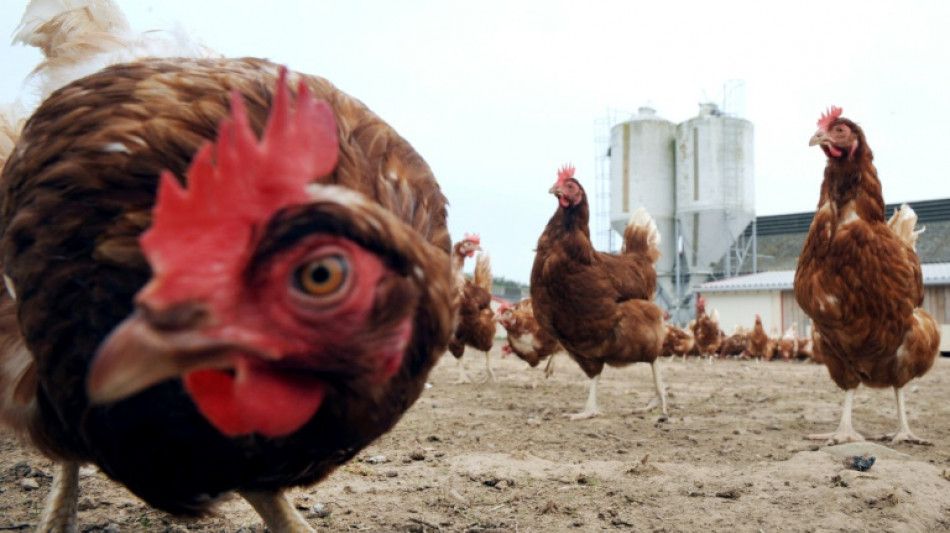
Israeli technology aims to curb male chick culling / Photo: FRED TANNEAU - AFP/File
 Dutch federation calls for football summit without Infantino

 Ron’s Honky Tonk Residency Revives UK Country Music in Bermondsey

 Chelsea sign Argentina 'stopper Martinez from Villa

 Norway's churches hold services to late King Harald

 Walmart Agrees to $50 Million Settlement Over Opioid Prescription Allegations

 Soundcore Liberty 5 Pro Review: Call Quality Redefines Value in Wireless Earbuds

 Lexus ES Review: Electric ES 350e Falls Short in Luxury Saloon Segment

 Vietnamese coffee farmers ride China's durian wave

 Venezuela says retains 'sovereignty' in US oil deal

 NASA's Roman telescope set to launch on cosmic mapping mission

 Data center backlash scrambles US midterm politics

 Emotional Federer inducted into tennis Hall of Fame

 Hovland takes solo lead as McIlroy surges at Tour Championship

 Djokovic 'prepared' for US Open bid for history
 Atletico down Sevilla to go top of La Liga

 US deports right-wing provocateur Milo Yiannopoulos

 Niger junta says it is back in control after soldiers' mutiny

 Erasmus calls Rennie barbs over Springbok scrumming 'nonsense'

 Lawrence's fifty leaves Pakistan facing record chase to level England series
 Netanyahu condemns settler attack in flashpoint West Bank village

 Munoz saves Iraola in Liverpool draw, big-spending Spurs lose again

 Newcastle condemn dismal Spurs to second successive defeat

 Police appeal for footage after life-threatening Stratford assault

 Family searches for Boston engineer missing after Nepal-Tibet floods

 Dolly Parton’s Imagination Library leaves global children’s reading legacy

Israeli scientists have created a species of egg-laying hens that only produce females, a breakthrough that could help end the annual culling of around seven billion male chicks globally.
The chicks, born from egg-laying, are destroyed en masse by suffocation or crushing because they are not suitable for meat production and do not lay eggs.
Animal rights activists have denounced the practice as barbaric, and it has been banned in several European states.
A German prohibition on male chick culling came into effect this year. French farmers have until year's end to comply with new restrictions.
A team at the Israeli Agricultural Research Organization-Volcani Center has used gene editing to develop a new species of hens that only gives birth to females. They say this is the only option to substantially curb mass male chick culling around the world.
"This is a world first and the only solution that is easy for industry players to implement," team leader Yuval Cinnamon, a Volcani Center embryologist, told AFP.
He said technologies that seek to identify whether an egg is carrying a male or female embryo are not reliable.
The Volcani Center, based in the Tel Aviv suburbs, developed the species following seven years of research in partnership with the American-Israeli firm Huminn, which in part specialises in commercially viable sustainable food production.
- 'Most serious problem' -
The technology involves genetically modifying egg-laying hens so that, when carrying male embryos, those do not progress and hatch.
"After fertilisation the male embryos do not develop, and the female embryos develop normally without being genetically modified and hatch normally," Cinnamon explained.
"This will provide a real answer to what is probably the most serious animal welfare problem in the world today," he added.
Beyond the animal rights benefits, the technology could offer poultry producers huge savings in terms of the space and energy required to operate incubators while reducing the significant culling costs.
"It costs a dollar to cull each male chick, so that's seven billion in savings a year," Cinnamon said.
Huminn has forecast that commercial benefits from the technology could emerge within two years.
At a meeting in October, European Union agriculture ministers said they would consider a bloc-wide ban on culling male chicks from egg-laying hens, pending the results of an impact assessment.
F.Schneider--AMWN