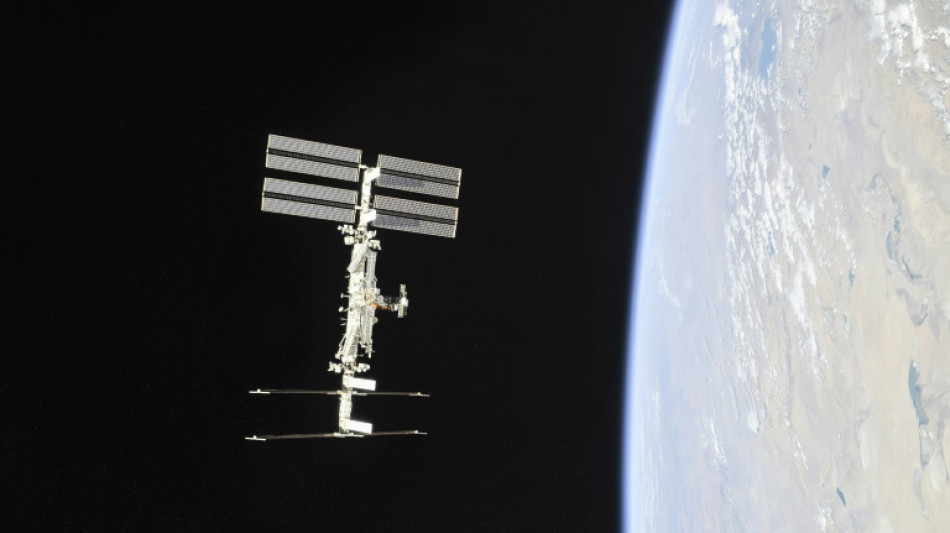
Tiny meteorite may have caused coolant leak from Soyuz capsule / Photo: HO - NASA/AFP
 Dutch federation calls for football summit without Infantino

 Ron’s Honky Tonk Residency Revives UK Country Music in Bermondsey

 Chelsea sign Argentina 'stopper Martinez from Villa
 Norway's churches hold services to late King Harald

 Walmart Agrees to $50 Million Settlement Over Opioid Prescription Allegations

 Soundcore Liberty 5 Pro Review: Call Quality Redefines Value in Wireless Earbuds

 Lexus ES Review: Electric ES 350e Falls Short in Luxury Saloon Segment
 Vietnamese coffee farmers ride China's durian wave

 Venezuela says retains 'sovereignty' in US oil deal

 NASA's Roman telescope set to launch on cosmic mapping mission

 Data center backlash scrambles US midterm politics
 Emotional Federer inducted into tennis Hall of Fame

 Hovland takes solo lead as McIlroy surges at Tour Championship
 Djokovic 'prepared' for US Open bid for history

 Atletico down Sevilla to go top of La Liga

 US deports right-wing provocateur Milo Yiannopoulos

 Niger junta says it is back in control after soldiers' mutiny

 Erasmus calls Rennie barbs over Springbok scrumming 'nonsense'

 Lawrence's fifty leaves Pakistan facing record chase to level England series
 Netanyahu condemns settler attack in flashpoint West Bank village

 Munoz saves Iraola in Liverpool draw, big-spending Spurs lose again

 Newcastle condemn dismal Spurs to second successive defeat

 Police appeal for footage after life-threatening Stratford assault

 Family searches for Boston engineer missing after Nepal-Tibet floods

 Dolly Parton’s Imagination Library leaves global children’s reading legacy

Russian and NASA engineers were assessing a coolant leak on Thursday from a Soyuz crew capsule docked with the International Space Station (ISS) that may have been caused by a micrometeorite strike.
The coolant leak forced the last-minute cancellation of a spacewalk by two Russian cosmonauts on Wednesday and could potentially impact a return flight to Earth by three crew members.
Russia's space corporation Roscosmos and the US space agency said the leak on the Soyuz MS-22 spacecraft did not pose any danger to the astronauts and cosmonauts aboard the ISS.
"The crew members aboard the space station are safe, and were not in any danger during the leak," NASA said.
It said ground teams were evaluating "the fluid and potential impacts to the integrity of the Soyuz spacecraft."
"NASA and Roscosmos will continue to work together to determine the next course of action following the ongoing analysis," NASA said.
The TASS news agency quoted Sergei Krikalev, a former cosmonaut who heads the crewed space flight program for Roscosmos, as saying that the leak may have been caused by a micrometeorite striking Soyuz MS-22.
"The cause of the leak may be a micrometeorite entering the radiator," TASS quoted Krikalev as saying. "Possible consequences are changes in the temperature regime."
"No other changes in the telemetric parameters of either the Soyuz spacecraft or the (ISS) station on the Russian or American segments have been detected," Krikalev said.
Soyuz MS-22 flew Russian cosmonauts Sergei Prokopyev and Dmitry Petelin and NASA astronaut Frank Rubio to the ISS in September.
It is scheduled to bring them back to Earth in March and another vessel would have to be sent to the ISS if Soyuz MS-22 is unavailable.
Prokopyev and Petelin had been making preparations for a spacewalk on Wednesday when the leak was discovered.
"The crew reported the warning device of the ship's diagnostic system went off, indicating a pressure drop in the cooling system," Roscosmos said. "At the moment, all systems of the ISS and the ship are operating normally, the crew is safe."
- White particles -
NASA said the leak had occurred on the "aft end" of Soyuz MS-22, which is secured to the ISS.
Dramatic NASA TV images showed white particles resembling snowflakes streaming out of the rear of the vessel for hours.
There are currently four other astronauts and cosmonauts aboard the space station in addition to Rubio, Prokopyev and Petelin.
NASA astronauts Josh Cassada and Nicole Mann, Japanese astronaut Koichi Wakata and Russian cosmonaut Anna Kikina were flown to the ISS in October aboard a SpaceX spacecraft.
Space has been a rare avenue of cooperation between Moscow and Washington since the start of Moscow's assault on Ukraine in February, and ensuing Western sanctions on Russia that shredded ties between the two countries.
The ISS was launched in 1998 at a time of increased US-Russia cooperation following their Space Race competition during the Cold War.
P.Costa--AMWN