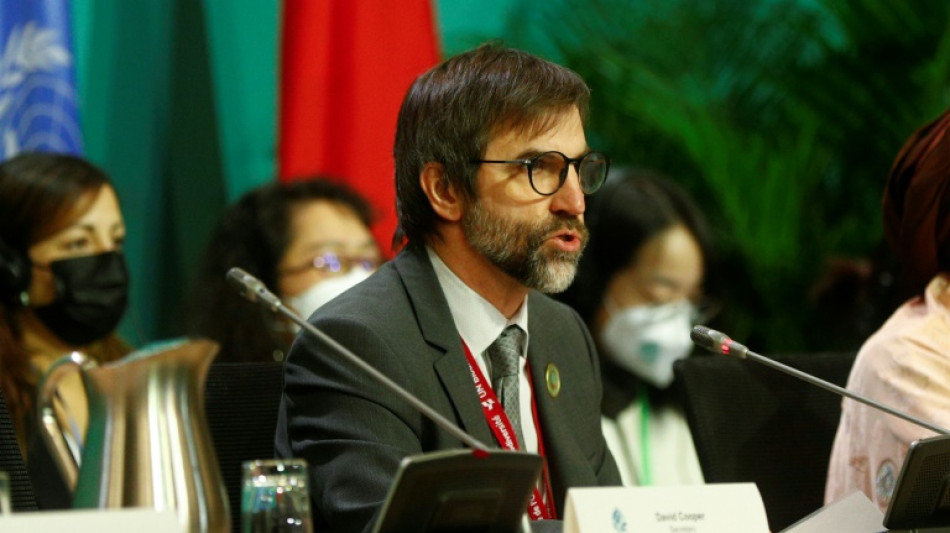
New funding announcements at high-stakes UN nature summit / Photo: Lars Hagberg - AFP
 Dutch federation calls for football summit without Infantino

 Ron’s Honky Tonk Residency Revives UK Country Music in Bermondsey

 Chelsea sign Argentina 'stopper Martinez from Villa

 Norway's churches hold services to late King Harald

 Walmart Agrees to $50 Million Settlement Over Opioid Prescription Allegations
 Soundcore Liberty 5 Pro Review: Call Quality Redefines Value in Wireless Earbuds

 Lexus ES Review: Electric ES 350e Falls Short in Luxury Saloon Segment

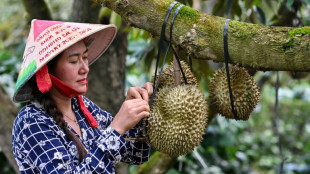 Vietnamese coffee farmers ride China's durian wave
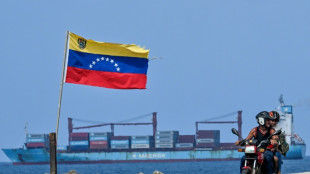 Venezuela says retains 'sovereignty' in US oil deal
 NASA's Roman telescope set to launch on cosmic mapping mission

 Data center backlash scrambles US midterm politics
 Emotional Federer inducted into tennis Hall of Fame

 Hovland takes solo lead as McIlroy surges at Tour Championship

 Djokovic 'prepared' for US Open bid for history
 Atletico down Sevilla to go top of La Liga

 US deports right-wing provocateur Milo Yiannopoulos

 Niger junta says it is back in control after soldiers' mutiny
 Erasmus calls Rennie barbs over Springbok scrumming 'nonsense'

 Lawrence's fifty leaves Pakistan facing record chase to level England series
 Netanyahu condemns settler attack in flashpoint West Bank village
 Munoz saves Iraola in Liverpool draw, big-spending Spurs lose again

 Newcastle condemn dismal Spurs to second successive defeat

 Police appeal for footage after life-threatening Stratford assault

 Family searches for Boston engineer missing after Nepal-Tibet floods

 Dolly Parton’s Imagination Library leaves global children’s reading legacy

The world's environment ministers began the final phase of crunch talks at a UN summit in Montreal on Thursday aimed at sealing a historic "peace pact with nature."
New international funding commitments from some wealthy donor countries could help lift the mood after negotiations appeared to be in trouble, though significant work is still needed to drag the deal across the finish line.
At stake is the future of the planet and whether humanity can roll back habitat destruction, pollution and the climate crisis, which are threatening an estimated million plant and animal species with extinction.
The thorny issue of how much money the rich nations will pay lower income countries to preserve their ecosystems is perhaps the biggest sticking point.
But the matter received a boost Thursday after Australia, Japan, the Netherlands, Norway, Spain and the United States all announced increased pledges, joining Germany, France, the EU, the United Kingdom and Canada who previously revised upward their commitments.
"This step forward is extremely important," European Commissioner for the Environment Virginijus Sinkevicius told AFP.
"These new announcements and reminder of existing commitments are a good signal of the much-needed political will in Montreal," said Claire Blanchard, head of global advocacy at WWF International.
- Long way to go -
But it isn't clear the new promises will be enough to satisfy countries of the Global South, home to most of the world's remaining biodiversity.
Dozens of nations, including Brazil, India, Indonesia and many African countries are seeking much more ambitious funding of $100 billion yearly, or one percent of global GDP, until 2030 -- compared to the current figure of around $10 billion.
Developing countries also want a new global biodiversity fund (GBF) to help them meet their goals, for example by setting up protected areas.
But rich countries are opposed -- and propose instead making existing financial mechanisms more accessible. The disagreement triggered a temporary walkout earlier.
"Funding proposals put forth by developing countries to generate new and additional funding dedicated specifically to biodiversity-related initiatives need to be taken seriously," Jorge Viana, representing Brazilian president-elect Luiz Inacio Lula da Silva, wrote in a letter.
He added the impasse could yet tank a possible deal.
"The idea, which is quite condescending, is the Global North thinking that they are doing the Global South a favor by providing money," Joseph Onoja of the Nigerian Conservation Foundation told AFP.
- 30 by 30 -
Other draft targets include a cornerstone pledge to protect 30 percent of the world's land and seas by 2030, reducing environmentally destructive subsidies, and how poor countries should be compensated for the exploitation of their natural resources, whose genetic information is stored in digital libraries.
"We must work together to promote harmonious coexistence between man and nature," Chinese President Xi Jinping said in a video message that opened the high-level segment involving 200 ministerial-level delegates.
China is chairing the summit, known as COP15, but is not hosting because of its strict Covid rules, leaving Canada to step in and hold the meeting in Montreal, one of North America's coldest cities, in deep winter.
"A brilliant Canadian artist, Joni Mitchell, sent us a message in a song -- that we have 'Paved paradise and put up a parking lot,'" said Canada's environment minister, Steven Guilbeault, who was nicknamed "Green Jesus" during his days as an activist.
"We listened to her music and sang along but didn't really understand her message. We must live in harmony with nature, not try and dominate it," he added.
Beyond the moral implications, there is the question of self-interest: $44 trillion of economic value generation -- more than half the world's total GDP -- is dependent on nature and its services.
C.Garcia--AMWN