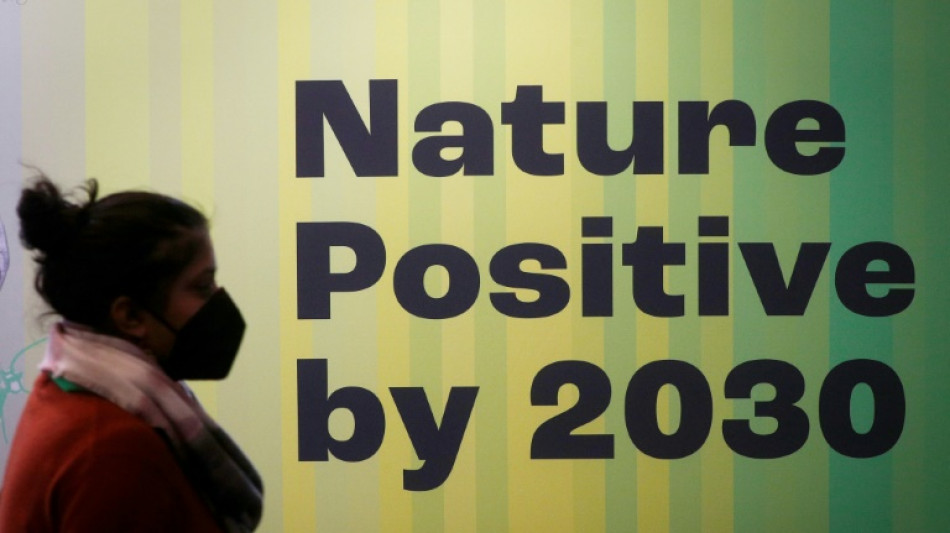
At COP15, businesses urged to act for nature / Photo: Lars Hagberg - AFP
 Dutch federation calls for football summit without Infantino

 Ron’s Honky Tonk Residency Revives UK Country Music in Bermondsey

 Chelsea sign Argentina 'stopper Martinez from Villa

 Norway's churches hold services to late King Harald

 Walmart Agrees to $50 Million Settlement Over Opioid Prescription Allegations
 Soundcore Liberty 5 Pro Review: Call Quality Redefines Value in Wireless Earbuds

 Lexus ES Review: Electric ES 350e Falls Short in Luxury Saloon Segment

 Vietnamese coffee farmers ride China's durian wave
 Venezuela says retains 'sovereignty' in US oil deal
 NASA's Roman telescope set to launch on cosmic mapping mission
 Data center backlash scrambles US midterm politics
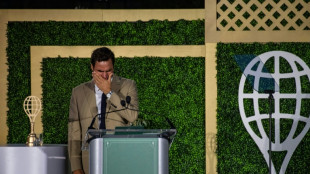 Emotional Federer inducted into tennis Hall of Fame

 Hovland takes solo lead as McIlroy surges at Tour Championship

 Djokovic 'prepared' for US Open bid for history
 Atletico down Sevilla to go top of La Liga

 US deports right-wing provocateur Milo Yiannopoulos

 Niger junta says it is back in control after soldiers' mutiny

 Erasmus calls Rennie barbs over Springbok scrumming 'nonsense'

 Lawrence's fifty leaves Pakistan facing record chase to level England series
 Netanyahu condemns settler attack in flashpoint West Bank village
 Munoz saves Iraola in Liverpool draw, big-spending Spurs lose again

 Newcastle condemn dismal Spurs to second successive defeat

 Police appeal for footage after life-threatening Stratford assault

 Family searches for Boston engineer missing after Nepal-Tibet floods

 Dolly Parton’s Imagination Library leaves global children’s reading legacy

Widely blamed for ravaging Earth's ecosystems, big businesses are nevertheless being turned to as key players in a deal to save nature at the COP15 biodiversity conference.
With hundreds of billions of dollars needed for the task, public funds can only fill part of the gap. Campaigners and experts at the talks are demanding companies act to reduce their impact -- and firms in turn are asking for clear rules of engagement.
Ministers at the meeting in Montreal are thrashing out a global agreement for the next decade to curb damage to Earth's forests, oceans and species -- with conservation and finance top of the agenda.
"One of the other things at stake in this COP is getting businesses involved," said Pierre Cannet of the Worldwide Fund for Nature, on the sidelines of the talks.
"Whatever the outcome of the summit, they will have to ask themselves how they can curb the fall in biodiversity."
Elizabeth Mrema, the head of the UN Convention on Biological Diversity that underpins COP15, said a record number of private-sector parties registered for this year's summit, where delegates are working on a new Global Biodiversity Framework.
"Clearly they've listened," she told AFP.
"They have understood or they are getting there now, understanding also the impact of their operations on nature, the nature biodiversity which we all depend on and (they) also depend (on) for their businesses," she added.
"If they are not part of the framework, their businesses will also suffer."
- Invest in nature -
Some $900 billion a year is needed to move from "an economy that devours nature to a neutral and then a positive economy," says Gilles Kleitz of the French state development agency AFD.
For this, "the role of businesses is fundamental," said Didier Babin, a researcher at Cirad, an institute that focuses on sustainable agriculture.
"More businesses have to be brought on board" to help fund the targets, he added. "They depend on biodiversity and they must invest more in the capital of nature. Nature needs to be thought of as an asset."
One of the targets in the framework under discussion at COP15 is a section aimed at obliging big companies and financial groups to measure and publish their impacts on the natural world and their exposure to it.
The World Economic Forum said in a 2020 report that more than half of global production depends heavily (15 percent) or moderately (37 percent) on nature and services related to it.
It calculated the value of businesses' exposure to degraded ecosystems at $44 trillion.
The report found that the construction sector was the most exposed with $4 trillion, followed by agriculture with $2.5 trillion and the food and drink industry with $1.4 trillion.
- Measuring biodiversity impact -
At COP15, a grouping of 330 businesses called Business for Nature is pushing for a uniform framework for all corporations to report their impacts and exposure.
With collective turnover of more than $1.5 trillion, they include big names such as Unilever, Ikea, Danone, BNP Paribas and Tata Steel.
"There will be no economy, there will be no business on a dead planet," said the grouping's executive director, Eva Zabey.
"And so now we need governments to adopt an ambitious global biodiversity framework that will provide the political certainty and it will require businesses to contribute."
Brune Poirson, director of sustainable development at the hotel group Accor, said COP15 "must be a key milestone" in this process.
"We need a framework with all the actors in the sector," she said.
Efforts are gaining pace to make companies disclose their contribution to the carbon emissions that drive climate change -- but relatively few companies currently declare their impact on the ecosystems that support all life.
"This summit needs to be a turning point in humanity's relationship with nature and to do so it needs to kick off fundamental changes in the way the economy works," said Eliot Whittington of the Cambridge Institute for Sustainability Leadership.
"More and more businesses and financial institutions are realizing how essential action on nature and biodiversity is, but they need governments to provide the right rules and incentives to solve market failures and make change possible."
Y.Kobayashi--AMWN