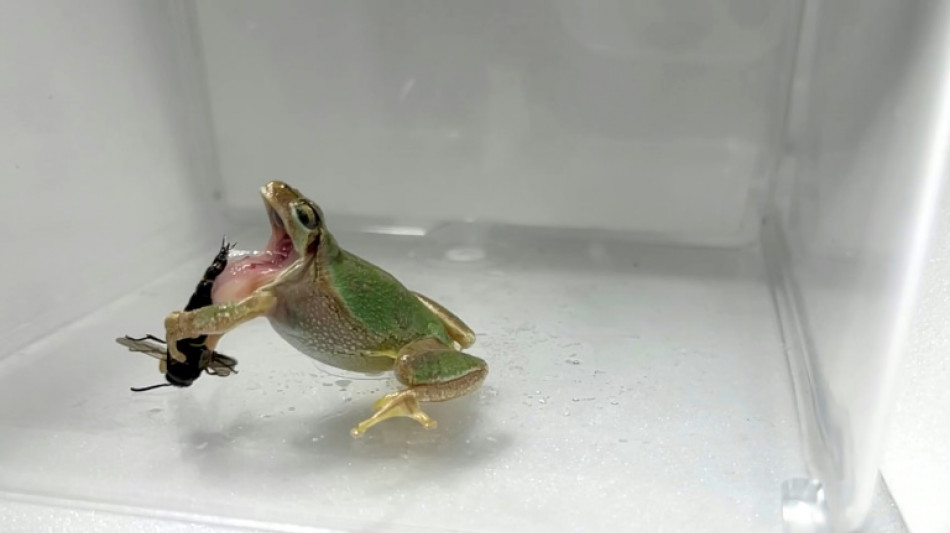
En garde! Wasps use penis spikes to ward off predators / Photo: Shinji SUGIURA - Kobe University/AFP
 Dutch federation calls for football summit without Infantino

 Ron’s Honky Tonk Residency Revives UK Country Music in Bermondsey

 Chelsea sign Argentina 'stopper Martinez from Villa

 Norway's churches hold services to late King Harald

 Walmart Agrees to $50 Million Settlement Over Opioid Prescription Allegations

 Soundcore Liberty 5 Pro Review: Call Quality Redefines Value in Wireless Earbuds

 Lexus ES Review: Electric ES 350e Falls Short in Luxury Saloon Segment

 Vietnamese coffee farmers ride China's durian wave

 Venezuela says retains 'sovereignty' in US oil deal

 NASA's Roman telescope set to launch on cosmic mapping mission

 Data center backlash scrambles US midterm politics

 Emotional Federer inducted into tennis Hall of Fame

 Hovland takes solo lead as McIlroy surges at Tour Championship

 Djokovic 'prepared' for US Open bid for history
 Atletico down Sevilla to go top of La Liga

 US deports right-wing provocateur Milo Yiannopoulos

 Niger junta says it is back in control after soldiers' mutiny

 Erasmus calls Rennie barbs over Springbok scrumming 'nonsense'

 Lawrence's fifty leaves Pakistan facing record chase to level England series
 Netanyahu condemns settler attack in flashpoint West Bank village

 Munoz saves Iraola in Liverpool draw, big-spending Spurs lose again

 Newcastle condemn dismal Spurs to second successive defeat

 Police appeal for footage after life-threatening Stratford assault

 Family searches for Boston engineer missing after Nepal-Tibet floods

 Dolly Parton’s Imagination Library leaves global children’s reading legacy

An accidental sting has helped Japanese scientists prove some male wasps have a rather unusual predator defence weapon: penis spikes.
While wasps are known for their prickly attacks, only females have a real sting in their tails. Their male counterparts generally evade predators by mimicking the fairer sex.
Scientists had theorised that some male wasps might have other defence mechanisms, including perhaps deploying their genital spikes.
"However, the evidence was lacking," explained Shinji Sugiura, an ecologist at Japan's Kobe University.
Sugiura studies animal anti-predator defences but it was only by chance that he investigated the unusual male wasp mechanism, after his graduate student and co-author reported being stung by a mason wasp.
"I tried to be stung after hearing her experience," Sugiura told AFP.
"Because I had believed male wasps as harmless, I was very surprised to experience the pain."
Female wasps sting via an ovipositor, a tube-like protrusion that deposits eggs but can also deliver a venomous riposte.
Male wasps lack the organ but are equipped with two large spikes that sit either side of their penis.
To test the effectiveness of this defence, Sugiura's team offered up male mason wasps to two different kinds of frogs to see how the spikes were deployed.
"Male wasps were frequently observed to pierce the mouth or other parts of frogs with their genitalia while being attacked," Sugiura reported in research published Tuesday in the Current Biology journal.
The attacks are documented in a video that shows an unfortunate frog trying repeatedly to chomp down on a wasp, before using its front feet to pull the stinging insect out of its mouth.
Pond frogs happily ate all the males, as well as stinging females, but over a third of tree frogs rejected the male wasps after being stung.
When the experiment was repeated with the genital spikes removed from the wasps, the tree frogs no longer held back and ate them without hesitation.
"The difference was statistically significant. Even a small difference of survival could cause the evolution of anti-predator devices in insects," Sugiura said.
There has been little research on insect genitalia outside of its role in reproduction, according to Sugiura, though the wasp defence mechanism is not entirely without precedent.
Previous research has found, for example, that some species of hawkmoth use their genitalia to emit ultrasound that jams bat sonar.
Sugiura is no stranger to uncovering some of the weirdest ways animals evade their predators.
He has documented how some beetles can escape after being swallowed, by following the digestive tract to its logical conclusion and escaping from the anus.
And he has shown that other insects can make any unfortunate toad that has eaten them vomit them back up.
He now hopes to expand his current research to determine whether other wasp families have the same genital spike defence mechanism.
P.Costa--AMWN