Dressing 'revolution' seeks artificial skin for burn victims / Photo: ARNAUD FINISTRE - AFP
 Dutch federation calls for football summit without Infantino

 Ron’s Honky Tonk Residency Revives UK Country Music in Bermondsey

 Chelsea sign Argentina 'stopper Martinez from Villa
 Norway's churches hold services to late King Harald

 Walmart Agrees to $50 Million Settlement Over Opioid Prescription Allegations

 Soundcore Liberty 5 Pro Review: Call Quality Redefines Value in Wireless Earbuds

 Lexus ES Review: Electric ES 350e Falls Short in Luxury Saloon Segment
 Vietnamese coffee farmers ride China's durian wave

 Venezuela says retains 'sovereignty' in US oil deal

 NASA's Roman telescope set to launch on cosmic mapping mission

 Data center backlash scrambles US midterm politics

 Emotional Federer inducted into tennis Hall of Fame

 Hovland takes solo lead as McIlroy surges at Tour Championship
 Djokovic 'prepared' for US Open bid for history

 Atletico down Sevilla to go top of La Liga

 US deports right-wing provocateur Milo Yiannopoulos

 Niger junta says it is back in control after soldiers' mutiny

 Erasmus calls Rennie barbs over Springbok scrumming 'nonsense'

 Lawrence's fifty leaves Pakistan facing record chase to level England series
 Netanyahu condemns settler attack in flashpoint West Bank village

 Munoz saves Iraola in Liverpool draw, big-spending Spurs lose again

 Newcastle condemn dismal Spurs to second successive defeat

 Police appeal for footage after life-threatening Stratford assault

 Family searches for Boston engineer missing after Nepal-Tibet floods

 Dolly Parton’s Imagination Library leaves global children’s reading legacy

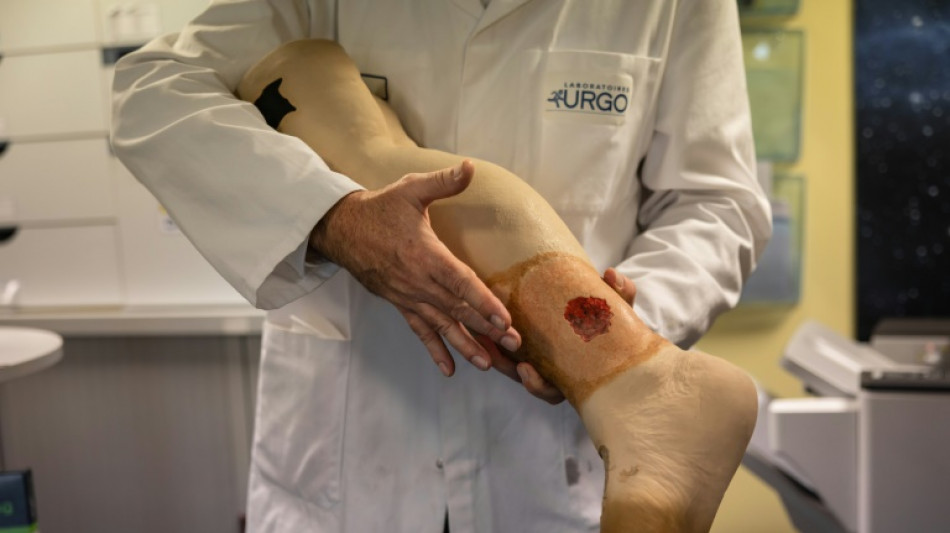
Far from the humble sticking plaster, medical firms and researchers are seeking to create the "ultimate dressing" -- artificial skin they hope will revolutionise the treatment of severe burns.
For the last 18 months, researchers from the French firm Urgo have been working towards achieving this Holy Grail of wound treatment, which would save serious burn victims from the painful and repeated skin grafts they currently endure.
The 100-million-euro ($106,000-million) "Genesis" project hopes to have a product ready by 2030.
Guirec Le Lous, the president of Urgo's medical arm, told AFP that it is a "crazy" project.
"Are we capable of designing artificial skin in a laboratory? No one in the world has succeeded," he said.
Inside Urgo's laboratory in Chenove, near the eastern French city of Dijon, living cells are being chilled before they can be cultivated.
"You have to be able to recreate all the functions of skin," including protecting against external threats and regulating the temperature, Le Lous said.
It must also be relatively easy to make, because artificial skin must be "available for all and at the right price," he said, without revealing the exact technology or type of cells Urgo is using.
Urgo, a family-owned business since 1880, has long made dressings for chronic wounds such as diabetic foot ulcers and venous leg ulcers.
"Since the 2000s, we have worked on materials that will correct healing problems: dressings have become intelligent, interactive with wounds, allowing them to perform better," Urgo's research director Laurent Apert said.
He called the change "a revolution".
- Silver bullet -
Urgo is far from alone in pushing the boundaries of what dressings can do.
Researchers at the University of South Australia have developed a new kind of dressing that knows when to release nanoparticles of silver, which can break down antibiotic-resistant bacteria.
"Our treatment is unique in that it capitalises on the anti-bacterial properties of silver, but avoids over-exposure, by only activating when infection in present," lead researcher Zlatko Kopecki said in a statement.
This makes the dressing "a much safer and effective treatment for children," he added.
Children suffer almost half of burn injuries worldwide, most of them aged between one to five years old, according to research using the World Health Organization's Global Burn Registry.
- 'Night and day' -
Another new technique does away with the idea of dressing altogether.
For a product from French startup VistaCare Medical, patients put their affected leg into a large device which never touches their wound.
Instead the chamber controls the humidity, temperature and other aspects important to healing.
"There is no more dressing. The idea is to put the wound in an enclosure, in a sterile air, VistaCare Medical president Francois Dufay said.
"With this system, we provide the wound with what it needs, at the right time."
VistaCare Medical's device is currently used in around 20 French hospitals, but next year the firm plans to apply for approval in the United States for a product to be used in the home.
The new developments have shaken up the world of wound healing, long a neglected area of medical research.
Isabelle Fromantin, who heads the wounds and healing research unit at the Curie Institute in Paris, said that "compared to 20 years ago, it's night and day in terms of wound care".
Along with her team, Fromantin has developed dressings that reduce the odours from necrotic wounds seen in some cancers.
However she said that not everything can be achieved by new technologies -- healing is a process that varies from person to person, depending on their age and health.
"Believing that a dressing will heal you all by itself is utopian," she said.
D.Sawyer--AMWN