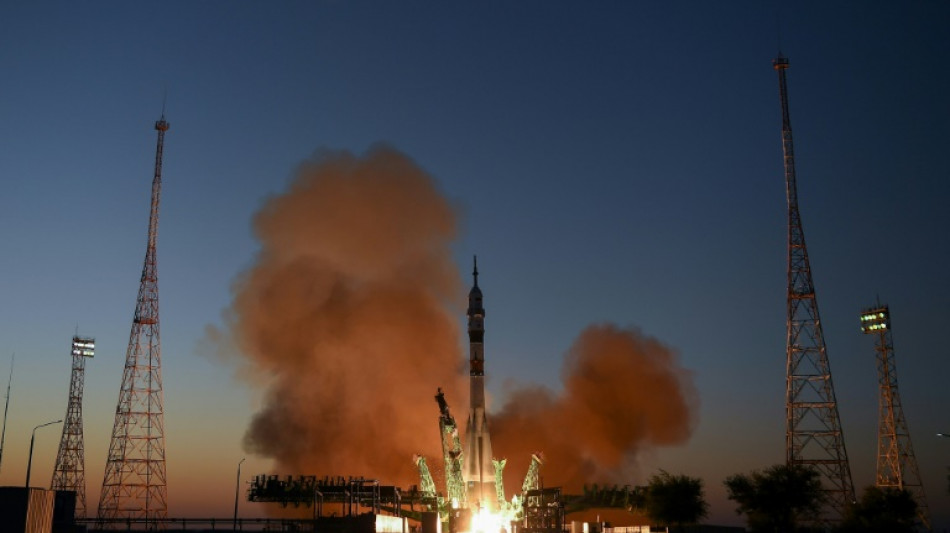
Russia to send rocket to rescue crew from ISS / Photo: NATALIA KOLESNIKOVA - AFP/File
 In-form Marc Marquez wins Aragon MotoGP Grand Prix

 At least six die in ferry capsize off Northern Cyprus

 Niamey back to normal after soldier mutiny

 King Haakon joins Norway memorials for Harald

 NASA launches Roman telescope on cosmic mapping mission

 Van Dijk wants Gakpo to stay at Liverpool amid Man City interest

 Five-wicket Abbas has Lord's landmark as Pakistan set 389 to win second Test

 Tadej Pogacar Out of Vuelta a Espana with Broken Collarbone and Concussion

 Iceland votes 'No' to resuming EU talks

 Berlin Literary Guide: Book Launches, Festivals, and Readings Through August

 Nepal rescuers drill through debris towards trapped tunnel workers

 Manhunt in Switzerland after fatal rave shooting

 'No' camp seen winning Iceland's EU referendum

 Nepal flood survivors return to ruins to salvage memories

 Killing of Palestinian children and teens by Israel surges in West Bank
 Educators keep 9/11 memory alive for next generation, 25 years on

 Venezuelans view US oil deal with doubt, hope

 Gobena and Jepchirchir power to Sydney Marathon victories

 Iceland in suspense after close EU vote

 Wallabies hold on for victory in Argentina

 Juve notch second straight win, Fiorentina's centenary party falls flat

 Rybakina eases injury fears ahead of US Open
 Djokovic kicks off latest Grand Slam quest under US Open lights

 'Sorry' De Zerbi won't panic after Spurs shambles

 UN, Nepal warn of climate threat after deadly floods

Russia said Wednesday it would send a rescue capsule next month for three crew members of the International Space Station, after a meteorite damaged the spacecraft that was due to return them to Earth.
The Russian space agency, Roscosmos, made the announcement after examining the flight worthiness of the Soyuz MS-22 crew capsule docked with the ISS that sprang a leak in December.
On Wednesday, Roscosmos said the spacecraft that was originally set to bring Russian cosmonauts Sergei Prokopyev and Dmitry Petelin and NASA astronaut Frank Rubio back to Earth was damaged by a small meteorite strike.
Roscosmos said it had ruled out a technical problem as being the cause of the leak.
Their space capsule will now need to return crewless and a new spaceship, the Soyuz MS-23, will be sent to the ISS on February 20 to retrieve the trio.
"'Soyuz MS-22' must descend to Earth without a crew," Roscosmos said, announcing the conclusion of a state commission that weighed how to handle the problem.
There are currently seven people aboard the ISS. With the MS-22 rocket now deemed unfit, it means that the ISS has just one "lifeboat" capable of carrying four people, in case it needs to be evacuated.
Roscosmos said any such scenario will be considered separately.
"In the event of particularly critical situations on the ISS, the possibility of using the Soyuz MS-22 to rescue the crew will be determined by a separate decision of the state commission," Roscosmos added.
MS-22 flew Russia's Petelin and Prokopyev, as well as NASA astronaut Rubio, to the ISS in September.
Due to the damage to the space capsule their mission is being extended and they will now return to Earth on board the MS-23, Roscosmos said without providing more details. They had been set to come home in March.
The vehicle began spraying its coolant into space on December 14, with dramatic NASA TV images showing white particles resembling snowflakes streaming out of the rear.
Roscosmos and NASA initially said the leak did not pose any danger to those on board although it caused temperature spikes.
Russian cosmonauts had to postpone a spacewalk because of the leak.
- 'Optimal solution' -
Dispatching a rescue ship to retrieve the three crew members means that another three astronauts will not go to space as scheduled.
Initially the Soyuz MS-23 had been expected to take to the ISS Russian cosmonauts Oleg Kononenko and Nikolai Chub and NASA's Loral O'Hara on March 16.
Space expert Vitaly Egorov praised the Roscosmos decision.
"This is an optimal solution for the safety of people and minimising damage to the space programme," he said on Facebook.
Space has remained a rare venue of cooperation between Moscow and Washington since the start of the Russian offensive in Ukraine and ensuing Western sanctions on Russia.
The head of the Russian space agency, Yury Borisov, in December praised Russia-US cooperation at the ISS following the leak.
NASA, which has closely monitored the Soyuz systems, is set to brief reporters later on Wednesday.
"NASA and Roscosmos are concluding their work together to develop a course of action following the analysis," the US space agency said.
The ISS was launched in 1998 at a time of increased US-Russia cooperation following their Space Race competition during the Cold War.
Russia has been using the ageing but reliable Soyuz capsules to ferry astronauts into space since the 1960s.
A.Malone--AMWN