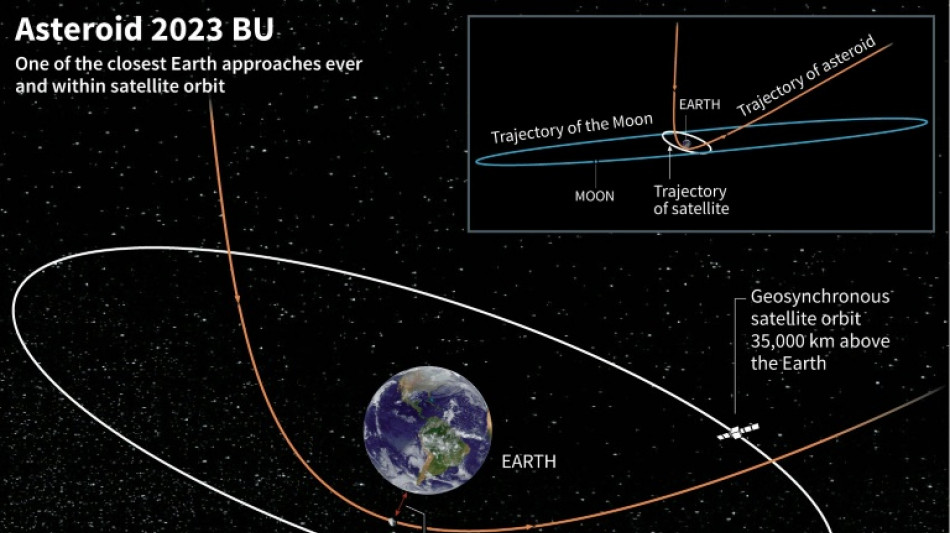
Asteroid to come 'extraordinarily close' to Earth: NASA / Photo: Laurence SAUBADU - AFP
 Chelsea beat Brighton in seven-goal thriller, Leeds hold Brentford

 At least seven die in ferry capsize off Northern Cyprus; 23 missing

 In-form Marc Marquez wins Aragon MotoGP Grand Prix

 At least six die in ferry capsize off Northern Cyprus

 Niamey back to normal after soldier mutiny

 King Haakon joins Norway memorials for Harald

 NASA launches Roman telescope on cosmic mapping mission

 Van Dijk wants Gakpo to stay at Liverpool amid Man City interest

 Five-wicket Abbas has Lord's landmark as Pakistan set 389 to win second Test

 Tadej Pogacar Out of Vuelta a Espana with Broken Collarbone and Concussion

 Iceland votes 'No' to resuming EU talks

 Berlin Literary Guide: Book Launches, Festivals, and Readings Through August

 Nepal rescuers drill through debris towards trapped tunnel workers

 Manhunt in Switzerland after fatal rave shooting

 'No' camp seen winning Iceland's EU referendum

 Nepal flood survivors return to ruins to salvage memories

 Killing of Palestinian children and teens by Israel surges in West Bank

 Educators keep 9/11 memory alive for next generation, 25 years on

 Venezuelans view US oil deal with doubt, hope

 Gobena and Jepchirchir power to Sydney Marathon victories

 Iceland in suspense after close EU vote

 Wallabies hold on for victory in Argentina

 Juve notch second straight win, Fiorentina's centenary party falls flat

 Rybakina eases injury fears ahead of US Open

 Djokovic kicks off latest Grand Slam quest under US Open lights

A truck-sized asteroid will pass near Earth on Thursday in one of the closest approaches to our planet ever recorded, NASA said, emphasising that it poses no danger.
Asteroid 2023 BU, which was recently discovered by an amateur astronomer, will zoom by the southern tip of South America at around 4:27 pm PST on Thursday (0027 GMT Friday), according to NASA.
It will pass just 2,200 miles (3,600 kilometres) from Earth's surface, much closer than many geostationary satellites orbiting the planet.
But there is no risk that the asteroid will hit Earth, NASA said in a statement on Wednesday.
Even if it did, the asteroid measuring 3.5-8.5 metres (11-28 feet) across would largely disintegrate in the Earth's atmosphere, potentially just resulting in a few small meteorites.
It was discovered on Saturday from an observatory in Crimea by amateur astronomer Gennadiy Borisov, who previously spotted an interstellar comet in 2019.
Dozens of observations were then carried out by observatories across the world.
NASA's Scout impact hazard assessment system quickly determined that the asteroid would miss Earth, the US space agency said.
"Despite the very few observations, it was nonetheless able to predict that the asteroid would make an extraordinarily close approach with Earth," said NASA's Davide Farnocchia who helped develop Scout.
"In fact, this is one of the closest approaches by a known near-Earth object ever recorded."
The asteroid will come so close that its trajectory around the Sun will be significantly altered.
Previously it took the asteroid 359 days to complete its orbit around the Sun, but after this close call with Earth, it will now take 425, NASA said.
A.Jones--AMWN