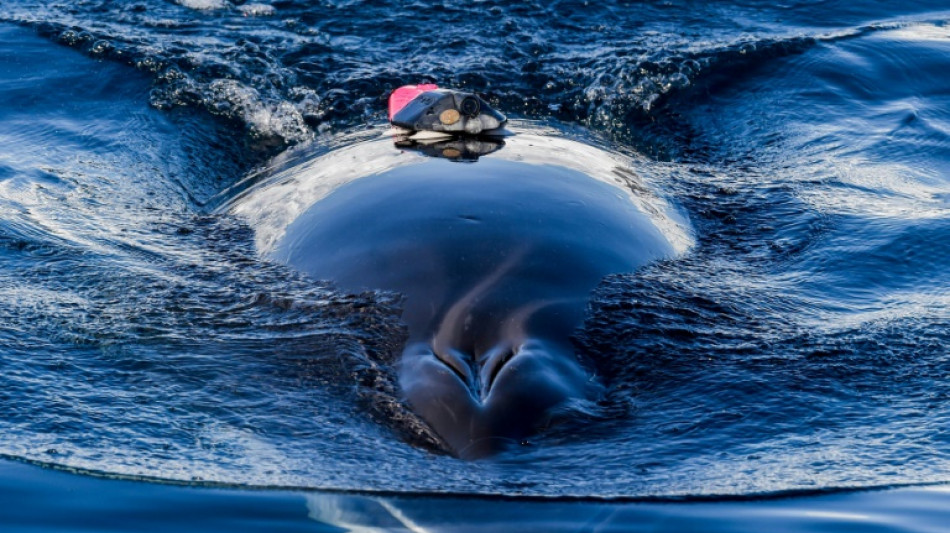
Norway study highlights whale excrement's role in ecosystem / Photo: Ari Friedlaender - Stanford University/Goldbogen Laboratory/AFP/File
 Fernandes hat-trick inspires Man Utd rout of Ipswich

 Suzuki sends 'perfect' Freiburg past Bremen, Schalke lose

 Instagram offers three routes to two-factor authentication

 September smartphone calendar spans Apple, Poco, Vivo and Xiaomi

 Eight dead and 23 missing after ferry sinks off Cyprus

 Russell Hobbs dual air fryer discounted to £99

 British woman dies after stabbing at German station

 Beeston pub closes after office fire injures man
 South West Water ranks worst in environmental comparison

 CERN creates quark-gluon plasma with smaller atomic nuclei

 WIRED tests label makers for home organisation

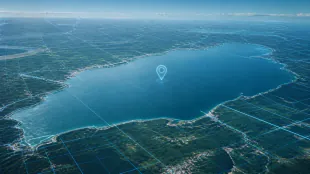 Google Maps adopts Lake America label for US users

 Bellingham, Mbappe fire as Real Madrid ease to Malaga win

 Mas wins Vuelta 9th stage to extend lead

 Robinson strikes as England close in on series win over Pakistan

 Chelsea beat Brighton in seven-goal thriller to extend Alonso's perfect start

 Zambia's opposition leader charged with treason

 Marc Marquez wins Aragon MotoGP Grand Prix

 Robinson rocks Pakistan again as England eye series win at Lord's

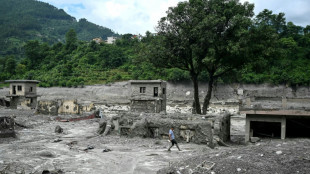 Nepal rescuers advance towards trapped tunnel workers

 Grisly search for missing as Nepal morgues overflow, burials begin

 Barcelona's Yamal getting back to 'top level': Flick

 Dutch federation calls for football summit without Infantino

 Ron’s Honky Tonk Residency Revives UK Country Music in Bermondsey

 Chelsea sign Argentina 'stopper Martinez from Villa

Minke whale excrement is "worth its weight in gold" as it plays an important role in fertilizing phytoplankton and thereby reducing the cetacean's carbon footprint, according to a Norwegian study.
For the first time, researchers from the Norwegian Institute for Marine Research have studied the concentration of nutrients in whale excrement before it is dissolved in seawater.
"It can sound disgusting, but for the ecosystem it's worth its weight in gold," researchers said in a statement Thursday.
"The idea is simply that the faeces fertilize the sea in the same way that cows and sheep do on land," they continued.
The researchers analysed the excrement of minke whales harpooned by whalers -- as Norway is one of few countries allowing the commercial hunting of these cetaceans.
The some 15,000 whales that migrate each summer to the Norwegian archipelago of Svalbard in the Arctic release some 600 tonnes of excrement on the surface of the water each day, at a rate of about 40 kilograms (88 pounds) per animal.
According to the study, the daily excrement releases about 10 tonnes of phosphorus and 7 tonnes of nitrogen into the oceans, nutrients that are essential for the growth of phytoplankton -- microscopic algae that absorb carbon dioxide through photosynthesis and convert it into oxygen.
The scientists concluded that the minke whale excrement contributed to between 0.2 and 4 percent of daily phytoplankton production in the Arctic Svalbard region.
"The real contribution of whales is probably higher because these estimates do not include urine, which is very rich in nitrogen," research leader Kjell Gundersen told AFP.
Each minke whale -- an animal weighing 40-50 tonnes as an adult that feeds by filtering large quantities of water -- releases "several hundred litres of urine" per day.
"If there are fewer whales, there is a risk that there will be less fertilisation of the ocean," Gundersen said.
"More phytoplankton production also means more CO2 is absorbed," he added.
"This is positive for the climate," he noted, "but we don't know the net balance of whales in terms of greenhouse gases" because cetaceans also emit methane when they breathe.
This question, which is still largely unexplored, will be the subject of a European study that will start in June and last four years.
Th.Berger--AMWN