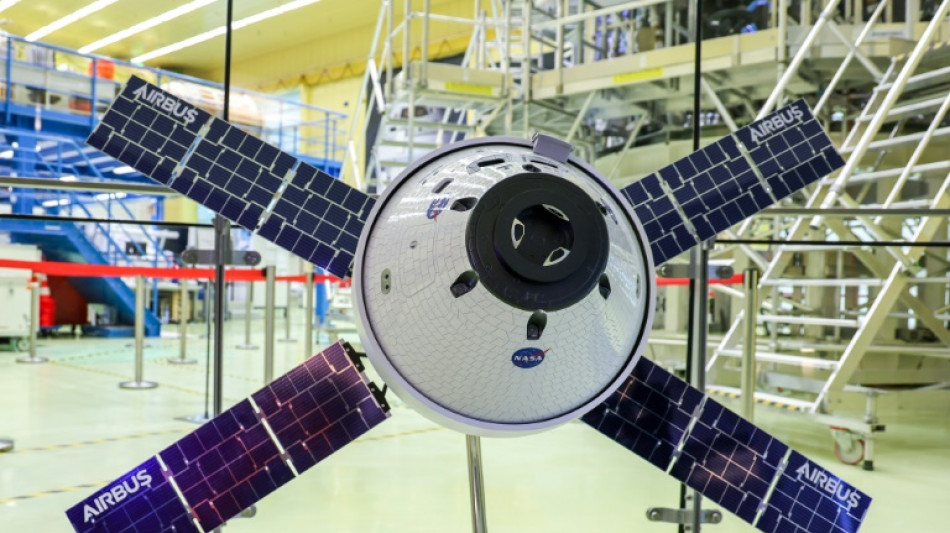
Europe shoots for the moon with role in NASA programme / Photo: FOCKE STRANGMANN - AFP
 Fernandes hat-trick inspires Man Utd rout of Ipswich

 Suzuki sends 'perfect' Freiburg past Bremen, Schalke lose

 Instagram offers three routes to two-factor authentication

 September smartphone calendar spans Apple, Poco, Vivo and Xiaomi

 Eight dead and 23 missing after ferry sinks off Cyprus

 Russell Hobbs dual air fryer discounted to £99

 British woman dies after stabbing at German station

 Beeston pub closes after office fire injures man

 South West Water ranks worst in environmental comparison

 CERN creates quark-gluon plasma with smaller atomic nuclei

 WIRED tests label makers for home organisation

 Google Maps adopts Lake America label for US users

 Bellingham, Mbappe fire as Real Madrid ease to Malaga win

 Mas wins Vuelta 9th stage to extend lead

 Robinson strikes as England close in on series win over Pakistan

 Chelsea beat Brighton in seven-goal thriller to extend Alonso's perfect start

 Zambia's opposition leader charged with treason

 Marc Marquez wins Aragon MotoGP Grand Prix

 Robinson rocks Pakistan again as England eye series win at Lord's
 Nepal rescuers advance towards trapped tunnel workers

 Grisly search for missing as Nepal morgues overflow, burials begin
 Barcelona's Yamal getting back to 'top level': Flick

 Dutch federation calls for football summit without Infantino

 Ron’s Honky Tonk Residency Revives UK Country Music in Bermondsey

 Chelsea sign Argentina 'stopper Martinez from Villa
European astronauts could walk on the Moon for the first time in the coming years, in exchange for the continent taking on a key role in an ambitious NASA space programme.
The US space agency's Artemis programme aims to return humans to the Moon for the first time since the historic Apollo missions, which ended in 1972.
For the first time, the European Space Agency (ESA) and European aerospace giant Airbus have been entrusted with supplying vital "service modules" (ESMs) for NASA's Orion spacecraft.
In exchange, Europe has three guaranteed seats on the mission's flights, probably from 2027, although discussions are ongoing to try to get earlier spots.
The role of the Europeans is vital -- they are providing "half of the spacecraft that will take people to the Moon and, of course, back to Earth safely," said Marc Steckling, Airbus's head of space exploration.
The modules are critical to power the spacecraft, providing electricity from solar panels, and other vital supplies such as water and oxygen.
Cylinders measuring about four by four metres with about 22,000 parts and weighing about 12 tons, the modules are put together at Airbus's site in Bremen, northern Germany.
Once assembled and safety tests are completed, they are transferred to the Kennedy Space Center in Florida.
The ESMs can also provide manoeuvring capability, and could even carry additional cargo to a planned space station in orbit around the Moon, called Gateway.
- 'Open history book' -
The two-billion-euro ($2.1 billion) project is running smoothly, and Airbus is on track to meet NASA's requirement of delivering one ESM a year, according to Steckling.
Supporters of the idea of sending humans back to the Moon say it could prove vital in scientific research.
Alexander Gerst, a German astronaut who has done two stints on the International Space Station, described the Moon as an "open history book".
"We can learn how Earth was actually formed and how it came into existence," he said.
A first Artemis mission wrapped up successfully in December, with an uncrewed Orion capsule returning safely to Earth after a more than 25-day journey around the Moon.
The Artemis 2 mission, planned for 2024, will take a crew towards the Moon but still without landing on it.
Artemis 3, scheduled for 2025, will see a spacecraft land for the first time on the south pole of the Moon, where they hope to find water in the form of ice. The space agency thereafter aims to launch one mission per year.
As part of the Artemis missions, NASA is planning to send a woman and a person of colour to the Moon for the first time.
Only 12 people -- all of them white men -- have set foot on the Moon, and that was during the Apollo missions.
- 'Repository of history' -
NASA hopes to establish a lasting human presence on the Moon, and later launch a years-long trip to Mars.
Philippe Berthe, European Space Agency project coordination manager for the modules, said the Moon had resources that could be exploited such as ice that could be used to make fuel, particularly at its south pole.
"The moon is a repository of history of the solar system since its creation, which has remained relatively untouched since there is no atmosphere, no erosion," he told AFP.
Whereas in the 1960s the space race was between the Soviet Union and Washington, China has now emerged as the United States's chief rival in the intergalactic arena with its own ambitious programme.
But such rivalry -- "a little bit of a scientific competition" -- isn't necessarily a bad thing, believes Gerst.
D.Sawyer--AMWN