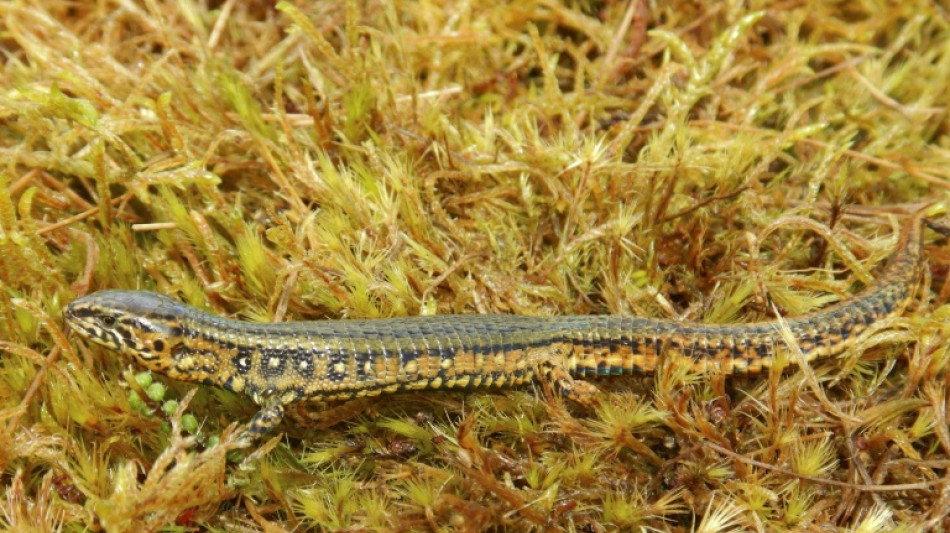
Leaping lizards: Peru finds a new one / Photo: Edgar LEHR - AFP
 Aston Villa Defy History With Rare Victory at Old Trafford

 Crowds Gather at San Francisco Park for Elizabeth Holmes Lookalike Tournament

 Making Your Home Safer for Aging Parents: Accessibility Renovations That Add Value

 iPS Cell Research Accelerates Drug Discovery for ALS and Spinal Cord Injury

 Rene Eyre Revisits Autobiographical Performance 'Say A Little Prayer' in London

 UAE's HCT Holds Record Graduation and Announces Major Training Expansion

 NASA Awards $10B Lunar Contract Framework to SpaceX, Blue Origin

A new species of lizard, of the genus Proctoporus, was found in a high Andean area of a national park in Peru, authorities said Friday.
This small species was located in the Otishi National Park, in the jungle area shared by the departments of Cusco and Junin, the Peruvian authority for protected areas announced.
This is a new specimen of the genus Proctoporus that includes species that inhabit yungas forests and high mountain grasslands on the Amazon slope of the Andes," said the National Service of Natural Areas Protected by the State (Sernanp), without specifying the date of discovery in an area located between 3,241 and 3,269 meters above sea level.
Among its characteristics, "its smooth scales on the head, which lack grooves or roughness, and the eyelids with an undivided translucent disc" stand out, the agency reported.
Males have a dark gray to black neck, breast, and belly, while females have a pale gray neck, breast, and belly with a diffused dark gray.
Peruvian authorities say that there are 20 species of Proctoporus, of which 18 are found in Peru. The discovery was made by a team of five researchers.
L.Durand--AMWN

