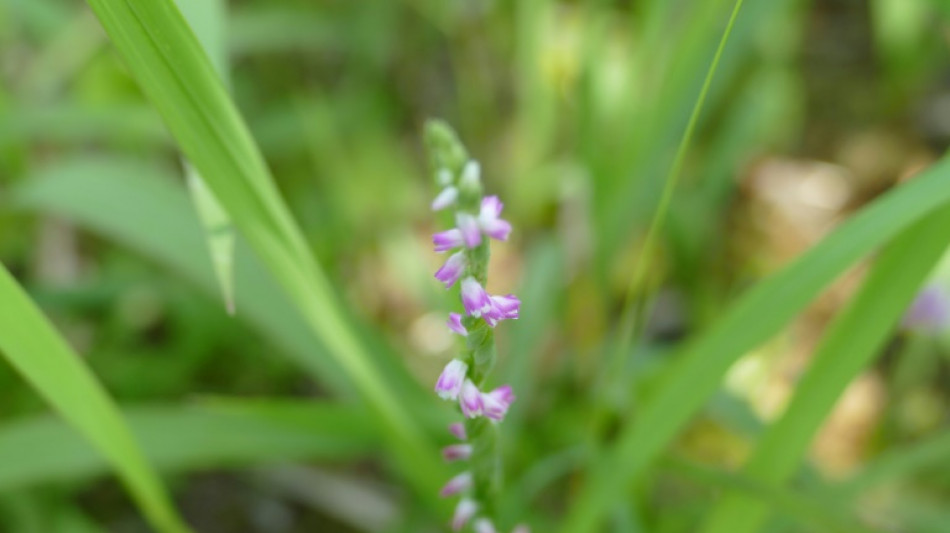
New 'glass-like' orchid species discovered in Japan / Photo: Kenji Suetsugu - Courtesy of Kenji Suetsugu/AFP
 Aston Villa Defy History With Rare Victory at Old Trafford

 Crowds Gather at San Francisco Park for Elizabeth Holmes Lookalike Tournament

 Making Your Home Safer for Aging Parents: Accessibility Renovations That Add Value

 iPS Cell Research Accelerates Drug Discovery for ALS and Spinal Cord Injury

 Rene Eyre Revisits Autobiographical Performance 'Say A Little Prayer' in London

 UAE's HCT Holds Record Graduation and Announces Major Training Expansion

 NASA Awards $10B Lunar Contract Framework to SpaceX, Blue Origin

A new species of orchid with delicate, glass-like blooms has been discovered by Japanese scientists, who found the pink and white plant hiding in plain sight.
Despite its presence in Japan's parks and gardens, it took researchers at Kobe University a decade to confirm that the plant -- dubbed the "Spiranthes hachijoensis" -- was a previously unknown species.
"It was a surprise to discover a new species of spiranthes, which is so common that you can see it in parks, gardens and among potted plants," lead researcher Kenji Suetsugu told AFP Thursday.
Some of the samples were "from potted plants and gardens", including ones kept at a high school in Japan's central Gifu region, the phytology professor said.
"From its curious look and dainty blooms that resemble glasswork, this flower has long been loved by people," the university said in a press release.
The plant, with its spiralling blossoms, was even mentioned in Japan's oldest anthology of poems, the eighth-century "Manyoshu".
The discovery of the new type of spiranthes, sometimes known as "ladies' tresses", was announced last week in the Journal of Plant Research. It was given the name "hachijoensis" because many samples were found on Tokyo's Hachijojima island.
Ch.Havering--AMWN

