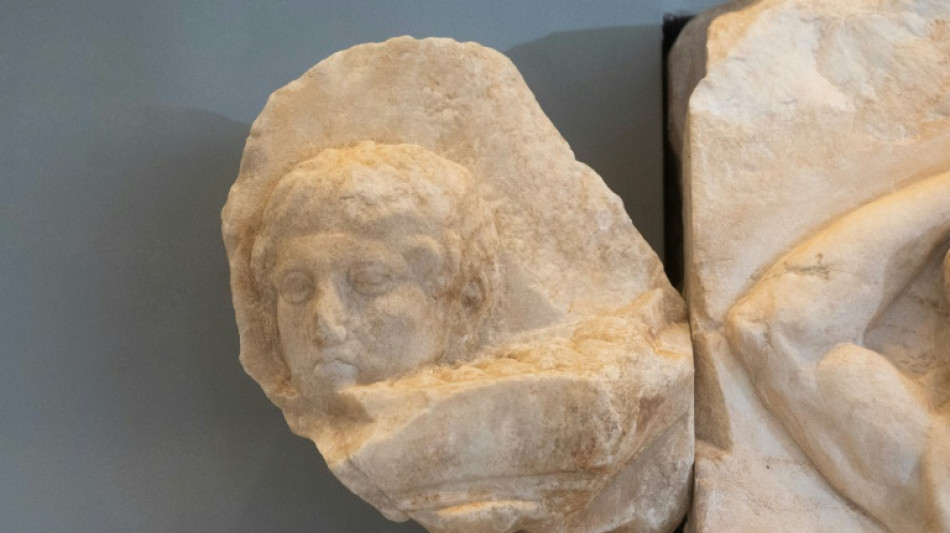
Parthenon fragments from Vatican return to Greece / Photo: Angelos Tzortzinis - AFP
 Aston Villa Defy History With Rare Victory at Old Trafford

 Crowds Gather at San Francisco Park for Elizabeth Holmes Lookalike Tournament

 Making Your Home Safer for Aging Parents: Accessibility Renovations That Add Value

 iPS Cell Research Accelerates Drug Discovery for ALS and Spinal Cord Injury

 Rene Eyre Revisits Autobiographical Performance 'Say A Little Prayer' in London

 UAE's HCT Holds Record Graduation and Announces Major Training Expansion

 NASA Awards $10B Lunar Contract Framework to SpaceX, Blue Origin

Three fragments of Athens' Parthenon temple, kept by the Vatican for centuries, were returned to Greece on Friday in what Pope Francis has called a gesture of friendship.
"The gifting of the fragments of the Parthenon, which have been held in the Vatican Museums for more than two centuries, shows itself as an ecclesial, cultural and social gesture of friendship and solidarity with the people of Greece," Bishop Brian Farrell, secretary for promoting Christian unity, told a ceremony at the Acropolis Museum in Athens.
The marble fragments from the Parthenon, one of the marvels of the ancient world, include the head of a horse, one of the four horses drawing Athena's mythical chariot, according to the Vatican Museums website.
It comes from the west front of the building, on which Athena and Poseidon -- the god of the sea -- were shown competing for dominion over the city.
The second is the head of a young boy, believed to be depicted carrying a tray of votive cakes, which were offered during a procession to commemorate the founding of Athens.
The last is a bearded male head from an area of the building featuring a battle between the Lapiths, a mythical group of people, and Centaurs -- creatures part horse, part man.
They had been held for centuries in the papal collection and Vatican Museums.
The Parthenon temple was built in the 5th century BCE on the Acropolis to honour Athena, the patron goddess of Athens.
It was partially destroyed during a Venetian bombardment in 1687, then looted.
Its fragments are scattered throughout many renowned museums.
Since the beginning of the 20th century, Greece has been trying to recover them.
In the early 1800s, workmen stripped entire friezes from the monument on the orders of Scottish nobleman Thomas Bruce, known as Lord Elgin.
Elgin sold the marbles to the British government, which in 1817 passed them on to the British Museum where they remain one of its most prized exhibits.
London has long argued that the sculptures had been taken with permission from the Ottoman Turks who ruled Greece at the time, but Athens insists they were stolen.
Greeks had a "legitimate wish to have the Parthenon fragments at home in their place of origin," Farrell said Friday.
burs-jph/fb
T.Ward--AMWN

