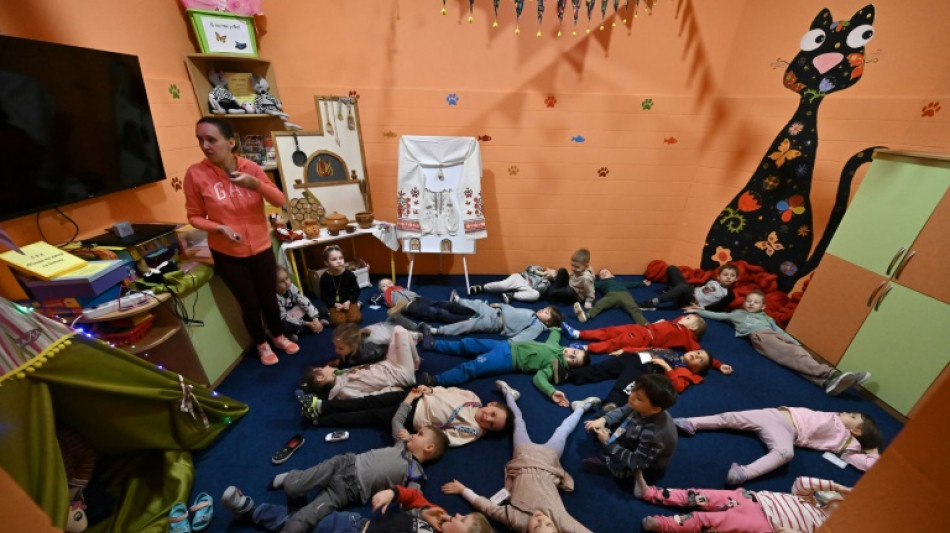
Toys and tales helping Ukraine kids process war trauma / Photo: Genya SAVILOV - AFP
 Aston Villa Defy History With Rare Victory at Old Trafford

 Crowds Gather at San Francisco Park for Elizabeth Holmes Lookalike Tournament

 Making Your Home Safer for Aging Parents: Accessibility Renovations That Add Value

 iPS Cell Research Accelerates Drug Discovery for ALS and Spinal Cord Injury

 Rene Eyre Revisits Autobiographical Performance 'Say A Little Prayer' in London

 UAE's HCT Holds Record Graduation and Announces Major Training Expansion

 NASA Awards $10B Lunar Contract Framework to SpaceX, Blue Origin

In the cellar of a Kyiv kindergarten decorated with bunting and wall paintings of doughnuts and cats, dozens of children are taking shelter during an air raid.
The staff try to reduce the psychological impact on children who can barely remember a time without sirens and fear.
"They go calmly, none of them cries," says one of the carers, Tetiana, 68.
The children chatter and giggle as they do colouring, listen to stories, build Lego and get their faces painted.
"We're hiding from bombs," one boy, Platon, tells AFP as he selects Lego pieces.
"When we expect bombs, we go to the cellar," a girl, Nadiya, adds matter-of-factly.
Concerns over the war's emotional toll on children have prompted diverse efforts to help -- from a book of therapeutic stories to specially commissioned videos from the makers of US show "Sesame Street".
The kindergarten director, Alla Pysmenchuk, said some of the children come from hotspots in eastern Ukraine that many families have fled.
"There are children whose father or mother, or close relatives, are now at war and defending our country," she said.
Iryna Kioresku, a psychologist, works with such children in a soft-surfaced sensory room.
"All the children understand that something's wrong, even if at home they don't talk about the war," she says.
"The topic of war is very hard for children. Whether you are talking about children who left their homes or stayed here, they are all anxious and have fears."
- Russian 'baddies' -
Ukrainian children's author Tania Stus has written a book of stories designed to help parents open up a conversation about the war with children aged 4 to 5.
"The most important thing is to explain to adults how to speak and explain to children... what is happening around them," says Stus.
The book, titled "Secret Stories of Small and Big Victories", was first released in audio format for free, to enable access for families fleeing Ukraine.
A psychologist supervised and checked "every word," Stus says.
She advises against lying to children about war, saying: "When a child asks, they must be told and given an explanation."
Her stories are "realistic, so as not to give children illusions that the war is some kind of fairy tale," she says.
Instead, she offers them "tools to cope".
In one story, a little girl says Ukraine is fighting "bad baddies".
A boy tells her the enemy are in fact Russians.
Stus says this wording was "an extremely difficult decision".
"The fact is that the people who have come to kill us -- including children and my relatives -- are residents of Russia," she says.
"No matter how much I'd like to call them abstract names from films or cartoons, this would be deceiving our children."
However, the book teaches children that troubles can be overcome, she says.
"Children should always be given hope."
- Sesame films -
Ukrainian children's trauma is also prompting an international response.
This week, Ukrainian television channel, PlusPlus, began airing videos designed for children in crisis and war, created by the US makers of "Sesame Street".
Right after the war broke out, Sesame Workshop set up "an immediate task force", says Estee Bardanashvili, the organisation's senior director and supervising producer for international social impact.
"We know from research that prolonged trauma affects children's development."
As well as dubbing existing content designed to support children through turmoil and displacement, the team commissioned short live-action films featuring Ukrainian children.
Shot in January, "they are really mini-documentaries," Bardanashvili says, with children talking about cooking a traditional dish, playing the "bandura" stringed instrument and embroidering "vyshyvanka" shirts.
The videos show "what the children really feel that they're proud of, what are some of the ways that they're coping with the crisis and with the war," Bardanashvili says.
There are no direct references to war, and Sesame Workshop seeks to help children with "coping tools and skills", she says.
"Trauma does have long-lasting effects on you," she says, stressing the importance of "moments of joy and moments of learning".
B.Finley--AMWN

