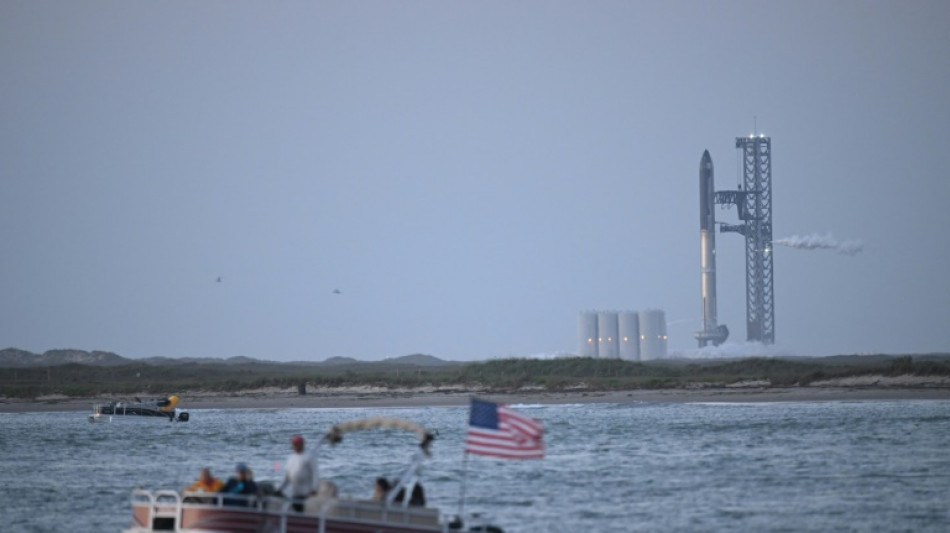
SpaceX postpones test flight of Starship, world's biggest rocket / Photo: Patrick T. Fallon - AFP
 Aston Villa Defy History With Rare Victory at Old Trafford

 Crowds Gather at San Francisco Park for Elizabeth Holmes Lookalike Tournament

 Making Your Home Safer for Aging Parents: Accessibility Renovations That Add Value

 iPS Cell Research Accelerates Drug Discovery for ALS and Spinal Cord Injury

 Rene Eyre Revisits Autobiographical Performance 'Say A Little Prayer' in London

 UAE's HCT Holds Record Graduation and Announces Major Training Expansion

 NASA Awards $10B Lunar Contract Framework to SpaceX, Blue Origin

SpaceX on Monday postponed the first test flight of Starship, the most powerful rocket ever built, designed to send astronauts to the Moon and Mars and beyond.
Liftoff of the gigantic rocket was called off just minutes ahead of the scheduled launch time because of a pressurization issue in the booster stage, SpaceX said.
SpaceX founder Elon Musk said a pressure valve appeared to be frozen, forcing a postponement of the launch which had been planned for 8:20 am Central Time (1320 GMT) from Starbase, the SpaceX spaceport in Boca Chica, Texas.
"Learned a lot today, now offloading propellant, retrying in a few day," Musk tweeted.
SpaceX said the launch will be delayed for at least 48 hours.
The US space agency NASA has picked the Starship spacecraft to ferry astronauts to the Moon in late 2025 -- a mission known as Artemis III -- for the first time since the Apollo program ended in 1972.
Starship consists of a 164-foot (50-meter) tall spacecraft designed to carry crew and cargo that sits atop a 230-foot tall first-stage Super Heavy booster rocket.
SpaceX conducted a successful test-firing of the 33 Raptor engines on the first-stage booster in February but the Starship spacecraft and the Super Heavy rocket have never flown together.
The test flight is intended to test their performance in combination.
Musk had warned ahead of the test that a delay was likely.
"It's a very risky flight," he said. "It's the first launch of a very complicated, gigantic rocket.
"There's a million ways this rocket could fail," Musk said. "We're going to be very careful and if we see anything that gives us concern, we'll postpone."
- 'Multi-planet species' -
NASA will take astronauts to lunar orbit itself in November 2024 using its own heavy rocket called the Space Launch System (SLS), which has been in development for more than a decade.
Starship is both bigger and more powerful than SLS.
It generates 17 million pounds of thrust, more than twice that of the Saturn V rockets used to send Apollo astronauts to the Moon.
SpaceX foresees eventually putting a Starship into orbit, and then refueling it with another Starship so it can continue on a journey to Mars or beyond.
Musk said the goal is to make Starship reusable and bring down the price to a few million dollars per flight.
"In the long run -- long run meaning, I don't know, two or three years -- we should achieve full and rapid reusability," he said.
The eventual objective is to establish bases on the Moon and Mars and put humans on the "path to being a multi-planet civilization," Musk said.
"We are at this brief moment in civilization where it is possible to become a multi-planet species," he said. "That's our goal. I think we've got a chance."
L.Durand--AMWN

