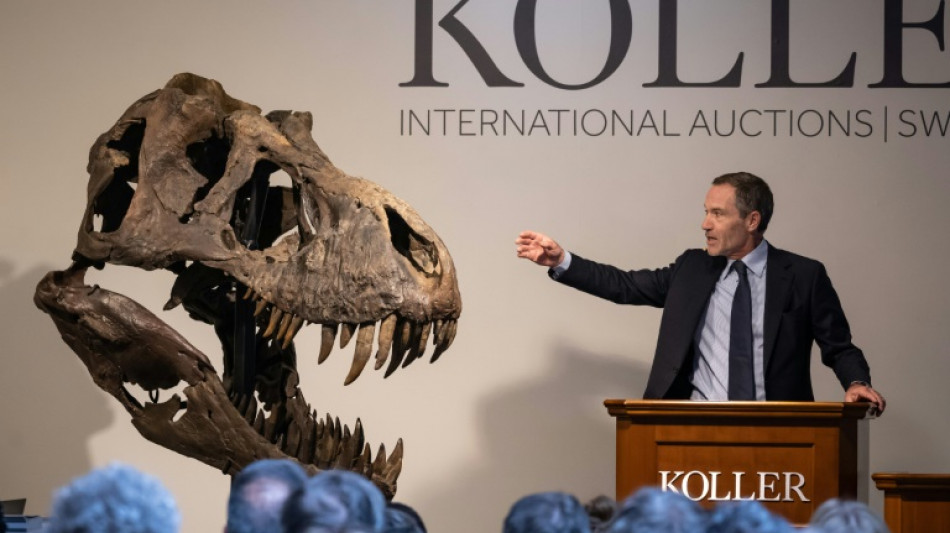
Trinity the T-rex claws in more than $6 million / Photo: Fabrice COFFRINI - AFP
 Aston Villa Defy History With Rare Victory at Old Trafford

 Crowds Gather at San Francisco Park for Elizabeth Holmes Lookalike Tournament

 Making Your Home Safer for Aging Parents: Accessibility Renovations That Add Value

 iPS Cell Research Accelerates Drug Discovery for ALS and Spinal Cord Injury

 Rene Eyre Revisits Autobiographical Performance 'Say A Little Prayer' in London

 UAE's HCT Holds Record Graduation and Announces Major Training Expansion

 NASA Awards $10B Lunar Contract Framework to SpaceX, Blue Origin

A composite Tyrannosaurus rex skeleton called Trinity sold for 5.5 million Swiss francs ($6.1 million) in a rare auction on Tuesday.
The 3.9-metre (12.8-foot) high skeleton, made up of bones from three different T-rexes estimated at 65 to 67 million years old, was sold at the Koller auction house in Zurich after being shipped from the United States in nine giant crates.
The skeleton fetched a hammer price of 4.8 million Swiss francs, rising to 5.5 million with the buyer's premium added on.
Trinity was put up for sale by an anonymous US private individual and was expected to fetch between five and eight million Swiss francs.
It was bought by a private European collector.
As its name suggests, Trinity is made up of bones from three dinosaurs -- excavated between 2008 and 2013 from the Hell Creek and Lance Creek formations in Montana and Wyoming.
The sites are known for the discoveries of two other significant T-rex skeletons that have gone to auction.
"Sue" went under the hammer in 1997 for $8.4 million, while "Stan" took the world-record hammer price of $31.8 million at Christie's, in 2020.
On Trinity, vertebrate palaeontologist Thomas Holtz -- who is against the sale of such specimens -- told AFP that it was "misleading" and "inappropriate... to combine multiple real bones from different individuals to create a single skeleton."
Just over half of the bone material in the skeleton comes from the three Tyrannosaurus specimens -- above the 50 percent level needed for experts to consider such a skeleton as high quality.
Holtz, of the University of Maryland, remained sceptical, insisting that Trinity "really isn't a 'specimen' so much as it is an art installation".
He also took issue with auctions of significant dinosaur skeletons and other fossils, which have raked in tens of millions of dollars in recent years.
Experts have warned such trade could be harmful to science by putting the specimens in private hands and out of the reach of researchers.
But Christian Link of Koller stressed that 95 percent of known T-rexes are currently in museums.
C.Garcia--AMWN

