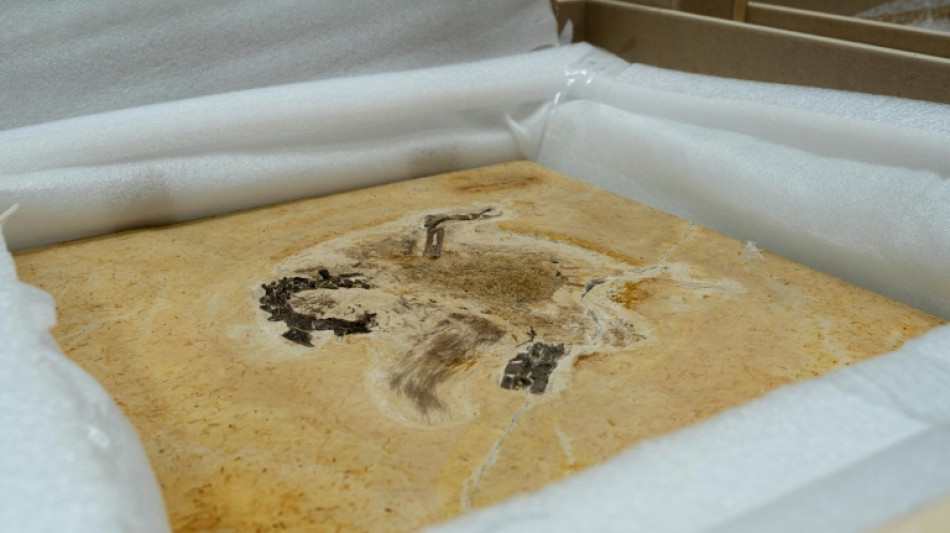
Germany returns 'stolen' dinosaur fossil to Brazil / Photo: Raul VASCONCELOS - BRAZIL'S MINISTRY OF SCIENCE AND TECHNOLOGY (MCTI)/AFP
 Brussels Education Unions Schedule Major November Protest Over Funding and Reforms

 Making Your Home Safer for Aging Parents: Accessibility Renovations That Add Value

 iPS Cell Research Accelerates Drug Discovery for ALS and Spinal Cord Injury

 Rene Eyre Revisits Autobiographical Performance 'Say A Little Prayer' in London

 UAE's HCT Holds Record Graduation and Announces Major Training Expansion

 NASA Awards $10B Lunar Contract Framework to SpaceX, Blue Origin

 Katy Perry Tells Fans Ex-Husband Russell Brand 'Should Be in Jail' During UK Concert

A fossil from a rare dinosaur that roamed South America 110 million years ago has been returned to Brazil from Germany, ending a diplomatic spat triggered by charges that researchers stole it.
The small dino, called Ubirajara jubatus, which had an early form of feathers and spearlike rods jutting from its shoulders, fascinated scientists, who identified it as previously unknown species in a paper published in 2020.
But it soon sparked a scientific and ethical scandal, when Brazilian researchers accused the German team behind the paper of illegally removing the fossil from Brazil.
After a nearly three-year standoff, a delegation led by German Foreign Minister Annalena Baerbock returned the fossil Sunday during a visit to Brasilia, officials said.
"The Ubirajara jubatus fossil, the first non-avian dinosaur with feather-like structures found in South America, has been returned to Brazil," the Brazilian science and technology ministry said in a statement Monday.
The fossil was found in 1990 by a team of paleontologists in the northeastern state of Ceara. They took it to Germany to study it, housing it in the State Museum of Natural History in Karlsruhe.
But Brazilian scientists cried foul after the publication of the December 2020 paper identifying the fossil as a new species, saying the specimen had been removed from the country irregularly.
Local legislation establishes that fossils found in Brazil belong to the state, and that foreign researchers must collaborate with a Brazilian institution if they want to export them.
Scientists launched an online campaign calling for the fossil to be returned, under the hashtag #UbirajarabelongstoBR.
"Without the mobilization of the Brazilian scientific community, we would not have been successful," Science and Technology Minister Inacio Arruda said.
The 11.5-kilo (25-pound) specimen will now be housed at a university paleontology museum in Ceara.
M.Fischer--AMWN
